
Benefits of Regular Common-Area Cleaning
See how regular common-area cleaning supports a building's appearance, protects finishes and helps managers address recurring complaints and daily use.
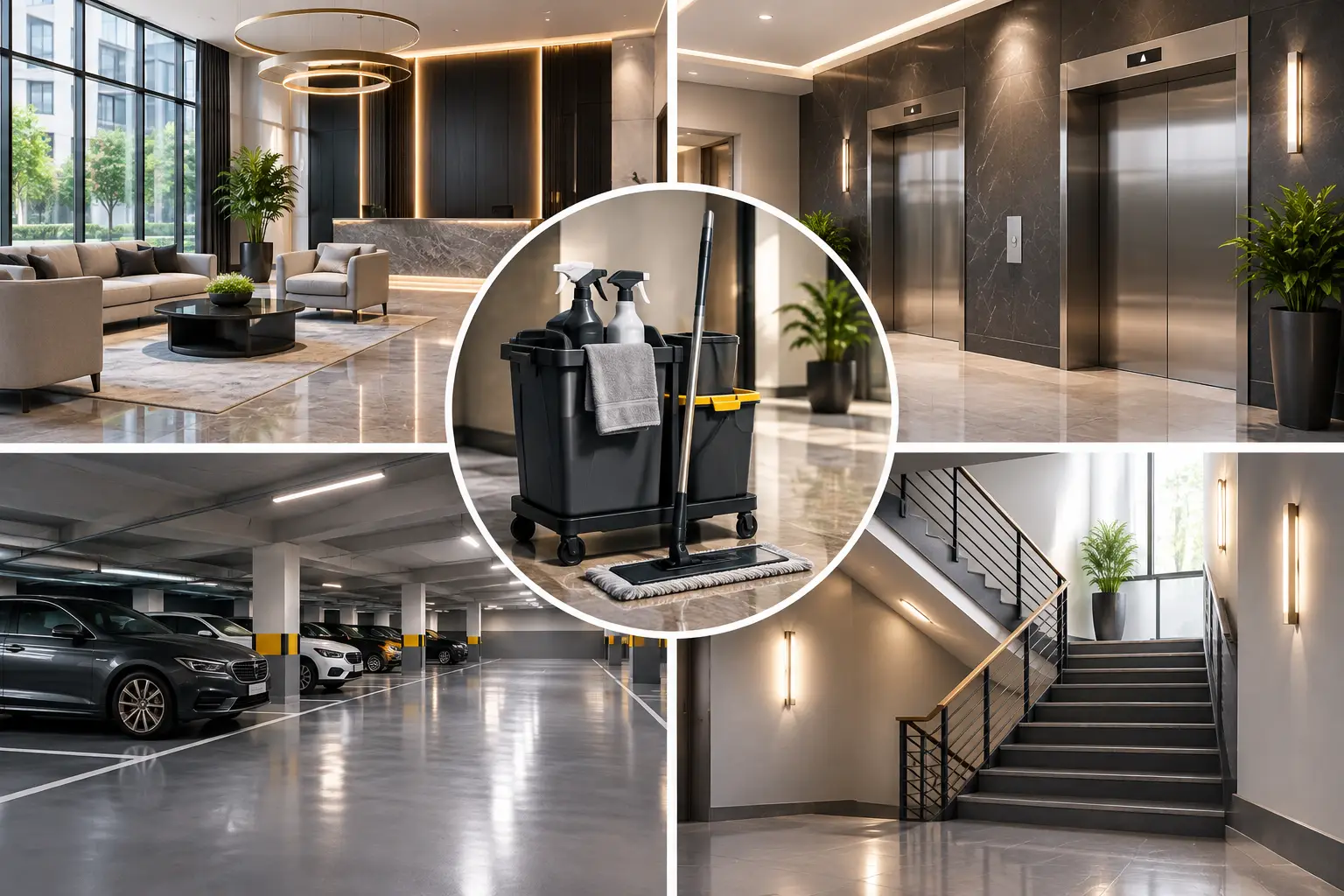
A corridor marked after a busy weekend, a smell that lingers in the waste room or an elevator whose walls bear the traces of dozens of people passing through: these are rarely small details for residents. The benefits of regular cleaning of common areas are seen in the condition of the building, but also in the number of complaints avoided, the perception of occupants, and the workload of the property manager.
For a condo, a multifamily building, a clinic, an office building, or a business, the cleanliness of shared spaces is an operational responsibility. It requires an appropriate frequency, consistent methods, and a team that knows the realities of an occupied building.
A better experience from the moment you enter the building
The entrance hall sets the tone. A clean floor, clear windows, a maintained entrance carpet, and clear surfaces indicate that the building is being maintained. Conversely, dust in the corners, fingerprints on the doors, and accumulated trash convey quickly an impression of neglect.
This perception counts just as much for residents as for visitors, potential tenants, customers, and suppliers. In a rental building, it can influence the sense of belonging of the occupants. In a condominium, it directly supports trust in the condo board and administration. In a business or clinic, it supports the professional image of the location.
Regular cleaning prevents problems from becoming visible. The traces of boots, spills, papers on the floor, and dust are not all emergencies. Without a planned schedule, they add up and eventually define the appearance of the building.
Reducing complaints before they become recurring
Complaints related to cleanliness often concern the same areas: corridors, stairwells, elevators, waste rooms, recycling rooms, and underground garages. They do not necessarily come from a complete lack of cleaning. They often come from an improperly adjusted frequency or a lack of follow-up between two visits.
An effective building janitorial service takes into account the real traffic. A busy entrance hall may require cleaning several times a week, or even daily. A secondary stairwell does not always need the same rhythm. The waste room requires special attention when odours, liquids on the floor, or deposits around the bins become a source of complaints.
The right program therefore does not consist of applying the same task everywhere. It targets areas that get dirty quickly, high-risk periods, and real irritants for occupants. This approach reduces last-minute calls and keeps the property manager from having to repeatedly contact the provider.
The advantages of regular cleaning of common areas on surfaces
Cleaning regularly also protects materials. Sand, salt, and gravel brought in from outside act as an abrasive on floors. In entrances and corridors, they can dull finishes, mark surfaces, and accelerate wear. Proper cleaning of floors, maintenance of carpets, and control of entry areas limit this damage.
In elevators, doors, buttons, mirrors, and metal panels show quickly fingerprints and dirt. Constant intervention helps maintain a neat appearance without having to plan too often for more costly restorative cleaning. The same goes for walls, baseboards, ramps, and doors in corridors.
The underground garage deserves distinct attention. Mud, de-icing salts, hydrocarbons, and concrete dust accumulate over the seasons. A planned cleaning reduces dirt, improves the appearance of the area, and facilitates the identification of leaks or debris that should be reported. A spot cleaning may be necessary, but it is much more effective when it fits into a general follow-up of the garage.
A building easier to manage on a daily basis
For a property manager or board of directors, the value of a supplier is not limited to seeing clean floors after their visit. Reliability counts just as much: respect of schedules, clearly defined tasks, communication when a problem is noticed, and consistency from week to week.
A well-organized cleaning of common areas reduces the need for supervision. Instead of checking each floor or responding to a series of reports, the property manager can rely on a known routine. When frequency, covered areas, and expectations are established from the start, deviations are easier to detect and correct.
This stability is particularly useful in buildings where multiple people circulate: delivery drivers, contractors, employees, residents, visitors, and maintenance staff. Cleaning must follow the life of the building, not just appear at the right time. After construction, a post-construction cleaning or a restorative cleaning may also be required before returning to the regular cleaning schedule.
What does a building janitorial service include?
A building janitorial service generally includes planned cleaning of shared spaces according to the needs of the site. It may cover entrances, corridors, stairwells, elevators, doors, interior windows, floors, waste rooms, recycling rooms, and entry areas. Depending on the building, it may also include cleaning of interior garages, underground parking garages, or targeted interventions after an incident.
The exact content depends on the size of the building, the number of occupants, the type of flooring, and the level of traffic. A low-density condominium does not have the same needs as a rental complex with multiple entrances. An office building often requires more attention to entrances and elevators, while a school must adapt its cleaning to the schedule of students and peak usage periods.
The best way to define the mandate is to start with problematic areas, then build a realistic routine. An overly general quote leaves room for missed tasks. A clear plan specifies the spaces, frequency, and specialized interventions planned as needed.
Who cleans the common areas of a condominium?
The common areas of a condominium are usually maintained by a building janitorial team or a commercial cleaning company hired by the condo board or its property manager. This team ensures the cleanliness of shared spaces and can report visible situations, such as a leak, an unusual accumulation, or an area that requires restorative cleaning.
The condo board retains the responsibility of choosing the level of service and defining its priorities. The cleaning team, however, executes the work according to a consistent and adapted plan for the building. For property managers, the goal is simple: a supplier who does on-site follow-up without needing to monitor every detail.
Finding the right cleaning frequency
There is no universal frequency. It depends on traffic, season, building configuration, and occupant habits. In winter, Montreal and Laval entrances often require more attention due to water, sand, and salt. During moves, construction, or frequent deliveries, elevators and corridors may require additional visits.
A good starting point is to observe what degrades between two cleanings. If carpets are saturated before the next visit, if waste rooms develop quickly odours, or if elevators seem marked the next day, the frequency or method may need adjustment. Conversely, oversizing the service can burden the budget without measurable improvement.
The Nickel & Krome team supports property managers, condo boards, and property owners in Montreal, Laval, and on the North Shore with an approach based on the actual conditions of the building. For a reliable building cleaning, a targeted commercial cleaning, or a restorative cleaning, the company can be contacted at +1 514-974-3311. NEQ 3381837957.
A clean common area should not be a pleasant surprise after a complaint. It should be the normal state of the building, day after day, thanks to a cleaning that truly follows the rhythm of the occupants.