
How to Reduce Building Cleanliness Complaints
Reduce recurring cleanliness complaints by identifying problem areas, adjusting cleaning routines and improving communication and follow-up in buildings.
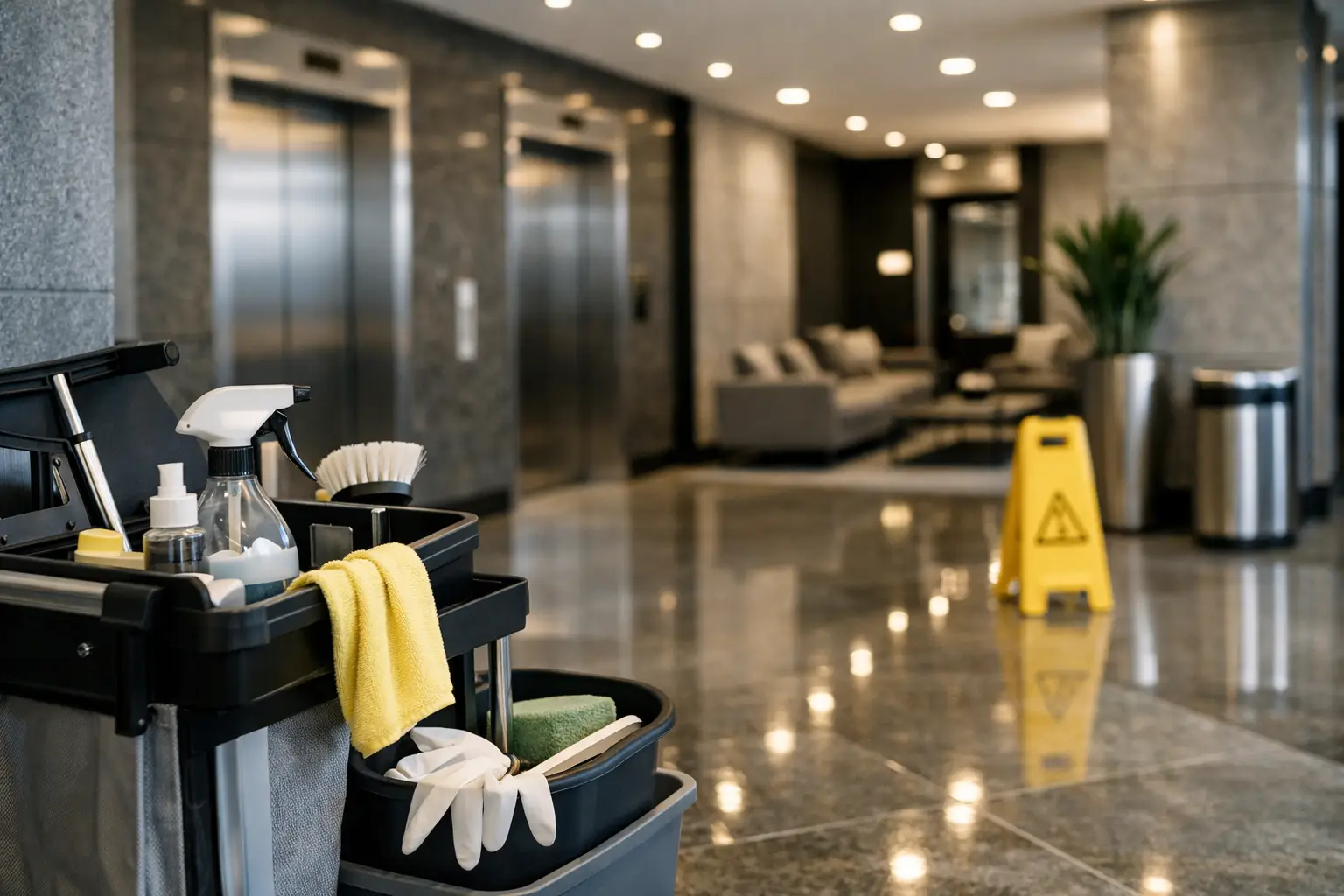
A clean lobby on Monday morning is not enough if residents find a marked elevator, an odorous waste room, and dull corridors by Wednesday. To reduce cleanliness complaints in a building, it is necessary to treat cleanliness as a continuous process, not just a simple cleaning visit. Complaints rarely arise from a single incident; they usually come from a lack of consistency in the areas that residents see and use every day.
For a property manager or condo board, the stakes go beyond appearance. Neglected common areas harm residents' experience, increase requests to the management office, and give the impression that the building lacks follow-up. On the contrary, a well-organized building maintenance service helps prevent irritants before they become recurring.
Identify the areas that really generate complaints
The first mistake is to distribute the cleaning time equally throughout the building. Not all areas get dirty at the same rate, and not all are as visible. A rarely used corridor can wait, while an entrance, elevator, or waste room requires more sustained attention.
Complaints most often concern entry lobbies, glass doors, corridors, elevators, stairwells, and waste or recycling rooms. In buildings with an underground garage, tire marks, salt residue, dust, and accumulated waste become frequent issues, especially in spring and winter.
Start by examining the complaints from the last few months. Classify them by location, by day of the week, and by type of problem: odour, dust, floor stains, waste, surface marks, or lack of equipment. This review provides a much more useful picture than a general impression that "the building is not clean enough."
Distinguish between a one-time problem and insufficient frequency
A stain caused by a move or an unexpected leak requires a quick intervention. But a consistently marked elevator or an overflowing recycling room every weekend reveals rather an improperly adjusted cleaning frequency. It is not necessarily the quality of the work that is at issue: actual foot traffic, the habits of the residents, or the volume of waste may have changed.
In a high-occupancy multi-unit building, a weekly visit may be adequate for some floors, but insufficient for the entrance and waste management. In a quieter condominium, the goal may be to maintain an impeccable appearance with a less intensive schedule and targeted visits. The right frequency depends on the actual use of the building, not just its size.
Create a visible and measurable maintenance plan
Reducing complaints does not mean promising a perfect building at all times. It means clearly defining what is maintained, when, with what level of finish, and how deviations are corrected. An effective maintenance plan distinguishes daily, weekly, monthly, and seasonal tasks.
Regular tasks generally cover the cleaning of entrances, lobbies, corridors, elevators, stairs, and contact surfaces. Periodic tasks may include wall washing, floor treatment, deep cleaning of waste rooms, interior garage maintenance, or restorative cleaning after a period of construction.
The key is to name the areas, rather than using a vague formula like "cleaning of common areas." A property manager must be able to quickly check if elevator buttons, baseboards, entrance carpets, mirrors, and recycling bins are part of the planned intervention. This precision avoids implicit expectations, which are often the root of frustrations.
Plan for times when the building gets dirtier
Operational cleanliness must follow the seasons and the life of the building. Montreal's winter increases water, calcium, and abrasive traces in lobbies, corridors, and elevators. In spring, underground garages often require special attention due to accumulated residue. After renovations, even minor ones, fine dust can circulate for a long time in common areas if not removed with the right methods and equipment.
Moves, large deliveries, and construction are also sensitive periods. A spot cleaning before or after these events can cost less than managing repeated complaints, photos sent by residents, and urgent requests at the last minute.
Improve on-site follow-up, not just cleaning
A good building janitorial service does not just check off a list of tasks. It must observe the actual condition of the premises. A persistent odour may come from an improperly closed bin, a drain, a leak, or poor ventilation. A dull floor despite cleanings may require restorative cleaning, another product, or mechanical scrubbing adapted to the floor covering.
On-site follow-up is precisely to signal these situations before they become complaints. It also helps distinguish between routine maintenance and specialized intervention or repair. This transparency protects the property manager: they receive useful information rather than discovering the problem after several complaints.
Communication must remain simple. A clear report on a damaged door, a spill in the garage, a broken bin, or an abnormal accumulation is better than a long report that leads to no action. For urgent cleanliness issues, a known channel and defined response reduce pressure on the management team.
Who maintains a building and who cleans the common areas?
Building maintenance is generally entrusted to a building janitorial service or commercial cleaning team experienced with shared spaces. They intervene in lobbies, corridors, elevators, stairwells, waste rooms, recycling rooms, garages, and other common areas according to a frequency established with the property manager, owner, or condo board.
In a condominium, it is usually the responsible individuals mandated by the condo board who clean the common areas. Their role goes beyond sweeping or mopping. A building janitorial service includes regular surface maintenance, cleanliness management in high-traffic areas, observation of anomalies, and, if needed, coordination of work such as restorative cleaning or a post-construction cleaning.
The choice of a specialized team for buildings is decisive. Methods for a residence, a rental building, a clinic, or an office may resemble each other in some ways, but hours, traffic risks, waste management, and presentation expectations are not the same.
Give residents a realistic checklist
Some complaints are legitimate and useful. They sometimes reveal a forgotten area or a change in the building's use. Other requests concern individual behaviours: bags discarded outside bins, spilled liquids, boxes left in corridors, or improperly sorted waste.
The property manager gains by communicating simple rules about waste rooms and explaining how to report an urgent problem. It is not about transferring responsibility to residents, but about avoiding incidents remaining untreated because no one knows who to report to. When occupants notice that the reported areas are handled quickly, the volume of repeated complaints usually decreases.
Choose a partner capable of adjusting the service
A fixed contract quickly becomes ineffective in a building that evolves. A new leasing phase, increased traffic, construction, seasonal change, or recurring waste issues: the plan must be able to be reviewed. Flexibility does not mean improvised interventions. It is based on on-site evaluation, documented priorities, and justified adjustments.
Nickel & Krome S.E.N.C., NEQ 3381837957, supports property managers, condominiums, and rental buildings in Montreal, Laval, and on the North Shore with building maintenance, building janitorial, and specialized cleaning services. The team can be contacted at +1 514-974-3311 to assess the areas that create the most complaints and establish a frequency appropriate for the building.
The best improvement is not one that adds tasks without reason. It is one that makes the most visible areas clean, monitored, and consistently maintained, day after day. When maintenance reflects the actual rhythm of the building, residents often notice it before they even need to complain.
From the guide to your project
To check the scope, access, and conditions of intervention, consult our service: Cleaning of common areas of condos and managed buildings.