
Why Odours Persist in Waste Rooms
Understand why waste-room odours return after cleaning and how residues, bins, moisture and maintenance routines affect conditions inside the building.
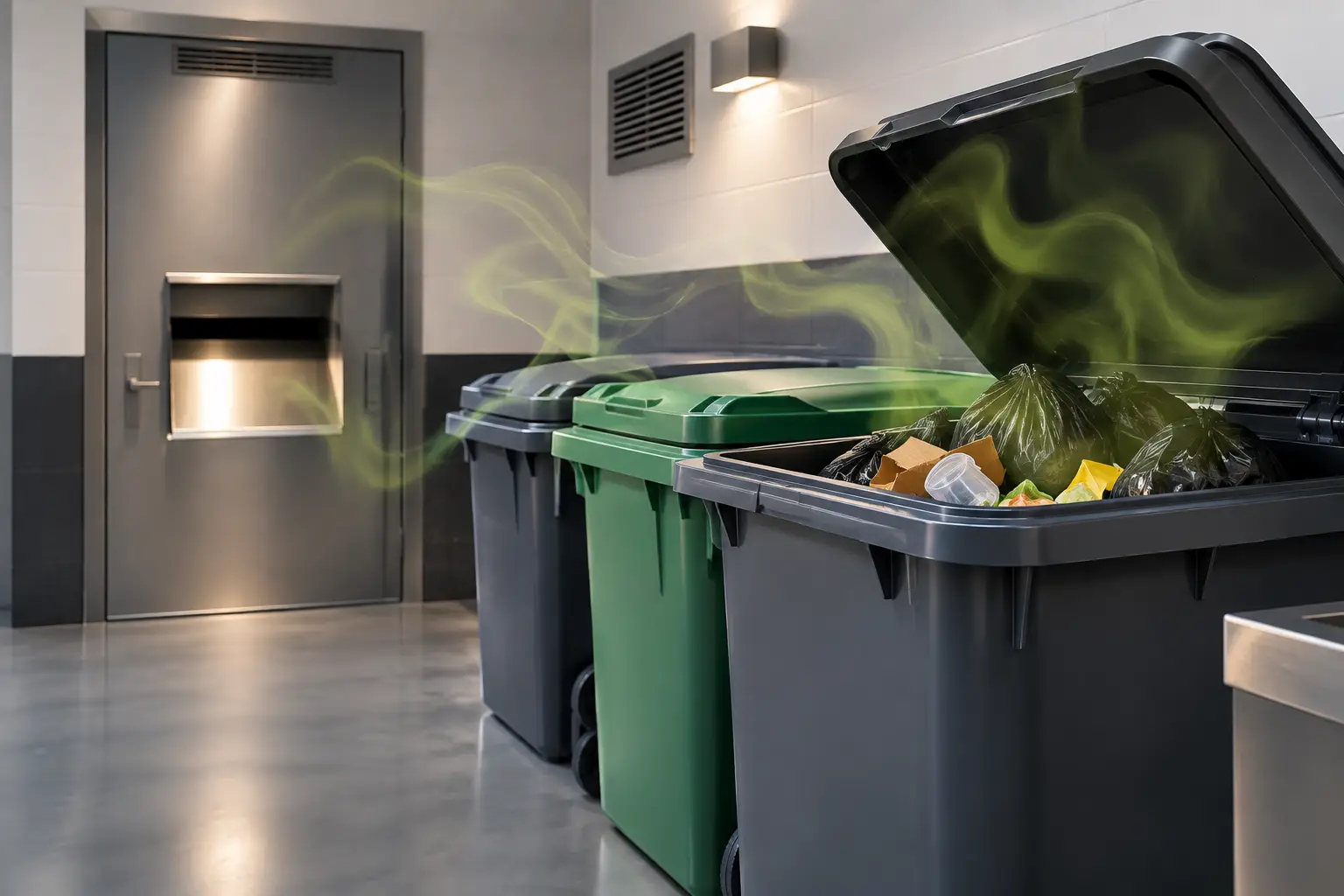
An odour that returns several hours after cleaning a waste room is generally not a problem with the scent or the product being too weak. To understand why odours persist in a waste room, it is necessary to look at what happens between collections: organic materials that flow, dirty bins, trapped humidity, inefficient ventilation, and forgotten areas behind the containers. In a condo or a multi-unit building, this situation quickly turns into resident complaints and a bad impression in the corridors or elevators nearby.
Why odours persist in the waste room
A waste room concentrates several factors that favor odours. Bags often remain for several days, especially during a holiday, a move, or a delayed collection. Heat, humidity, and organic liquids accelerate decomposition. Even when the bags are removed, residues remain on the floor, wheels, lids, and walls of the bins.
The problem is often invisible. Liquid from a garbage bag can pass under a container, seep into a floor joint, or dry on the bottom of a wall. A deodorizing spray temporarily masks the odour, but does not remove the matter or the bacteria that are the source. This is why a room can seem correct just after a visit, then become uncomfortable the next day.
In more heavily used buildings, the frequency of deposits also counts. A small room used by several floors, family units, or businesses produces a real load that sometimes exceeds the established cleaning schedule. It then requires adjusting the frequency, methods, and sometimes the organization of the room itself.
The bins are often the first source
A waste bin is not only cleaned when its contents are removed. Lids, handles, edges, wheels, and underneath receive frequent splashes. The liquids that accumulate at the bottom can ferment, especially in the summer. Recycling bins can also smell bad when the containers are not emptied or rinsed before disposal.
Cleaning must be done with an appropriate mechanical action, not just with a product applied from a distance. Depending on the type of bin and surfaces, this may require degreasing, controlled rinsing, disinfection, and sufficient drying. Too much water left on the floor actually maintains the humidity that is being tried to eliminate.
The floor and drains retain the residues
In a waste room, the floor is a work surface, not just a simple floor to sweep. Spill trails, corners, baseboards, and space under the bins must be part of the cleaning. Cracked or porous joints can absorb liquids and retain a persistent odour even after regular cleanings.
The drain is another critical point. A dry drain trap, a partially blocked drain, or a grille covered with residues can emit an odour similar to that of waste. Routine cleaning does not replace plumbing intervention when necessary, but it allows for quick detection of anomalies and prevents them from going unnoticed for weeks.
Ventilation can move the problem
Inadequate ventilation keeps odour-laden air trapped in the room. On the contrary, an unbalanced air pressure can push odours into the corridors, lobby, or certain units. Cleaning reduces odour sources, but it does not correct a faulty fan, a clogged vent, or a door that doesn't close properly.
For a property manager, the right approach is to distinguish the odour generated by the waste from that coming from the building. If the room has been thoroughly cleaned, the bins are clean, and the odour returns without significant new deposits, a check of the ventilation, the drain, and the door's seal becomes relevant.
Errors that perpetuate the problem
The first error is treating the waste room like an ordinary common area. It requires a different protocol than a corridor or a lobby, as it receives wet materials, food waste, and soiled containers. A quick visit can maintain the overall appearance without controlling the odours at the source.
The second error is cleaning only visible surfaces. The underneath of the containers, the wall behind the bins, the corners of the door, and the wheels are precisely the areas where residues remain for a long time. A team that knows the realities of building maintenance plans access to these areas and repositions the bins without contaminating a floor already treated.
The third is using a deodorizer as the main solution. A odour neutralizer can be part of an intervention, but it comes after removing the materials, cleaning, and controlling the humidity. Otherwise, the odour is simply mixed with a stronger fragrance.
Finally, it happens that the schedule no longer matches the actual usage. The opening of a business on the ground floor, an increase in occupancy, construction work, or a moving period may require additional passes. The cleaning frequency must follow the volume, not just a management habit.
An effective method to reduce odours
Effective cleaning starts with an inspection. Before cleaning, it is necessary to locate spill trails, note the condition of the bins, check the drain, and observe if the ventilation works. This step avoids repeating the same cleaning without addressing the cause.
Next, the sequence matters. Waste and solid residues are removed before cleaning the bins and surfaces. The floor, baseboards, low walls, and rear areas are then treated with products suitable for organic stains and the type of flooring. Rinsing must be controlled to avoid overloading the drain or creating persistent humidity.
After drying, the team should return the room to a functional state: bins properly positioned, access clear, clean lids, and a safe circulation area. This level of detail helps control odours as much as it facilitates the next collection or next cleaning visit.
For buildings that receive recurring complaints, a simple follow-up is useful. It allows comparing the times when the odour increases with collection days, weather, waste volume, or particular incidents. This information helps decide whether to increase the frequency, do an intensive bin cleaning, or request a technical building check.
When to call a specialized cleaning team?
A specialized intervention is indicated when the odour persists after collections, spreads into common areas, returns every week, or is accompanied by floor traces, flies, or accumulated liquid. It is also appropriate after a leak, a torn bag, a hot spell, or a long-neglected restorative cleaning.
Who maintains a building in this context? A building janitorial services team ensures the planned maintenance of common areas, including waste rooms and recycling according to the service agreement. What does a building janitorial services team cover? It can include halls, corridors, elevators, stairs, high-traffic areas, and sensitive locations, with a frequency adapted to the building's occupancy and needs.
Who cleans the common areas of a condo when odours become an issue? The condo board or property manager usually hires a building maintenance provider capable of consistent intervention and reporting problems that go beyond cleaning. This coordination prevents residents from feeling that no one is taking the situation seriously.
In Montreal, Laval, and on the North Shore, the Nickel & Krome team performs the cleaning of waste rooms, common areas, and operational zones for condos, multi-unit buildings, and commercial buildings. Their on-site work aims for lasting cleanliness, with methods adapted to the building's real conditions. For a cleaning request or targeted intervention, the company is reachable at +1 514-974-3311, NEQ 3381837957.
A clean waste room should not only have a well-maintained appearance at the time of the visit. It must be controlled between collections, so that residents, visitors, and on-site teams can move around without experiencing a problem that could have been detected and corrected at the source.