
10 Signs of Poor Building Maintenance
Persistent odours, recurring complaints and neglected common areas: recognize the signs of poor building maintenance and identify what needs to change.
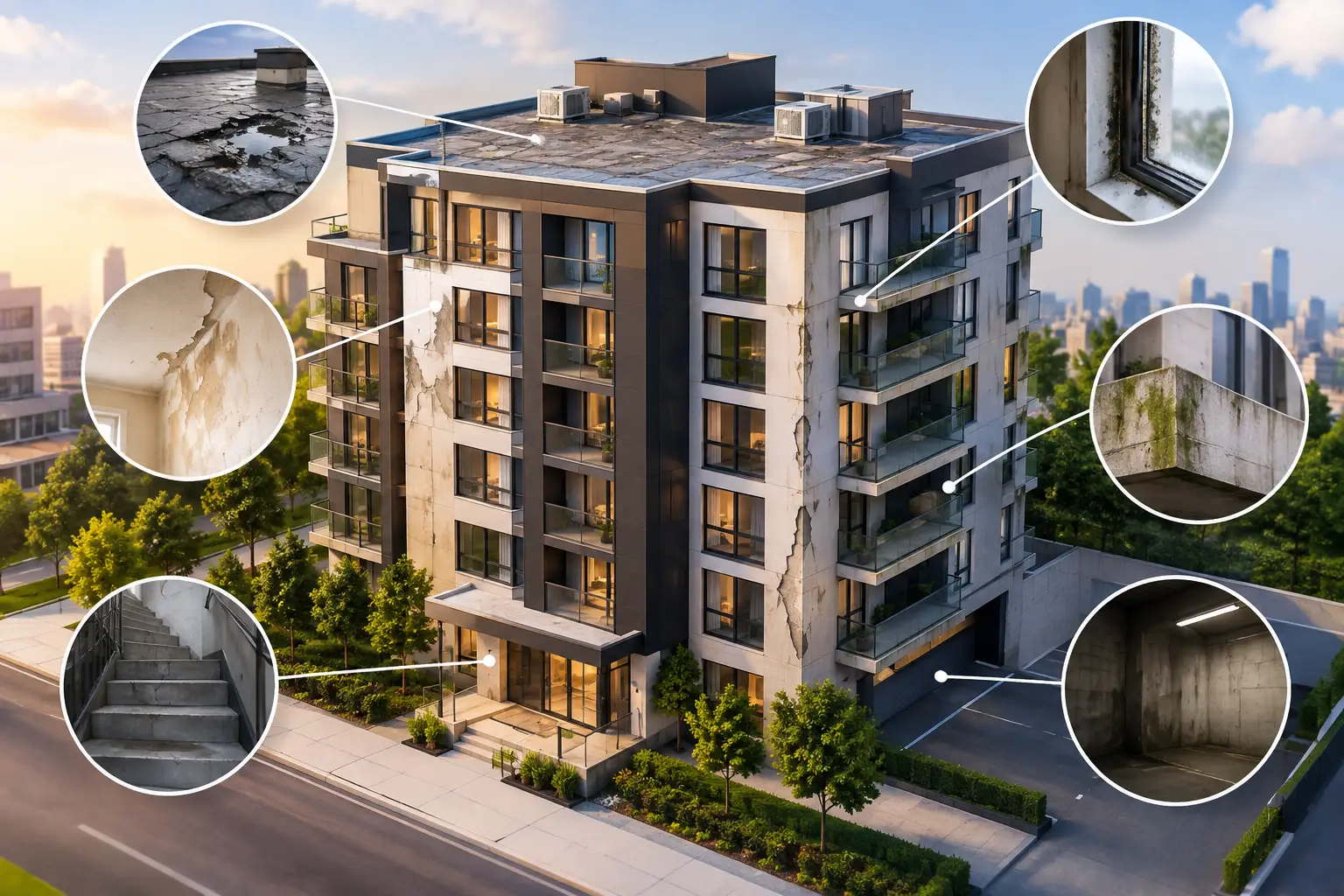
A building may appear acceptable at first glance while accumulating problems that eventually cost a lot. The signs of poor building maintenance rarely appear all at once. They manifest themselves rather in the details that residents, visitors and property managers notice every day: a persistent odour, a marked elevator, a dull corridor or an overflowing waste room.
For a condo board, a property manager or a multi-unit owner, these indicators are not just aesthetic. They influence complaints, the sense of security, the perceived value of the building and the management burden. Here are the situations that require intervention before they become the norm.
1. Corridors, halls and stairwells always look dirty
Footprints on the floor that remain for several days, dusty corners, marked baseboards and glass doors covered in fingerprints often indicate too infrequent or incomplete maintenance. In common areas, cleanliness is not just about floor cleaning. It requires a routine adapted to actual foot traffic, season and type of flooring.
A building with many entrances and exits, animals, strollers or deliveries cannot be maintained like a lightly occupied building. The frequency must follow the traffic. When it does not, the marks become visible quickly and give the impression that no one is taking care of the place.
2. Odours return to the waste rooms and recycling areas
A waste room that smells bad even after the staff has passed is not necessarily due to a lack of deodorizer. The problem may come from the bins, walls, floor, drains, doors or insufficient cleaning around the bins. Moisture and organic residues settle quickly in these enclosed areas.
Odours are also a sign of poor coordination. If the bins are cleaned without the floor, edges and contact points also being cleaned, the result remains temporary. An effective building janitorial service treats the area as a whole and reports operational issues, such as a broken bin, a leak or an unusual accumulation.
3. Resident complaints become repetitive
An isolated complaint can occur in any building. However, the same comments about dirty elevators, stained carpets, garbage in the garage or neglected corridors should alert the property manager. When residents repeat the same requests, the problem is rarely a lack of goodwill. It is often the absence of a clear plan, regular inspections or on-site follow-up.
You must distinguish between unrealistic expectations and a real service issue. A building can be cleaned according to the scheduled timetable, but this timetable may no longer suit the current occupancy. A review of the frequency and tasks often allows for reducing complaints without unnecessarily increasing the number of interventions.
4. Elevators and contact points are neglected
Elevator buttons, door handles, handrails, intercoms and glass panels are among the first surfaces noticed. They get dirty quickly and are directly associated with the quality of building management. Fingerprints, dust in the rails or stains on the panels give an impression of neglect, even if the rest of the hall is relatively clean.
These elements require frequent and methodical maintenance. It is not about quickly spraying a product on visible surfaces, but cleaning contact points, edges, grooves and materials without damaging them. The right product and method are particularly important for steel, mirrors, glass and specialized finishes.
5. The underground garage accumulates dust, salt and tire marks
An underground garage is a completely separate operational area. It receives water, salt, sand, oil, dust and debris brought by vehicles. When its maintenance is delayed too long, the marks become embedded, the drains get dirty and the environment becomes more unpleasant for residents.
In Quebec, winter significantly increases the pressure on these spaces. Appropriate maintenance can include collecting waste, treating localized stains, cleaning walkways and paying attention to entrances, doors and approaches to elevators. High-pressure washing may be appropriate in certain contexts, but it must respect the building's constraints and water management.
6. Dust after construction remains in common areas
After a renovation, a construction handover or corrective work, fine dust does not disappear with a sweep. It settles on door frames, baseboards, ventilation grilles, elevators and high surfaces. It can also return several days after the work if post-construction cleaning was not done thoroughly.
This is a common sign of maintenance not adapted to the situation. Regular cleaning maintains common areas, but post-construction cleaning requires specialized intervention. Confusing the two often leaves visible residues and creates frustration for occupants who expect the building to be ready to use.
7. The supplier is difficult to reach or does not follow up
Poor maintenance is not only visible on floors. It is also noticeable in communication. A supplier who does not respond to urgent requests, who does not confirm interventions or who never reports anomalies forces the property manager to monitor every detail. This removes one of the main advantages of outsourcing maintenance to an external team.
A good on-site partner alerts the responsible person when they notice a leak, damage, a shortage of bags, a damaged door or a situation that could generate complaints. They do not replace the property manager, but provide an extra set of eyes on common areas between visits.
8. Tasks are done, but forgotten areas accumulate
Problems often hide in less visible places: behind doors, in the corners of stairwells, around bins, under entrance carpets, near emergency exits or along baseboards. If these areas remain constantly neglected, the work is probably done hastily or according to an overly limited task list.
A reliable service includes recurring tasks, but also attention to details that change according to seasons and the actual condition of the space. The challenge is not to add an endless number of tasks. It is to define what must be done each week, each month or as needed, then to check that the result meets the building's expectations.
9. The building's appearance deteriorates before visits or deliveries
When a team must do an urgent cleaning before every visit, inspection or arrival of new tenants, regular maintenance no longer fulfills its role. A well-maintained building should not require a full restoration to look presentable with short notice.
Emergencies do happen, especially after a leak, construction work or an exceptional event. But they should not compensate for a lack of consistency. A good routine of common area maintenance protects the building's image daily, not just when someone important is expected.
10. No one clearly knows what is included in the service
Ambiguity is one of the most common causes of disappointment. The property manager believes the garage is included, the supplier thinks it's an extra. The condo board expects window cleaning in the hall, but this task is nowhere listed. Without a clear service scope, sensitive areas end up being forgotten.
What does a building janitorial service include? According to the agreement, it may cover the maintenance of halls, corridors, elevators, stairwells, waste rooms, recycling rooms, entrances and other common areas. It may also include inspections, restocking of certain products and reporting of issues observed on-site. Garages, post-construction cleaning and restorative cleaning are often planned separately, because their needs and frequency differ.
Who maintains a building and who cleans a condominium?
In a residential or commercial building, the property manager coordinates the needs, but the daily maintenance of shared spaces is generally entrusted to a building janitorial service or commercial cleaning company. For a condominium, this team cleans common areas and works according to priorities established by the condo board or the management firm.
In Montreal, Laval and on the North Shore, the Nickel & Krome team supports property managers, condominiums, multi-unit buildings and commercial spaces with a building maintenance service focused on consistency, on-site follow-up and areas that generate the most complaints. The company, NEQ 3381837957, can be contacted at +1 514-974-3311 to discuss a recurring situation, a restorative cleaning or a tailored maintenance plan.
The right time to act is not when complaints accumulate. It is when the first details start to show that the building receives less attention than it deserves.