
School and Daycare Cleaning Guide
Plan school and daycare cleaning by area, traffic and daily schedules. Clarify responsibilities, surface care and the follow-up your facility requires.
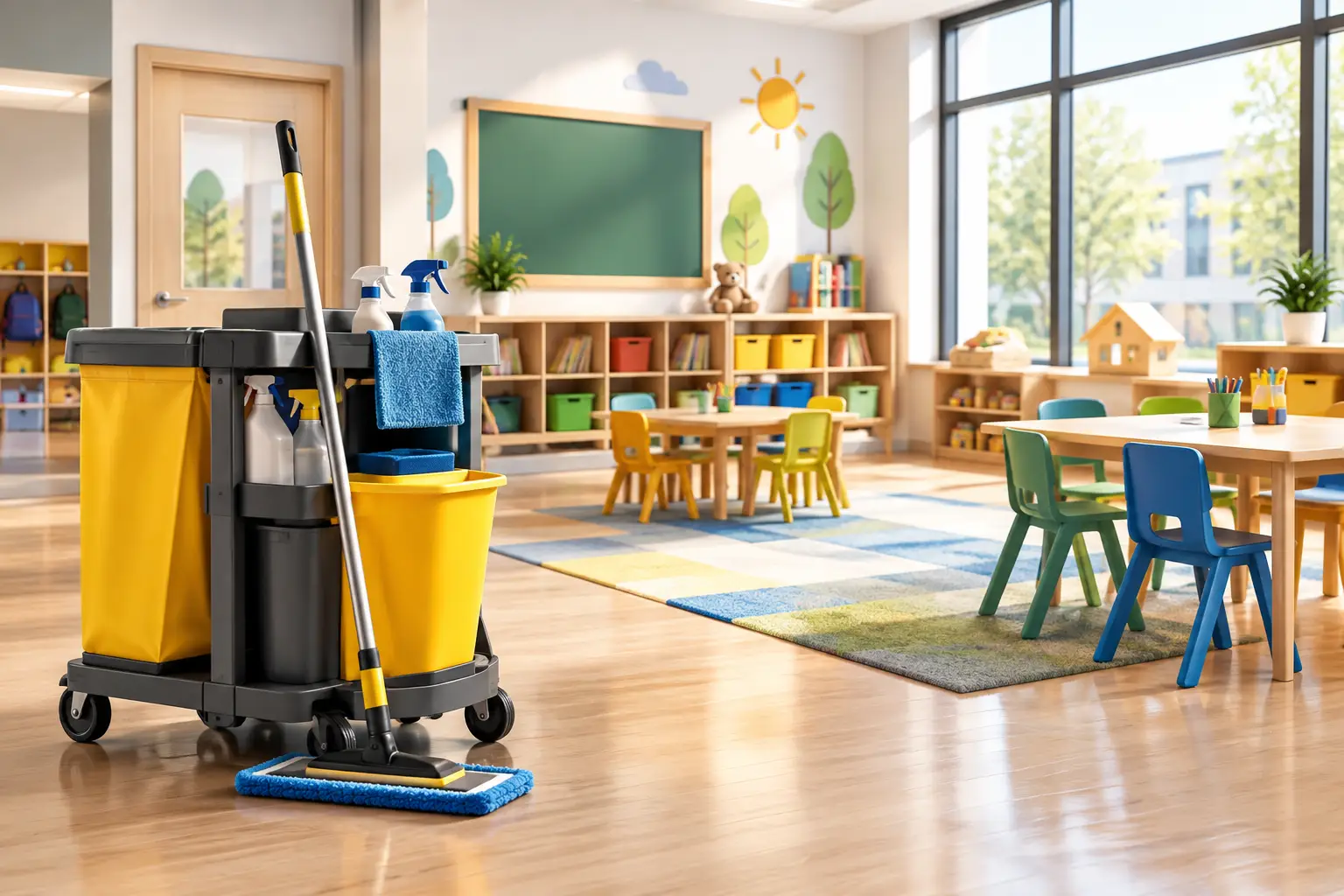
At 7 a.m., before the children arrive, a marked corridor, a poorly maintained toilet, or a persistent odour in a waste room is already an operational problem. A good cleaning guide for schools and daycare centres goes beyond making the place look clean: it organizes priorities, protects sensitive areas, and provides a reassuring environment for both staff and parents as soon as the doors open.
In a school or daycare, cleaning must follow the real rhythm of the building. Entrances receive snow, water and salt in winter. Toilets experience several peaks of use. Activity rooms accumulate dust, fingerprints and craft residue. A generic routine without checks for each area quickly leads to missed tasks and complaints.
Why schools and daycare centres require precise cleaning
The cleanliness of a school influences the perceived health, comfort of the staff and the image of the establishment. It also has a direct impact on daily operations. When bins overflow, floors become slippery or toilets are not restored between two periods of high traffic, staff must compensate. This is neither effective nor sustainable.
The challenge is particularly unique because there are many users and their habits vary with age. In a daycare, low-height surfaces, handles, tables and dining areas require constant attention. In a school, corridors, changing rooms, stairs, gyms and toilets can deteriorate very quickly between morning and the end of classes.
You also have to take into account the presence constraints. A complete cleaning of certain areas is done after hours of occupation, while light interventions must take place during the day: picking up, checking toilets, tidying an entrance or responding to a leak. The best schedule is therefore rarely the one that promises the most passes. It is the one that assigns the right task, to the right area, at the right time.
Cleaning guide for schools and daycare centres: start with real areas
Before setting a frequency, it is necessary to visit the building and observe its paths. An entrance used by several groups in the morning does not have the same needs as an administrative wing that is rarely used. Similarly, a small daycare with an active kitchen does not require the same plan as a multi-storey school with a gym and cafeteria.
A clear plan generally distinguishes the following areas:
- entrances, vestibules, corridors, stairs and elevators, where shoe prints and dust accumulate quickly;
- toilets, sinks, changing rooms and change areas, which require frequent and documented checks;
- classrooms, activity rooms, play areas and dormitories, where contact surfaces and floors must be maintained according to usage;
- meal rooms, kitchens and staff areas, where food residues and odours require constant management;
- waste rooms, recycling rooms, technical rooms and exterior access points, often forgotten until they become a source of complaints.
This assessment by area avoids two common errors: treating all rooms at the same frequency and concentrating effort only on what is visible. A poorly managed waste room can affect the entire building through its odours. A saturated entry carpet may make a lobby appear clean, but allow moisture and dirt to circulate through all the corridors.
Establish a frequency that follows the traffic
Areas with high traffic often require daily presence, sometimes more than one intervention during active periods. Toilets deserve regular checks during operating hours, especially in large schools. Floors in activity rooms can be maintained every night, while more complete tasks, such as detailed cleaning of baseboards, accessible walls or ventilation grilles, are integrated into a periodic schedule.
The frequency also depends on the season. In Montreal, Laval and on the North Shore, winter significantly increases the needs at entrances: water, abrasives, calcium, salt and black stains require more than a simple sweep. Conversely, summer work or renovations can leave fine dust that settles in the building. A post-construction cleaning or a restoration must then precede the reopening, especially when the work has touched ceilings, floors or mechanical systems.
Distinguishing cleaning, disinfection and restoration
These terms are often used as if they meant the same thing. On the ground, they respond to different needs. Cleaning removes visible dirt, residue and dust. Disinfection is applied according to the establishment's protocols, the surfaces involved and the allowed products. Restoration aims for a more severe situation: a greasy floor, traces after work, accumulation in a closed room or preparation of a space before its occupation.
This distinction is useful to avoid unrealistic expectations. Disinfecting a surface still soiled is not a complete solution. Likewise, daily cleaning does not replace a stripping or specialized intervention when floors have lost their appearance or protection.
Products, dilutions and methods must be adapted to materials and occupants. In a daycare, it is necessary to plan drying times and safe re-entry into spaces. In a gym, an inappropriate product can leave a slippery floor. In a school, excessive use of fragrant products can create unnecessary irritants. A serious team prefers controlled methods, professional equipment and clear instructions rather than a uniform approach.
Preventing complaints with a simple follow-up
Complaints rarely occur without a sign. They often begin with a recurring detail: empty dispenser, forgotten bin, poorly cleaned corner of a corridor, odour in the toilets or persistent stains in the lobby. The property manager does not need to monitor each intervention, but must be able to know what has been done, when and in which area.
A good follow-up includes a task list per sector, realistic schedules and a communication channel for urgent requests. The person responsible on site must also be able to report a leak, an incident or an area that requires additional attention without waiting for the next regular service.
Communication makes a particular difference during school events, open house days, evening activities or construction work. A multi-purpose room used after classes may require an additional pass. A planned intervention in a stairwell must be coordinated to not disrupt circulation. Reliability is not only measured by the final cleanliness, but by the ability to adjust without disrupting the establishment.
What does a building janitorial service include in a school?
A building janitorial service covers the operational maintenance of shared spaces and circulation areas. In a school or daycare, this can include lobbies, corridors, stairs, toilets, waste rooms, common areas, entrances and some administrative spaces. According to the agreement, the team may also be responsible for floor washing, waste collection, cleaning of accessible windows, maintenance of immediate outdoor areas or interventions after construction.
Who maintains a building? In practice, the property manager, owner or administration delegates this responsibility to a janitorial or commercial cleaning team capable of working according to a defined schedule and measurable standards. Who cleans the common areas of a condominium? The same principle applies: a regular maintenance provider ensures lobbies, corridors, elevators, stairs, garages and waste rooms according to the building's needs.
For a school, the challenge is to add an understanding of spaces frequented by children and the academic calendar. The provider must be able to intervene discreetly, respect agreed access and maintain consistency, even when an unexpected change modifies the day.
When to call on a specialized team
Regular cleaning is sufficient to maintain a well-managed building, but certain situations require expertise or additional equipment. This is the case after renovations, before a handover of spaces, after a major leak, during an unusual accumulation of dust or when floors and common areas have not received the required periodic cleaning.
It is also appropriate to request an evaluation when complaints recur without an apparent cause. Sometimes, the problem comes from an improperly distributed frequency. In other cases, it is due to difficult access, inadequate equipment or a lack of follow-up on waste rooms and toilets. A site visit allows determining what needs to be corrected, without paying for unnecessary tasks.
Nickel & Krome supports property managers, building managers and commercial spaces in Montreal, Laval and on the North Shore with an approach based on the real areas of the building. For a regular maintenance plan, a restoration or a need after construction, the company is registered under NEQ 3381837957 and can be contacted at +1 514-974-3311. A well-maintained establishment does not require constant supervision: it relies on a clear plan, reliable passes and a team that sees the details before they become a problem.