
Post-Renovation Cleaning or Routine Maintenance?
Distinguish post-renovation cleaning from routine maintenance so dust, residues and sensitive finishes receive the right attention after building work.
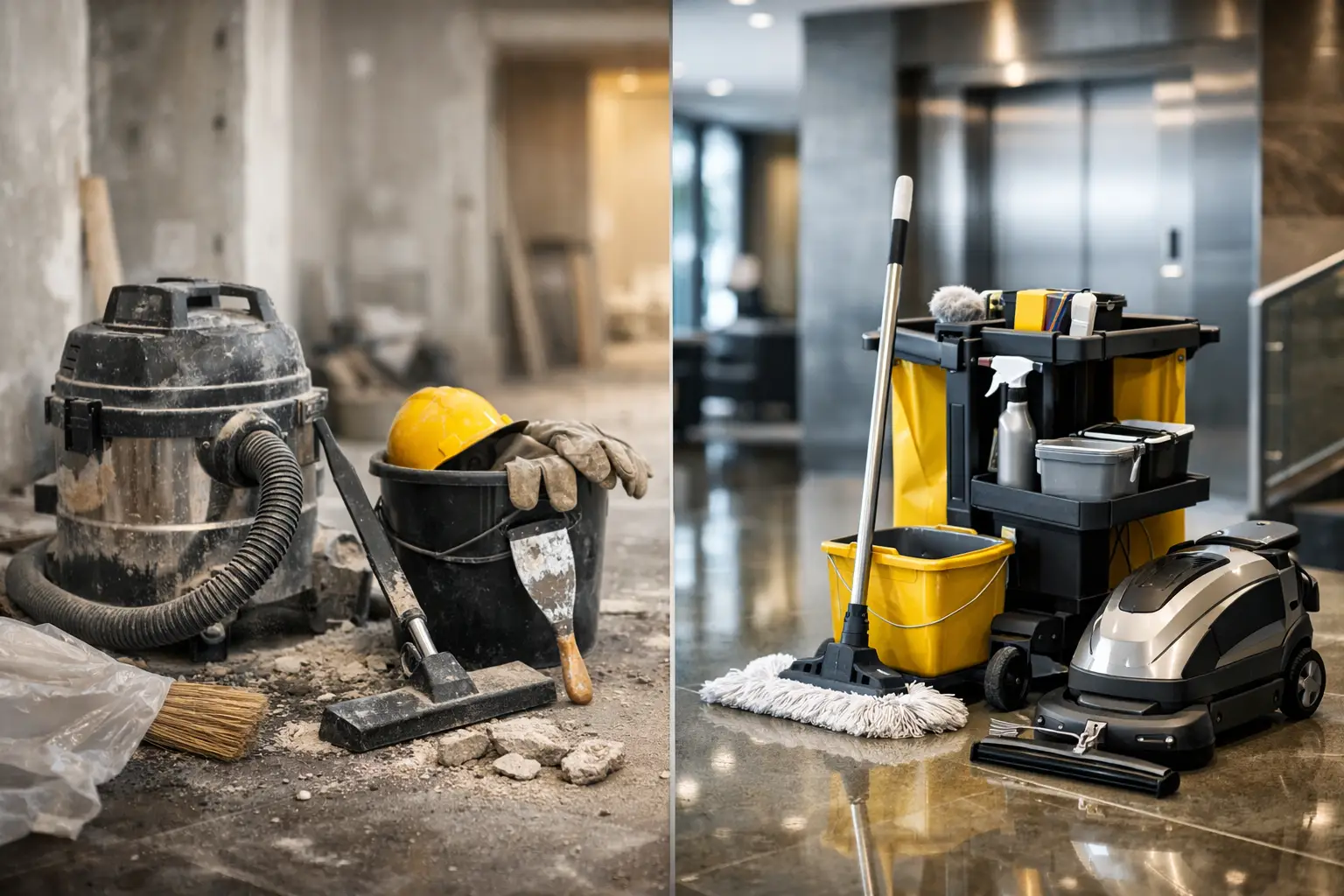
A dusty hallway, an elevator marked by deliveries, or a waste room emitting odours require different responses. Between post-construction cleaning or regular maintenance, the right choice depends on the source of the problem, the actual condition of the surfaces, and the use of the building. For a property manager, confusing the two can lead to delays, repeated complaints, and poorly planned costs.
In a residential building, a condominium, a clinic, or an office, the goal remains the same: to keep the premises clean, functional, and presentable. The method, equipment, time required, and frequency of intervention, however, change completely depending on whether an area needs to be restored after a construction project or maintained week after week.
Two services, two operational objectives
Post-construction cleaning takes place after a construction, renovation, remodelling, or major repair. It aims to remove the residues left by the construction site before the handover, the return of the occupants, or the resumption of normal activities. Fine dust, paint traces, adhesive tape, cement residues, protective coatings, and finishing debris are common situations.
Regular maintenance, also called building janitorial services or recurring maintenance, is rather aimed at preventing dirt from settling. It concerns halls, corridors, stairwells, elevators, waste rooms and recycling rooms, entrances, interior garages, and other common areas. Its role is to maintain a consistent level of cleanliness, even with the daily passage of residents, employees, visitors, and suppliers.
The difference is simple: post-construction cleaning brings the premises back to a standard after an exceptional period; regular maintenance preserves this standard over time. An intensive cleaning therefore does not replace a regular maintenance routine, just as a weekly tour cannot always absorb the dust and residues from a construction site.
When to choose post-construction cleaning?
A specialized intervention is indicated as soon as the works have generated visible or difficult-to-remove contamination with regular maintenance. This is often the case after the renovation of an empty unit, the modernization of a hallway, the replacement of floor coverings, repairs in the corridors, or mechanical work that has produced dust in shared areas.
Construction dust is a good example. It settles on baseboards, doors, frames, handrails, and ventilation grilles. It sometimes returns several days after the first vacuuming, particularly if the construction work is not fully completed or if air circulation is strong. A team experienced with buildings evaluates the condition of the construction site before setting the time for the final intervention.
You also need to distinguish between post-construction cleaning and cleaning during construction. During the works, debris is removed, the spread of dust is limited, and access is kept practical. At the end, a detailed restoration of the surfaces is carried out. Planning these two stages avoids requesting a final cleaning while contractors still need to move around with materials and tools.
Post-construction cleaning is generally occasional, but it may require multiple passes. In an occupied building, access, elevators, and schedules must be carefully coordinated. The work must reduce the impact on residents without unnecessarily slowing down the project handover.
Signs that regular maintenance is not enough
Regular maintenance reaches its limits when marks persist despite scheduled visits, when dust quickly reappears, or when surfaces have stuck residues. Grout stains on tiles, paint splashes on door frames, or a thin white film on hallway furniture require an appropriate method.
The same principle applies to transition areas. A contractor may protect the floor of a unit, but cart wheels, boots, and elevator doors easily carry dirt and debris into common areas. In this case, intervention is needed on the routes used during construction, not just in the renovated room.
What does regular building maintenance include?
Building janitorial services include the tasks necessary to maintain the cleanliness and appearance of shared spaces according to a defined schedule. The exact content varies depending on the frequency of use, the number of floors, the presence of an underground garage, the type of floor, and the expectations of the property manager.
In a condominium, who cleans the common areas? A maintenance provider or a team assigned to the building usually takes on this responsibility. Their mandate may include floor cleaning, wiping high-contact surfaces, elevator maintenance, entrance cleaning, visual management of waste rooms, and attention to fingerprints in the corridors.
Who maintains a building? Depending on its size, maintenance may be carried out by an in-house janitor, a maintenance employee, or a specialized company. For condo boards and property managers who want a stable frequency, clear procedures, and less daily supervision, an external provider often allows for structured on-site follow-up. The key is that responsibilities, covered areas, and reporting deadlines are clearly established.
A good routine is not just about sweeping. It takes into account the reality of the building: entrances accumulate water and abrasive substances in winter, elevators leave fingerprints and cart marks, waste rooms require attention to odours, and underground garages retain dust, salt, and tyre marks.
Post-construction cleaning or regular maintenance: how to decide?
The decision is better made based on a concrete inspection than on a simple impression. Four questions allow you to choose the right service:
- Does the dirt come from a single event, such as a renovation or a delivery?
- Do the surfaces require the removal of technical residues, fine dust, or embedded stains?
- Does the problem return every week due to normal passage in the building?
- Is the space ready for occupation, a visit, a handover, or a specific reopening?
If the answer relates to a recent event and construction residues, post-construction cleaning is generally the right approach. If the need comes from normal usage and recurs constantly, a regular maintenance schedule is more cost-effective and efficient.
There are also mixed cases. After the renovation of a condominium hallway, for example, a detailed final cleaning prepares the handover. Then, regular maintenance resumes to protect the new finishes and prevent the first traces from accumulating. This continuity is particularly useful in buildings where the appearance of common areas directly influences resident or commercial tenant satisfaction.
Post-construction cleaning or regular maintenance: what determines the frequency?
A quiet residential building does not have the same needs as a condo tower with several elevators. A clinic receives concentrated traffic during the day; a multi-unit building has peaks in the morning, in the evening, and on weekends. The frequency must follow this reality.
High-traffic areas may require maintenance several times a week, or even daily. On the contrary, some secondary areas may be scheduled for less frequent cleaning, provided their condition is checked. Reducing visits everywhere to cut costs may seem reasonable at first, but complaints, odours, or floor degradation often end up costing more.
A good schedule also specifies what must be done at each visit and what belongs to periodic interventions. Interior glass cleaning, treatment of certain floors, restoration of a garage, or pressure washing do not necessarily follow the same rhythm as corridor maintenance.
Prevent complaints with simple communication
For a property manager, the quality of cleaning is also measured by what does not come back: complaints about odours, comments on a dirty elevator, repeated requests for a marked corridor. This requires a provider who knows the sensitive areas and who communicates when a situation exceeds the planned maintenance.
It is useful to agree from the start on a reporting method for emergencies, minor incidents, and problems observed on site. A strangely dirty waste room, a leak in an entrance, or traces left after a move should not wait for the next visit without anyone being informed.
In Montreal, Laval, and on the North Shore, the Nickel & Krome team supports property managers, condo boards, and contractors with a maintenance-focused approach, building janitorial services, and post-construction cleaning. Its field experience, professional equipment, and common area follow-up allow it to adapt the intervention to the condition of the building. To discuss a mandate, the company is reachable at +1 514-974-3311, NEQ 3381837957.
Before planning the next intervention, take a walk through the premises when they are most busy. This is often where the right choice becomes clear: a targeted restoration after construction, or a regular maintenance plan capable of keeping the building spotless without waiting for problems to become visible.
From the guide to your project
To check the scope, access, and conditions for intervention, consult our service: Post-construction cleaning for ready-to-handover commercial construction sites.