
Building Concierge vs Internal Cleaning
Building concierge vs internal cleaning: compare cost, control, quality and flexibility to choose the right maintenance model.
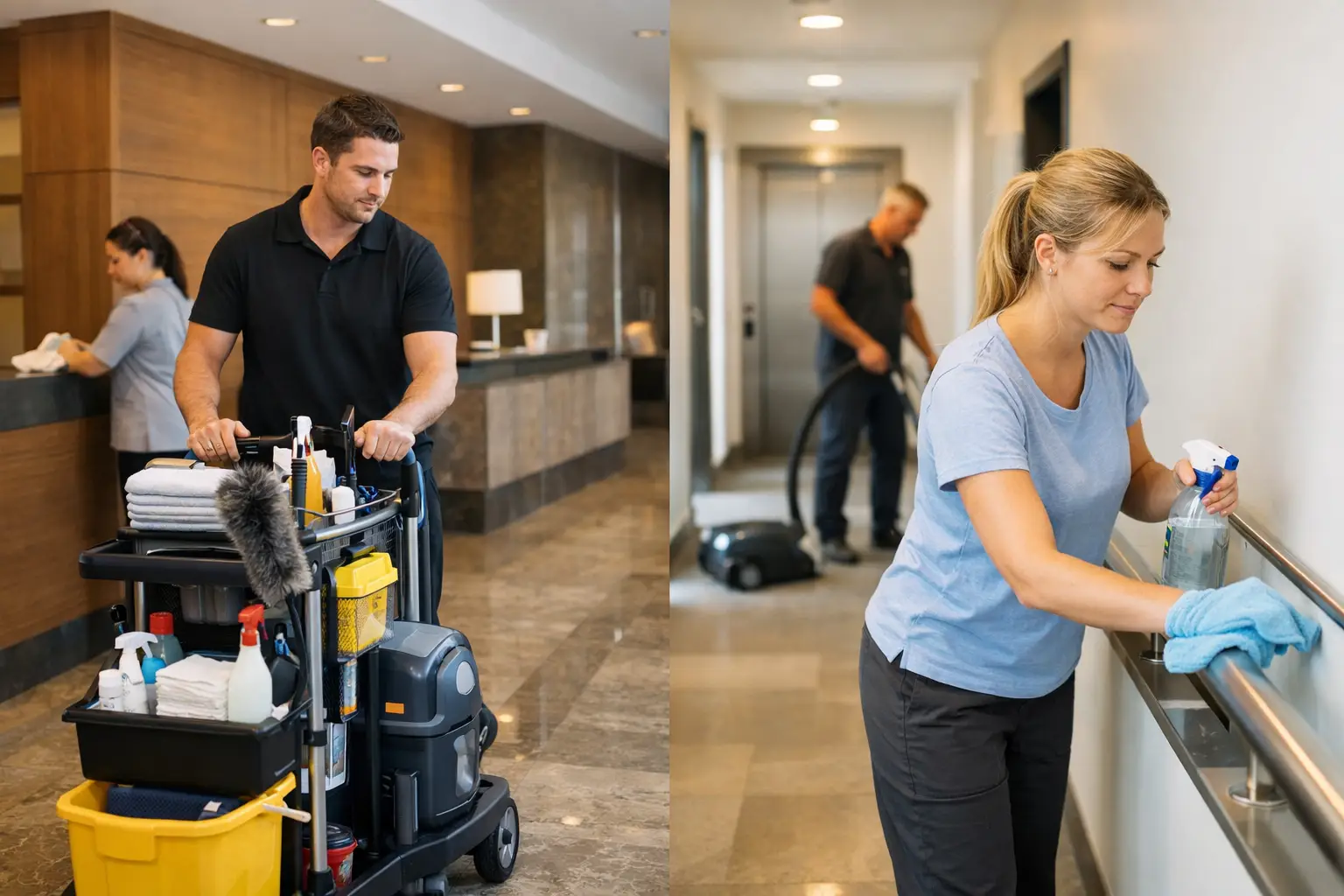
Building concierge vs internal cleaning means comparing cost, control, quality and flexibility to choose the right maintenance model for a property.
When an entrance lobby starts to deteriorate, stairwells lose their standard or tenant complaints accumulate, the question comes up quickly: building concierge vs internal cleaning, which model actually holds up day to day? For a property manager, condominium syndicate or commercial building owner, this is not a matter of preference.
It affects execution quality, operational stability and the ability to keep a building clean without multiplying irritants.
Building concierge vs internal cleaning: the real question
The debate is often framed incorrectly. People sometimes oppose an on-site concierge to a directly managed employee as if one automatically guaranteed proximity and the other guaranteed control. In reality, the right choice depends mostly on the type of building, the required standard, the tasks to cover and how variable the needs are.
In a small stable building with low turnover, little work and needs limited to common areas, internal cleaning may seem simple to manage. By contrast, as soon as a site combines high traffic, image requirements, specialized surfaces, bin handling, heavier periodic cleaning or post-work interventions, the organization becomes more technical. That is where building concierge services or specialized outsourcing often gain the advantage.
What a building concierge service really covers
Building concierge is not limited to mopping a corridor. In a serious form, it frames recurring maintenance of common spaces, general observation of the property condition, escalation of anomalies and sometimes certain routine connected tasks. The value is not only in presence, but in method.
A structured provider works with defined frequencies, result standards, replacement procedures and adapted equipment. This changes many things in multi-unit buildings, commercial properties or condominiums where consistency matters more than goodwill. A lobby can look clean on Monday morning and deteriorate very quickly if follow-up is not designed around actual traffic.
The strength of outsourced concierge service is often its ability to absorb variation. A one-time need after a move-in, a stairwell reset, an intervention after small work or deeper cleaning at certain periods can be integrated more easily than with a single internal resource.
What it means to manage internal cleaning
Internal cleaning gives, on paper, direct control. You recruit, schedule, set priorities and keep execution under your own management. For some managers, this proximity is reassuring, especially when the building has strong particularities or occupants expect a regular human presence.
But that control has a management cost. You have to recruit, train, supervise, replace absences, manage products, equipment, schedules, vacations and sometimes quality gaps. In many buildings, the difficulty is not defining the task. The difficulty is maintaining the same quality all year without service interruption.
An internal employee can do the work well, sometimes very well. The problem often appears over time. When a key person leaves, becomes absent or no longer meets the expected level, the manager has to run an operational function that may not have been worth internalizing.
Cost: more complex than a simple hourly rate
Comparing the two models only on the displayed price often leads to poor decisions. Internal cleaning sometimes appears cheaper because the reading is immediate: a salary, a few products and some equipment. Yet the real cost includes charges, administration, supervision time, replacements, absenteeism, consumable storage and unexpected purchases.
Outsourced concierge has a more visible contract cost. It may look higher at first glance. But that cost often includes organization, supervision, replacement coverage, basic supply management and continuity of service. For an asset manager or condo board, that predictability has real value.
The cost of poor quality also has to be considered. A poorly maintained building is visible immediately. It affects tenant experience, the image of the property, lease renewals and the general perception of management standards. In some assets, saving a little on maintenance costs much more in reputation and corrective reset work.
Execution quality: the question of standards
The difference between an acceptable site and a well-maintained site rarely lies in the task list. It lies in the result standard. Are handles really cleaned? Are floor corners treated? Do entrances keep their appearance despite weather? Are marks after service corrected?
Internal cleaning often depends heavily on one person’s discipline. If that discipline drops, quality drops with it. In a concierge model, especially when carried by a specialized company, quality can be better framed through methods, checks and a service logic. That does not mean every provider is better by default. It means a good provider creates a more stable framework for producing a consistent result.
In buildings that require more technical interventions, such as post-construction cleaning, reset work after a project or treatment of certain exterior surfaces, internal cleaning quickly reaches its limits. These tasks require equipment, experience and a protocol. They cannot be improvised between two regular rounds.
Flexibility and response capacity
This is often where the gap widens. Internal cleaning works correctly when needs are predictable and repetitive. As soon as the schedule moves, urgent requests accumulate or a building goes through a more demanding phase, the structure can become strained very quickly.
A well-organized building concierge service generally offers more flexibility. It can adjust frequencies, reinforce certain zones, respond after an incident or support a period of work. For managers handling several addresses, this matters a lot. It is simpler to coordinate with a partner able to scale up or down according to the actual condition of the portfolio.
In Greater Montreal, where seasonal conditions, entrance dirt, abrasives and transition periods strongly affect common areas, this ability to adjust is not a detail. It determines the building’s standard over several months, not only during a typical week.
When internal cleaning remains a good option
The topic should not be caricatured. Internal cleaning can be suitable in some contexts. This is the case for a small building with low occupancy, low turnover, few complex surfaces and mostly routine needs. It can also work when a versatile employee already provides an on-site presence with simple, well-defined tasks.
It works best if the manager already has a strong HR structure, close supervision and enough volume to justify that organization. In that case, internal cleaning can offer good local responsiveness. But this option remains more fragile if it depends on one person without a clear backup plan.
When outsourced concierge becomes the most rational choice
As soon as a building must preserve a polished image, absorb workload variations or combine routine maintenance with specialized needs, outsourcing often becomes more coherent. This is especially true for medium to large condominiums, high-traffic multi-unit buildings, commercial sites and properties that alternate between regular maintenance and reset work.
The real interest is not only delegating. It is giving execution to a team whose work is precisely to keep demanding environments at a consistent standard. For managers who want less operational friction, fewer personnel surprises and better continuity, the gain is concrete.
A specialized company like Nickel & Krome brings this field logic: framed execution, ability to work on common areas as well as more technical needs, and a realistic understanding of building constraints. This is often what is missing in a purely internal approach, even when well intentioned.
How to decide without making the wrong choice
The right decision is not asking which model is cheapest, but which one holds your standards with the least hidden management. If your priority is daily proximity on a small simple site, internal cleaning can be defended. If your priority is consistency, operational coverage and the ability to manage variable or specialized needs, outsourced concierge is generally stronger.
Ask three simple questions: are your needs stable all year, can your organization handle absences without service degradation, and does your building require more than basic upkeep? The answers often point quickly toward the right decision.
In the end, between building concierge and internal cleaning, the best choice is the one that keeps maintenance from becoming a management problem. A clean building should remain a visible standard, not a file that keeps coming back to the desk.
Apply this guide to your property
Review the scope, access requirements and service details for Building concierge support in Montreal, Laval, and the North Shore.