
8 Post-Construction Cleaning Mistakes to Avoid
Avoid the cleaning mistakes that delay building handover, damage new finishes and generate complaints. A practical guide for contractors and managers.
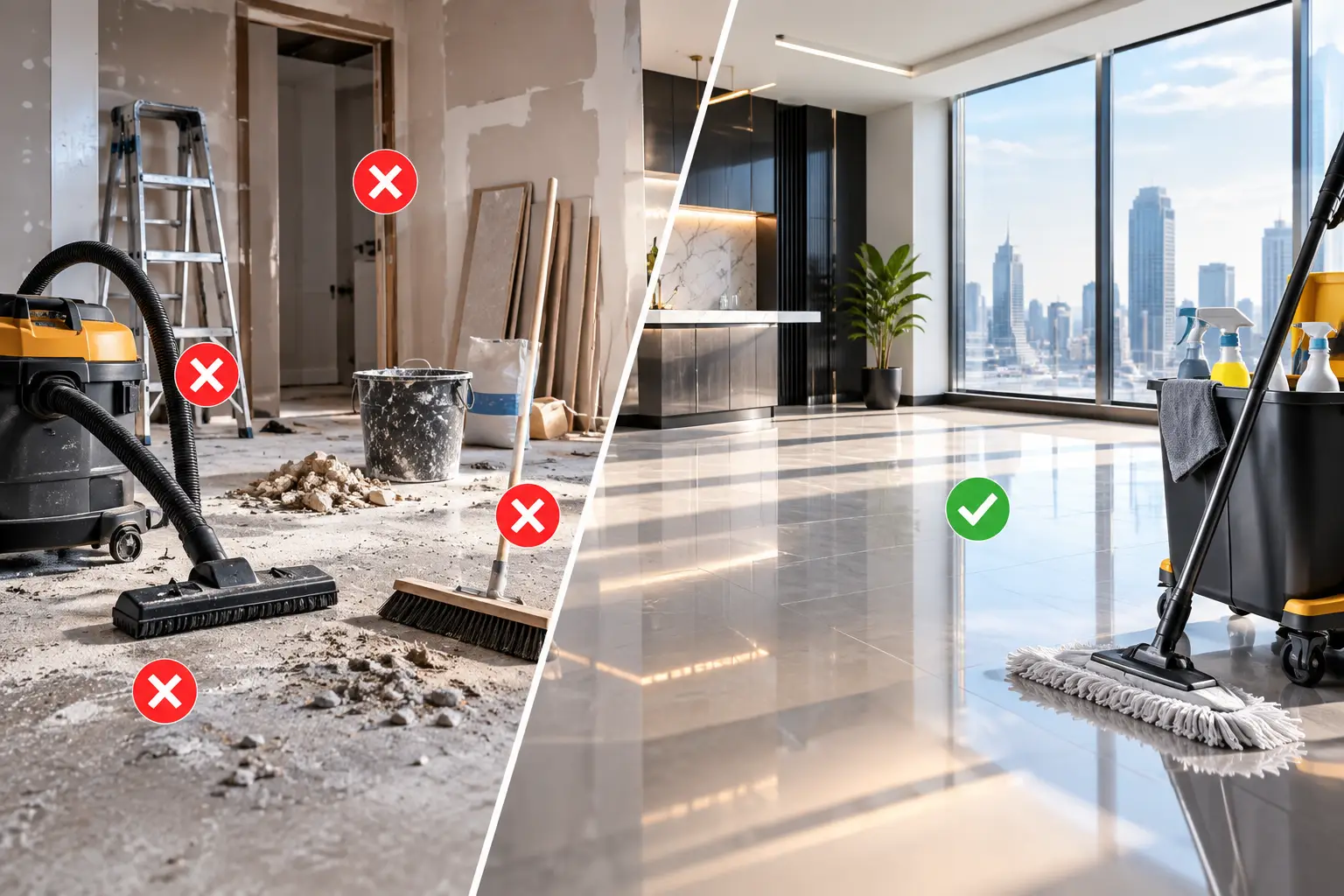
A building may appear finished, yet the details that matter most are still present on site: fine dust in the corridors, plaster traces on the frames, glue on the windows, residue in the elevators and marks on the floor. Cleaning errors at the end of construction not only affect appearance. They can delay a handover, cause complaints as soon as occupancy begins and damage new materials that are expensive to replace.
For a general contractor, a property manager or a condo board, the restorative cleaning must be considered an operational step of the project. The goal is not to eliminate visible dirt hastily. It is to deliver common areas, commercial spaces or units ready to be used, inspected and maintained afterwards.
1. Starting before construction is actually finished
The first mistake is to plan the final cleaning while several trades are still working in the building. A corridor cleaned before the installation of doors, lighting or the last corrections will quickly be marked again. The movement of people brings dust, cardboard, debris and boot marks back into already treated areas.
You should not wait until everything is perfect either. A smooth process usually includes a rough cleaning during construction, followed by a detailed intervention once the dirty work is completed. In a partially occupied building, sequencing becomes even more important: residents, deliveries and construction teams must be able to move around without compromising the clean areas.
A site visit allows you to determine what is actually ready. Common areas, the lobby, stairwells, elevators, waste rooms and the underground parking garage do not always progress at the same pace.
2. Treating all dust as ordinary dust
Construction dust is not the same as regular cleaning dust. It can contain gypsum, cement, grout, silica, fibres or wood residues. It settles on baseboards, ventilation grilles, window sills, tracks, light fixtures and vertical surfaces. A quick sweep with a broom can simply redistribute it.
An effective restorative cleaning begins with vacuuming with the appropriate equipment, followed by systematic wiping of surfaces. You must work from top to bottom and check less visible areas, especially above doors, behind appliances, in the corners of corridors and around air returns.
Forgetting this step creates a recurring problem: when the ventilation system is fully operational or when the first occupants move in, the dust reappears. The building seems poorly maintained, even though the construction is only just finished.
3. Using the same product on every surface
New materials are often vulnerable in the first few weeks after delivery. Natural stone, porcelain, floating floors, stainless steel, aluminum, treated glass and vinyl flooring do not all accept the same product or method.
An overly strong degreaser can dull a finish. A poorly chosen acidic product can damage joints, stone or certain metals. A blade used too aggressively on glass can leave permanent scratches. On the other hand, a product that is too mild will not remove glue, grout or tape residue.
Before starting, it is necessary to identify the finishes and, if needed, do a discreet test. Manufacturer guidelines and installer recommendations are useful, especially in condo lobbies and commercial spaces where materials were selected for their appearance and durability.
4. Neglecting transition areas and hidden spaces
A post-construction cleaning often fails in places that are only noticeable upon close inspection. Door thresholds, baseboards, frames, guardrails, switches, elevator tracks and parking garage corners accumulate residue. These details become very visible under the constant lighting of a lobby or corridor.
The waste rooms and recycling areas also require special attention. After construction, they may contain dust, odours, bin marks and floor residue. Cleaning them only on the surface risks leaving a bad first impression for residents and creating complaints on the first days.
In an underground parking garage, tire marks, concrete dust, debris near the walls and runoff around the entrances must be evaluated according to the actual condition of the site. High-pressure washing may be useful, but it must be adapted to drainage, surrounding equipment and building restrictions.
5. Confusing visual cleanliness with handover readiness
An area may appear clean at first glance, but not be ready for delivery. A final construction inspection must look at surfaces at different heights and from multiple angles. Windows reveal traces with side lighting. Floors show residue when observed closely. Elevators readily show fingerprints, dust in grooves and marks on steel.
Cleaning must therefore include a quality control check before the team leaves. This verification reduces urgent returns, unnecessary rework and discussions about what was or was not included in the intervention. It is particularly useful when the building is delivered to a property manager who was not present daily.
A checklist tailored to the building helps confirm that sensitive points have been treated: windows, glass doors, restrooms, appliances, grilles, baseboards, accessible light fixtures, common areas, accessible technical spaces and exterior access.
6. Forgetting the transition to day-to-day building operations
The end of construction is not the end of cleanliness needs. It is the beginning of daily operations. After a restorative cleaning, the first occupants bring boxes, dust, packaging waste and additional traffic. A new building can quickly lose its appearance if no transition to regular cleaning is planned.
It is here that a building janitorial service takes over. It generally includes the cleaning of lobbies, corridors, elevators, stairwells, waste rooms, recycling areas and other common areas, according to a frequency adapted to traffic. Who cleans the common areas of a condominium? A janitorial team hired by the condo board or property manager, with a clear scope of work and on-site follow-up.
The frequency depends on the number of units, the type of clientele, the season, the presence of a garage and the volume of traffic. A quiet small building does not have the same needs as a tower with elevators, frequent moves and a heavily used waste collection area.
7. Choosing a team without experience in occupied buildings
Post-construction cleaning requires more than a team available at short notice. It requires knowing how to work around contractors, protecting finishes, managing access and communicating the limits of an intervention. In an occupied building, it also requires respecting schedules, reducing noise, limiting strong-smelling products and maintaining safe passages.
A supplier who knows buildings can distinguish between cleaning, construction correction and finish issues. This distinction prevents the cleaning team from being called to hide a scratch, a poorly installed joint or damage that should have been documented before delivery.
For property managers in Montreal, Laval and on the North Shore, the right partner is one who understands high-traffic areas and can then ensure continuous cleaning without starting from scratch on each visit.
8. Leaving the scope of work unclear
Vague expectations are a frequent source of disappointment. Are interior and exterior windows included? Should stickers, temporary protection and construction waste be removed? Are units included, or only common areas? Are the garage, storage areas and mechanical rooms included?
Before the intervention, it is preferable to specify the areas, the expected condition, access constraints, delivery dates and excluded elements. This protects both the contractor and the property manager. A clear scope also allows for the preparation of personnel, equipment and time needed, rather than having to improvise in front of a more complex site than anticipated.
The Nickel & Krome team supports property managers, condo boards, businesses and contractors with a practical, on-site approach to post-construction cleaning and building maintenance. To discuss a restorative cleaning or ongoing janitorial services, the company is reachable at +1 514-974-3311, NEQ 3381837957.
A well-delivered building sets the tone for the rest. Taking the time to correct details before occupancy helps protect finishes, reduce complaints and offer common areas that occupants can be proud of on the first day.