
How to Prepare a Building for Handover
Prepare a building for handover by coordinating final work, cleaning, access and inspections, with practical checkpoints for contractors and managers.
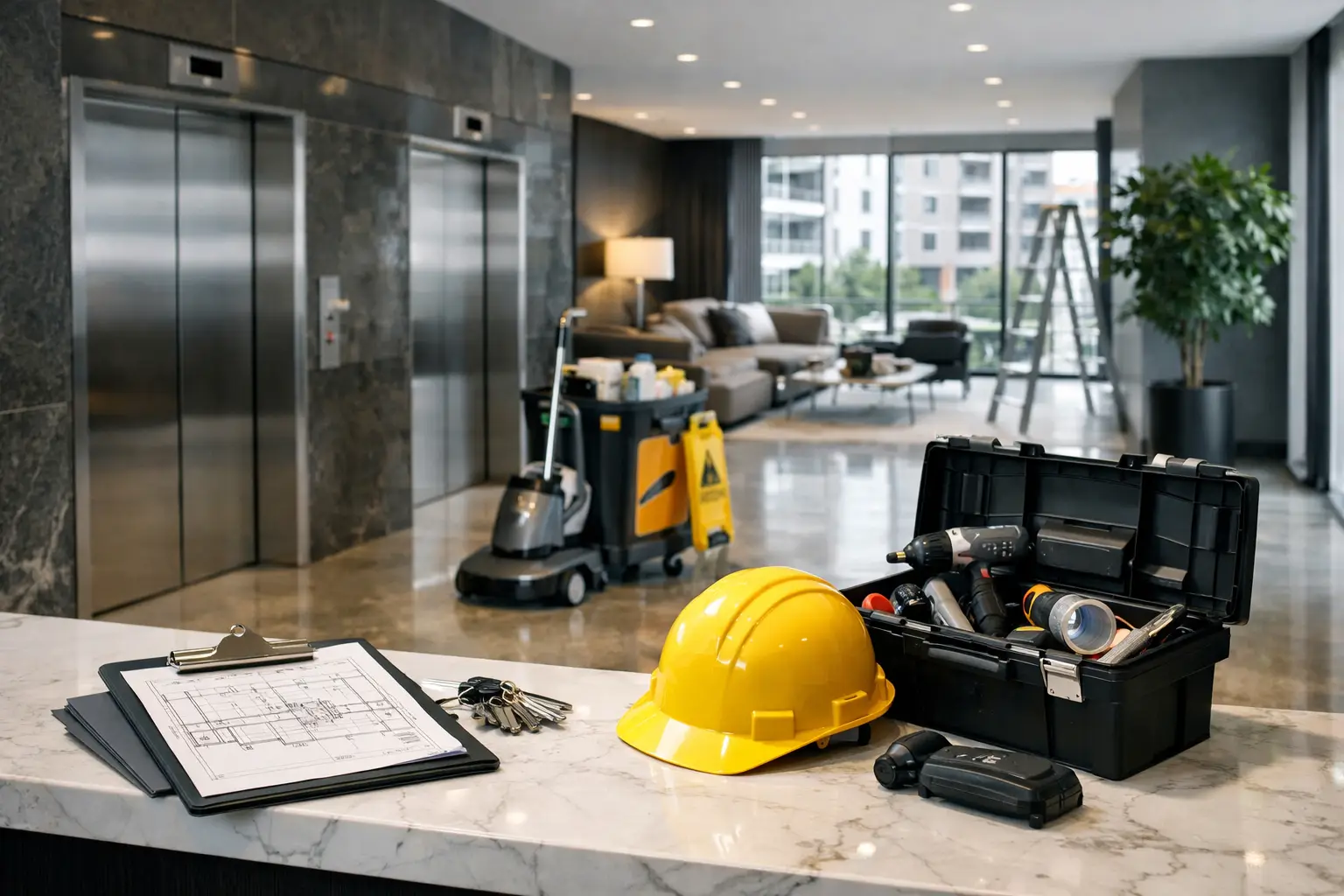
A building may appear finished when it is not yet ready for handover. In the last days before occupation, fine dust returns to the corridors, windows keep stains, elevators are marked by equipment moves, and waste rooms are not always functional. Knowing how to prepare a building before handover is about organizing a complete restorative cleaning that protects the image of the project from the first visit.
For a property manager, general contractor or condo board, this step is not just about making the lobby shine. It serves to identify incomplete areas, reduce last-minute corrections, and deliver a clean, safe, and ready building for residents, tenants or employees.
Start with a structured on-site inspection
Before planning the cleaning, it is necessary to walk through the building as someone would do upon first entry. The route usually starts at the entrance, continues through the lobby, corridors, stairwells and elevators, then includes less visible areas such as accessible mechanical rooms, waste rooms, recycling rooms, underground garages and parking lots.
This inspection allows distinguishing what belongs to cleaning and what requires correction by another professional. A door of an elevator covered in fingerprints can be cleaned. A baseboard that is loose, a water leak or a missing detector must be reported to the works supervisor. Mixing these two realities wastes time and creates unrealistic expectations towards the cleaning team.
The property manager gains by noting priorities by area, with photos when necessary. The goal is not to produce a complex report. It is to clearly know what must be cleaned, what must be protected and what must be corrected before official handover.
Plan for a real post-construction cleaning
The post-construction cleaning is different from regular commercial cleaning. Even after the apparent departure of workers, surfaces often contain gypsum dust, adhesive residue, tape marks, paint splashes, dust in corners and debris in technical spaces. A quick pass is not enough.
Restorative cleaning must follow a logical sequence. We start by removing debris and remaining protections, then treat high surfaces before finishing floors. Without this method, dust falls on already cleaned areas and the result lacks consistency.
Windows, door frames, baseboards, accessible ventilation grilles and light fixtures must also be checked. These are often the details that give the impression that the building is not finished. In a new condo or a rental building, these defects become comments during visits and first possession.
Adapt products to new materials
Newly installed materials do not all tolerate the same products. Marble, vinyl, engineered wood, stainless steel, floor coverings and decorative panels require appropriate methods. A too aggressive product can dull a surface, leave a film or damage a newly applied finish.
Therefore, it is necessary to avoid improvised cleaning, especially when the construction team is still working on certain floors. In this context, a partial restorative cleaning may be necessary, followed by a final cleaning after the corrections are completed. The right time depends on the actual progress of the work, not just the scheduled date.
Give priority to visible common areas
Common areas are the operational face of a building. The lobby, corridors, elevators and stairs are used by everyone, several times a day. They quickly accumulate dust, fingerprints, cardboard marks and light debris.
Who cleans the common areas of a condominium? In practice, it is a building janitorial services or building maintenance team hired by the condo board, property manager or owner. Their role includes maintaining cleanliness in shared spaces according to a frequency adapted to traffic and building needs.
Before handover, each common area should undergo a simple visual check. Are the floors free of dust and traces? Are the mirrors, elevator buttons and handrails clean? Do the doors close without visible marks? Have the corners, thresholds and baseboards been finalized? This check reduces missed details that easily go unnoticed in a large project.
Elevators deserve particular attention. They are often used to transport materials, tools and boxes until the last minute. The walls, rails, thresholds, control panels and mirrors must be cleaned carefully without compromising finishes. If occupation begins while the work is still ongoing, additional protections and more frequent maintenance passes will be necessary.
Do not neglect waste rooms and underground garage
A waste room poorly prepared quickly becomes a source of odours, complaints and dirt in adjacent corridors. Before the arrival of occupants, it is necessary to remove construction waste, clean floors and accessible drains, disinfect necessary surfaces and confirm that containers are in place. The sorting instructions and access must also be clear enough to avoid the first residents disposing of their waste in the wrong place.
The underground garage requires the same level of preparation. Concrete dust, tire marks, debris, wall marks and accumulation around entrances can quickly affect the overall perception of the building. According to the site inspection, an industrial sweeping, targeted floor washing or a more thorough restorative cleaning may be required.
In buildings where exterior work is not completely finished, it is necessary to accept that a garage can get dirty again. The best choice is then to plan a first cleaning before handover, followed by a follow-up visit when construction traffic has ceased.
Set up maintenance from the first day
Handover is also the time to prepare for day-to-day operation. Waiting for complaints to start before delegating the maintenance of common areas creates a difficult period to catch up. A new building quickly accumulates dust, fingerprints and debris when moves, suppliers and first occupants circulate at the same time.
What do building janitorial services include? According to the mandate, it includes regular cleaning of lobbies, corridors, elevators, stairwells, waste rooms, recycling rooms, garages and other common spaces. It can also include emergency cleanliness treatment, follow-up of high-traffic areas and clear communication with the property manager.
The frequency depends on the type of building. A condo tower with several elevators and a busy entrance has different needs than a small multi-family building. An office building often requires interventions outside of business hours, while a clinic or school requires special attention to frequently touched surfaces. The right maintenance plan is one that takes into account real traffic, not just the size.
Clarify responsibilities before occupation
A reliable provider must know who to contact, which areas are priorities, which hours must be respected and how to report an anomaly. For the property manager, this clarity avoids having to monitor every passage or repeating the same requests.
Who maintains a building? According to its size and operation, maintenance can be handled by an internal team, an on-site janitor or a specialized building maintenance company. For condos, multi-family buildings, offices and commercial properties, an external partner often brings a work structure, professional equipment and easier service continuity.
In Montreal, Laval and on the North Shore, the Nickel & Krome team supports property managers, condo boards and contractors with post-construction cleaning, restorative cleaning and building janitorial services. The approach is based on on-site follow-up of areas that generate the most complaints or influence the building's presentation. The company is registered under NEQ 3381837957 and can be contacted at +1 514-974-3311.
Plan for a final walkthrough before handing over the keys
The final walkthrough should take place as close to handover as possible, after the final cleaning and before the official arrival of occupants. It serves to check new traces, forgotten debris, damage caused by the last works and the overall condition of shared spaces.
You should not look for theoretical perfection when corrections or moves are still planned. Rather, you should deliver a clean, orderly and ready building, with a clear plan to preserve this state. It is this continuity between the end of construction and regular maintenance that transforms a correct handover into a lasting first impression.