Building Graffiti Removal: Why Prompt Action Matters
Building graffiti removal depends on substrate condition, a suitable test area, realistic limits and separate preventive-protection planning in Montreal.
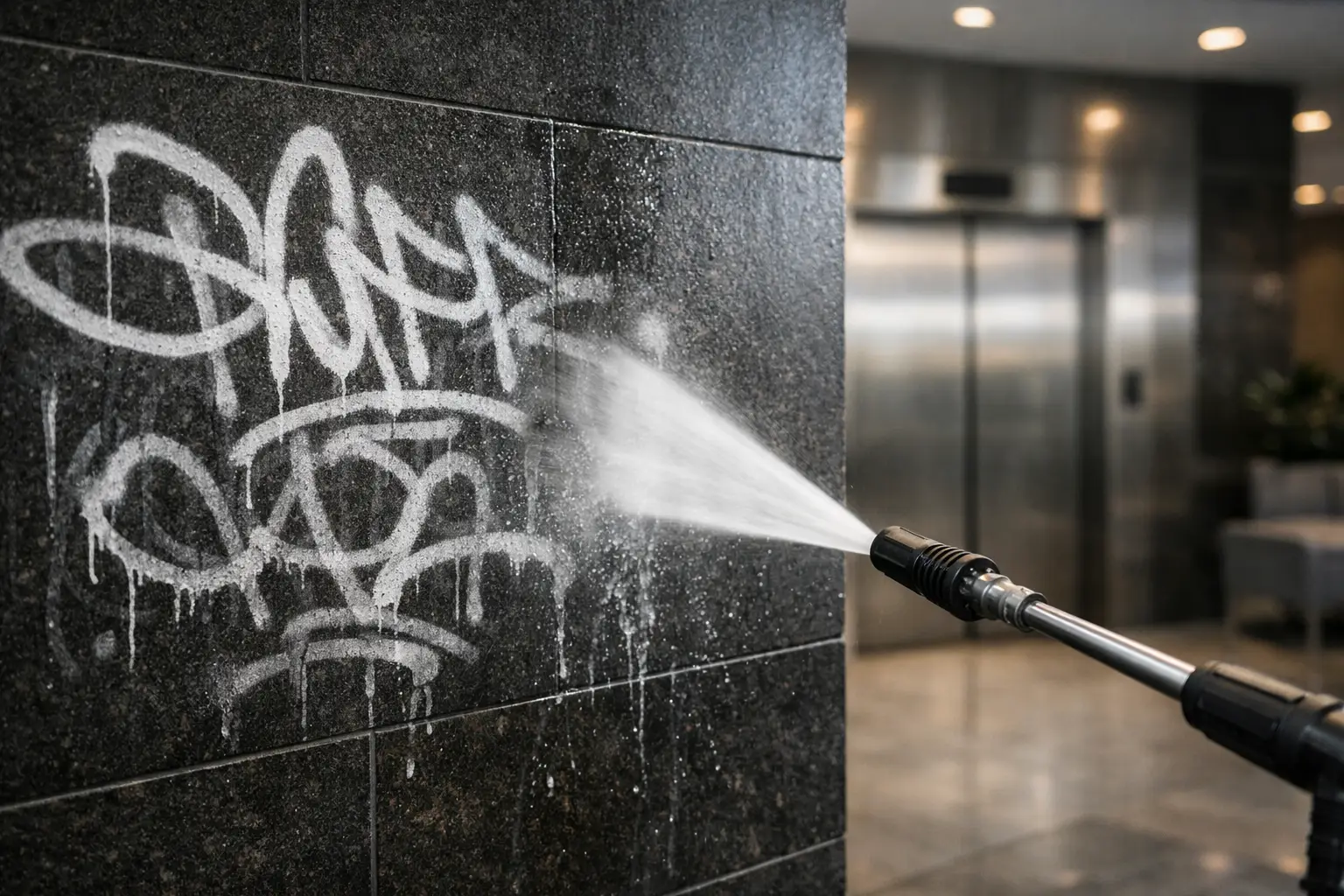
A marked building entrance, a tagged garage door or a defaced common-area wall can quickly trigger complaints. Building graffiti removal is not simply a matter of making a visible inscription fade. For a property manager, it means assessing a method that is compatible with the substrate, reducing the risk of alteration, preserving the building's presentation and preventing the issue from becoming established.
In a condominium, multi-unit property, commercial building or office building, prompt action matters. Graffiti left for several days can make a property look neglected and may attract additional markings in the same place. A structured intervention aims to limit that effect while accounting for the surface, its condition and site-access requirements.
Why graffiti should be addressed promptly
The most frequently affected areas are rarely chosen at random: secondary entrances, walls facing an alley, garage doors, fences, waste rooms, loading docks and parking areas. These locations are often less closely monitored but remain highly visible to residents, visitors, employees and commercial tenants.
Graffiti can also complicate routine maintenance. On a porous surface, paint penetrates brick joints, concrete, stucco or wood. The longer it dries, the more likely the intervention is to require several passes or a more targeted method. Acting promptly generally reduces cleaning time and the likelihood of residual traces.
The decision should not be rushed to the point of damaging the finish. Aggressively scrubbing old brick, applying an unsuitable product to painted aluminum or using excessive pressure on a weakened wall can cost much more than a professionally planned intervention. The objective is to reduce or remove the marking while limiting alteration of the substrate. Results still depend on porosity, coating condition, absorbed pigment and previous treatments.
The removal method depends on the substrate
Before any intervention, a specialized team should identify the surface, its porosity, the paint or marker involved and the overall condition of the finish. A method that works on a metal door may not be appropriate for a masonry facade or commercial sign. A discreet test area may be required before the entire surface is treated.
Brick, concrete and stone
These materials absorb pigment easily, especially when they are unsealed or highly porous. The work may require a compatible stripping product, controlled dwell time and pressure-adjusted rinsing. The treatment aims to draw paint from the pores while reducing the risk of eroding joints, whitening the stone or creating an area that is lighter than the rest of the wall.
In some cases, particularly on aging masonry, complete removal is not realistic in a single pass. A residual shadow or absorbed pigment may remain. The next step may involve a localized touch-up, a complementary treatment or an assessment of separate preventive protection. Stating these limits clearly helps the manager plan the restoration without unrealistic expectations.
Metal, doors and painted panels
Garage doors, metal frames, service boxes and exterior panels require particular care. An overly aggressive solvent can dull the finish, lift the existing paint or leave a halo. The intervention should account for the coating, its colour, its age and its current wear.
When the underlying paint is already flaking, graffiti removal may reveal the need for a touch-up. It is better to identify that condition before the work than to discover afterward a colour difference that already existed beneath the marking.
Glass, plastic and sensitive surfaces
Storefront glass, private shelters, signage, acrylic surfaces and composite finishes may appear simple to clean, but they scratch easily. Abrasive tools and some products can leave permanent marks. A controlled intervention aims to preserve sign legibility, entrance appearance and material integrity.
What a property manager should confirm before assigning the work
A capable provider does more than arrive with a pressure washer. The team confirms the exact location, site access, substrate type, nearby vehicle and pedestrian traffic, and the hours when the intervention will cause the least disruption. In an occupied condominium, treating the main entrance during peak traffic can create an avoidable problem.
It is also useful to document the graffiti before removal. A few dated photographs support internal follow-up, insurance needs where applicable and comparison after the work. They also help establish whether the same area is being targeted repeatedly.
A service request should identify the affected surface, approximate dimensions, urgency, access to water or electricity, schedule restrictions and required site-safety measures. This information allows the team to plan suitable equipment for the first visit.
Removing graffiti without disrupting building operations
In an occupied building, graffiti removal must fit the property's operating conditions. The affected area may be near an emergency exit, delivery lane, mechanical room or underground parking entrance. Adjacent surfaces must be protected, spray must be controlled and the work area must be left orderly after the intervention.
Pressure washing can be useful, but it is not an automatic solution. Incorrect pressure can project dirty water onto walls, windows or vehicles. A manual method using specialized products may be slower but better suited to a small area near an entrance or a fragile finish.
Cleaning residue must also be considered. Depending on the products and site configuration, runoff toward drains, planting beds or pedestrian areas may need to be controlled. The intervention should not create a new nuisance for residents or maintenance staff.
Preventing repeat marking in vulnerable areas
Removing graffiti is necessary, but prevention can reduce urgent calls and future maintenance costs. Prevention does not rely on cameras alone. Lighting, visibility, upkeep around the property and prompt removal can all make a practical difference.
For walls or doors that are marked repeatedly, a compatible anti-graffiti protection system may be considered as a separate preventive service. Suitability depends on the material and desired appearance. On some substrates, a protective coating may slightly change the finish or require a specific maintenance method. A substrate assessment and, where needed, a test area help determine whether that option is appropriate.
Property managers can also include vulnerable areas in their building-maintenance routine. Regular checks of secondary entrances, waste rooms, garages, exterior stairs and fences make it easier to report new markings promptly. The same approach applies to stains, pasted notices and residue that affect the presentation of common areas.
Who maintains a building's shared spaces?
Responsibility varies by property type, but the operational answer is straightforward: a building-maintenance or commercial-cleaning team maintains shared spaces at an agreed frequency. The scope may cover lobbies, corridors, elevators, stairwells, waste rooms, recycling rooms, indoor garages and exterior access points.
In a condominium, the condo board generally appoints a provider to maintain common spaces. In a multi-unit or commercial building, the property manager or owner organizes that service. Graffiti removal is usually a one-time specialized intervention that complements recurring maintenance, much like a post-work reset or underground garage cleaning.
Across Montreal, Laval and the North Shore, Nickel & Krome S.E.N.C. supports property managers, condo boards and building owners with building maintenance and specialized cleaning interventions. The team uses professional equipment and plans work around occupied areas, complex access conditions and surfaces that require a compatible method. For a targeted request, contact the team at +1 514-974-3311. Nickel & Krome is registered under Quebec enterprise number 3381837957.
A well-maintained building should not look as though it is under constant intervention. Prompt graffiti removal, an appropriate method and realistic limits help support a consistent, presentable property.
Plan removal and prevention
When a building requires removal of the current marking and a separate prevention decision, review the coordinated graffiti removal and anti-graffiti protection solution. It separates the incident, substrate preparation, and optional protection without guaranteeing compatibility or complete results.
Apply this guide to your property
Review the scope, access requirements and service details for Commercial graffiti removal in Montreal, Laval and downtown.