
Exterior commercial building washing
Exterior commercial building washing enhances curb appeal, protects surfaces, and reduces wear. Learn about methods, frequency, and key considerations.
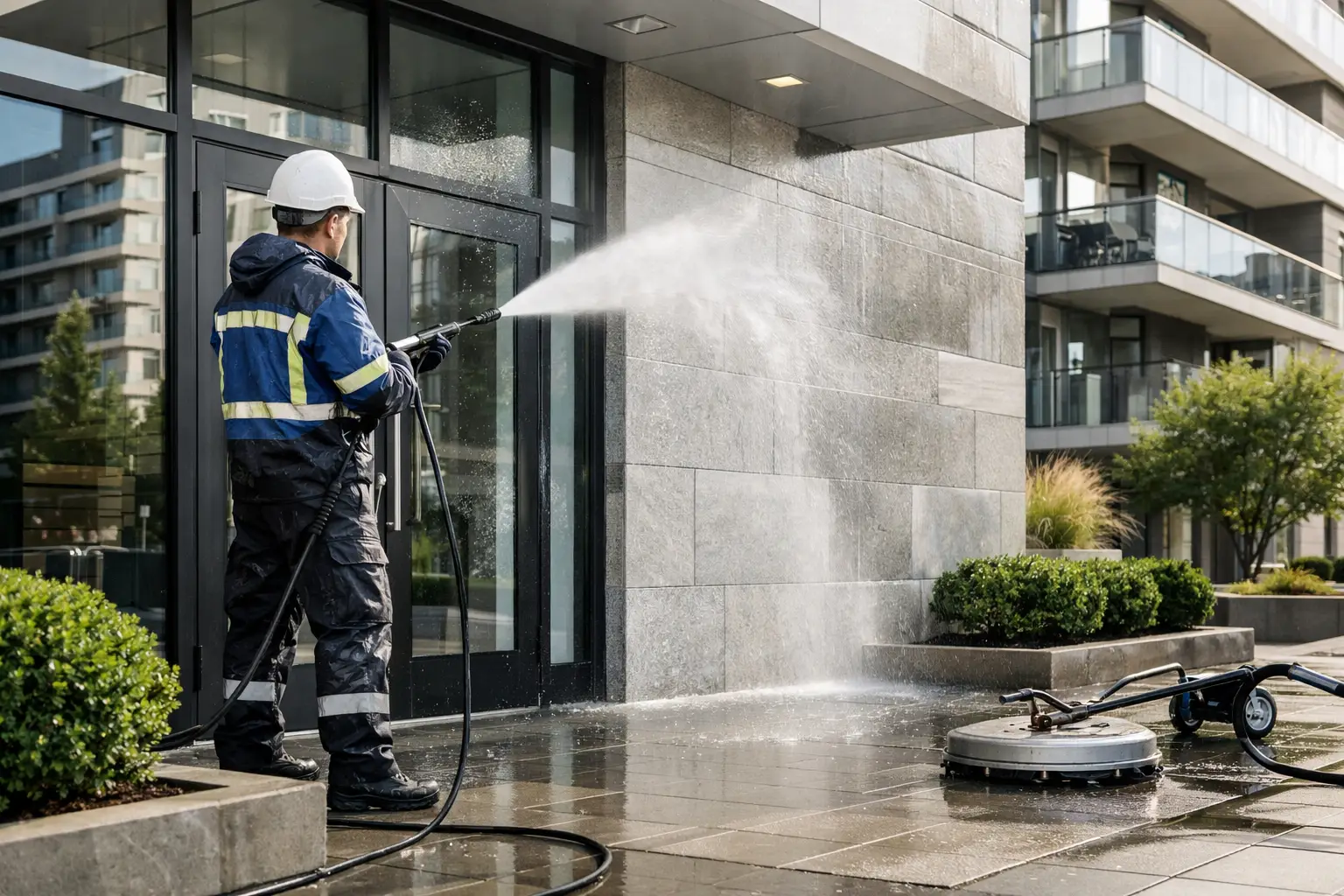
A façade marked by pollution, black streaks under the joints, a sidewalk that dulls the main entrance — for a property manager or commercial owner, these are never minor details. Exterior commercial building washing directly impacts the site’s image, the durability of materials, and the perception of occupants, visitors, and tenants. When maintenance is well-planned, it also prevents dirt buildup from becoming a costlier problem to fix.
Why exterior commercial building washing really matters
On a commercial building, the exterior is constantly exposed to weather, fine dust, urban residue, moss, rust streaks, and organic deposits. In Montreal, Laval, and on the North Shore, freeze-thaw cycles, de-icing salts, and moisture further accelerate this visual and structural wear.
The first priority is presentation. A clean façade, neat entrances, and well-maintained exterior surfaces immediately strengthen the site’s image. For a retail space, office building, multi-unit property, or condo, this influences the perceived quality of management.
The second priority is more practical. Accumulated dirt isn’t just unsightly. On certain surfaces, it traps moisture, speeds up the aging of finishes, and encourages stubborn stains. The longer you wait, the more intensive the cleaning required, with a higher risk of damaging materials if the intervention is poorly executed.
Not all surfaces are cleaned the same way
This is often where the difference lies between a basic cleaning and a truly professional job. Pressure washing is a familiar term, but in practice, pressure is just one factor. The material’s nature, its condition, age, and type of grime must guide the method.
Brick isn’t treated like aluminum. Stucco, architectural stone, painted metal cladding, concrete slabs, or interlocking pavers don’t tolerate the same pressure levels or cleaning agents. Too much pressure can erode joints, mar surfaces, lift finishes, or force water into sensitive areas.
Conversely, a method that’s too gentle leaves residue, requires redoing the work, and delivers uneven results. The right exterior commercial building washing relies on a simple but essential assessment: what material, what contamination, what method, what action level, and in what order.
Most common types of grime
On commercial buildings and multi-unit properties, you often find a mix of urban dust, atmospheric pollution, algae, surface mould, gum, grease in service areas, mineral efflorescence, and runoff stains. These contaminants don’t adhere the same way.
Some come off with controlled rinsing and an adapted detergent. Others require dwell time, localized brushing, or multi-pass cleaning. This is also why a quick price per square foot doesn’t tell the whole story about the quality of the job.
What a solid intervention plan should include
A reputable provider doesn’t start by pulling out equipment. They start by scoping the job. This includes identifying surfaces, flagging fragile areas, site access, pedestrian traffic, proximity to windows, air intakes, signage, and managing wastewater.
In a commercial setting, the goal isn’t just to clean. You also need to avoid disrupting site activities. Depending on the building, it may be best to work early in the morning, outside peak hours, or in phases to keep access open.
A solid plan also includes protecting sensitive elements like hardware, certain signage, aging joints, nearby landscaping, or surfaces that could react to certain cleaning agents. This level of execution matters just as much as the final result.
How often should exterior washing be scheduled?
There’s no universal frequency — and that’s often the wrong question. The right question is: how quickly does your building get dirty, and which surfaces degrade visually or structurally the fastest?
A building along a busy road doesn’t behave like one set back from traffic. A heavily trafficked main entrance, a north-facing façade that stays damp, or a delivery zone exposed to oils and splashes will need different monitoring than the rest of the building.
In many cases, an annual intervention is enough to maintain a good appearance on façades and access points. But some properties benefit from seasonal or targeted maintenance, especially for sidewalks, interlocking pavers, welcome areas, and surfaces where buildup is visible quickly. Regular, controlled maintenance is better than a heavy overhaul every three years.
Pressure washing or soft washing: the right choice depends on the surface
Pressure washing is effective, but it’s not always the best solution. On durable mineral surfaces like certain concretes or pavers, it quickly removes heavy buildup. On more sensitive finishes, reduced-pressure washing or chemical application can deliver better results with less risk.
The key is control. Pressure, flow rate, water temperature, working distance, and application angle drastically change the impact on the surface. A well-executed job isn’t about hitting hard. It’s about removing dirt without damaging the building.
For a property manager, this nuance matters. Aggressive cleaning that weakens joints or marks finishes always costs more in the long run than a slightly more technical but tailored method.
What decision-makers should check before hiring a provider
The issue isn’t just the price. For an exterior commercial building washing mandate, operational reliability makes a real difference. You need to rely on a team that understands access constraints, respects deadlines, and works cleanly on an occupied site.
Ask how surfaces will be assessed, which method will be used based on materials, how sensitive areas will be protected, and how the job will be sequenced. If the answer is vague or one-size-fits-all, the risk is real.
Also verify whether the provider regularly works in environments similar to yours. A street-level retail space, a multi-unit building, a condo, or a post-construction site don’t share the same constraints. A company specializing in demanding mandates will typically be better at adjusting its approach to the site.
When site conditions change the method
A building may look simple to clean in photos, but become much more technical on-site. Restricted access, active parking, tight surroundings, ongoing construction, varying heights, recently renovated surfaces, or a mix of old and new materials — all these factors require adjustments.
This is precisely where a partner like Nickel & Krome adds value. The goal isn’t just to clean quickly, but to deliver a clean, consistent, and safe result without improvisation on a site that keeps operating.
Exterior washing as a maintenance tool
This service is often associated with appearance, but it’s also part of preventive maintenance. Regular cleaning helps spot issues faster: worn joints, abnormal streaks, cracks, runoff zones, repetitive deposits, or localized finish degradation.
In other words, a clean façade is easier to read. For maintenance teams, this is useful. It’s easier to distinguish what’s just dirt buildup from what signals a technical intervention that needs planning.
This logic also applies to ground surfaces. Regularly cleaned interlocking pavers or concrete stay more presentable, but they also make it easier to spot early subsidence, open joints, or water-retaining areas sooner. Cleaning isn’t isolated from the rest of property management. It’s part of a site’s overall upkeep.
A lasting result requires more than a single pass
A building may look clean right after the job, but reveal overlooked traces days later if the work was rushed. Shadowed areas, drips under overhangs, base walls, thresholds, and equipment perimeters are often where superficial cleaning shows.
Quality is about consistency. Uniformity of finish, respect for materials, attention to detail, and coordination with site constraints. This is what commercial property owners, condo boards, and managers look for in a provider — someone easy to work with, capable of intervening without creating a second problem around the first.
When exterior washing is treated as a technical operation rather than a quick clean, the building stays in better shape, heavy interventions are less frequent, and the site’s image stays in line with what’s expected of a well-managed property. This is often where the difference lies between maintenance done out of necessity and maintenance done with control.
Apply this guide to your property
Review the scope, access requirements and service details for Commercial pressure washing in Montreal, Laval, and the North Shore.