
Effective commercial interlocking paver cleaning
Commercial interlocking paver cleaning removes stains, moss, and grime to maintain appearance, safety, and surface durability for high-traffic areas.
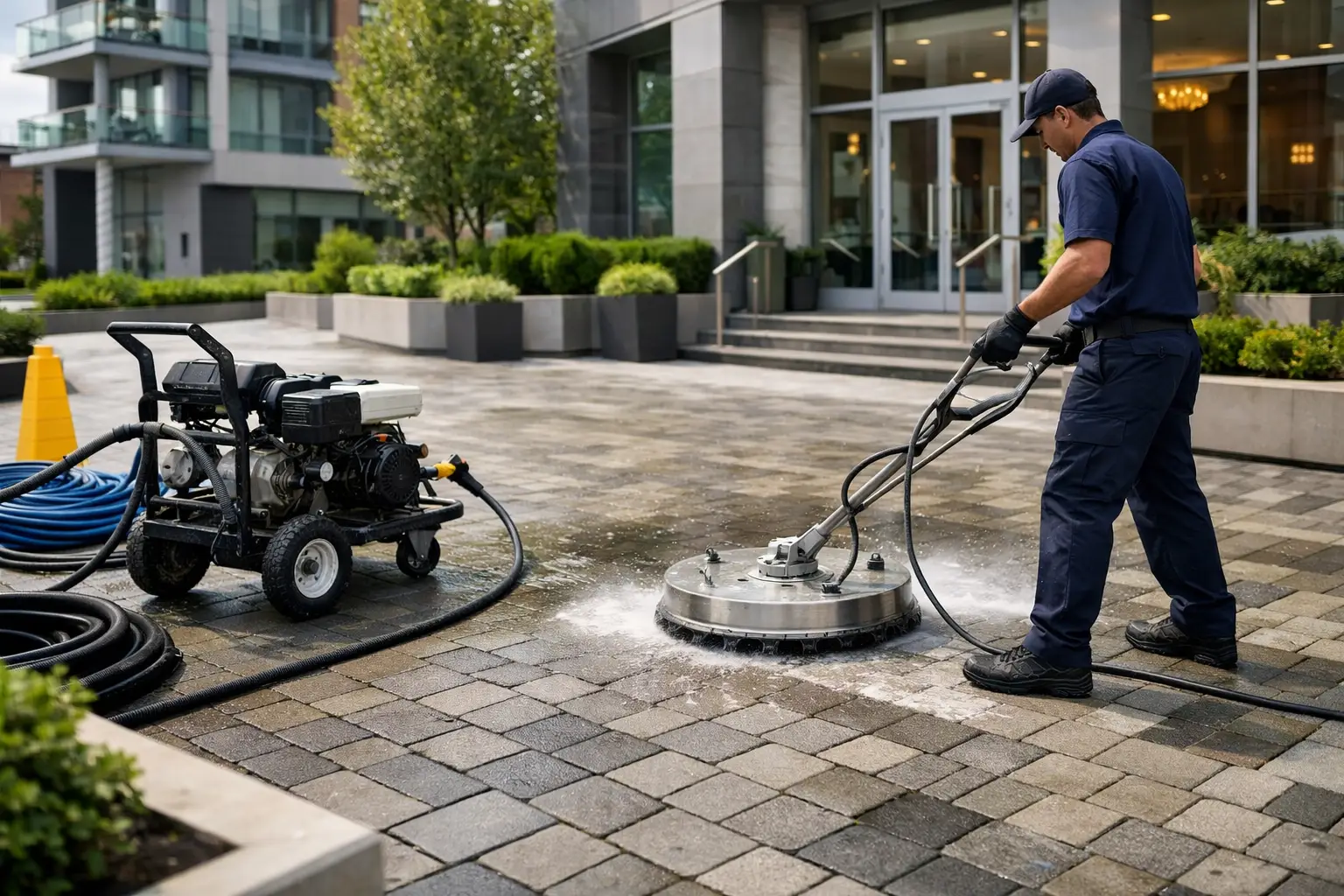
A dirty interlocking paver surface is noticeable before a customer even enters the building. Black stains, efflorescence, moss in the joints, grease deposits near delivery zones—on a commercial site, these details immediately suggest neglect. Commercial interlocking paver cleaning isn’t just about aesthetics. It’s a maintenance intervention that protects the building’s image, reduces slip hazards, and helps extend the surface’s lifespan.
For property managers, commercial owners, or maintenance supervisors, this is a practical issue. It’s not simply about “cleaning outside.” You need to know what to remove, at what pressure, when during the year, and how far to go without damaging the joints or displacing materials. This is where specialized expertise makes the difference.
Why commercial interlocking pavers degrade faster
On commercial properties, interlocking pavers face far greater wear than residential installations. Frequent pedestrian traffic, vehicle maneuvers, oil splashes, tire marks, de-icing salts, and urban dust create an abrasive, soiling mix. Even high-quality pavers lose their appearance if maintenance is delayed.
Quebec’s climate adds another challenge. Freeze-thaw cycles weaken joints, sometimes lifting sections and trapping moisture. Surfaces that stay damp longer become more prone to moss, algae, and organic buildup. In shaded or poorly ventilated areas, grime accumulates faster than expected.
You also need to consider the space’s function. A main entrance, commercial terrace, walkway between buildings, or the perimeter of a multi-unit property doesn’t endure the same stresses. A good cleaning plan isn’t one-size-fits-all—it depends on the site’s actual use.
What commercial interlocking paver cleaning must really address
When people think of cleaning, they often picture visible dirt. In reality, multiple contaminants can coexist on the same surface. Compacted dust and traffic marks form the base of grime. Add to that grease stains, organic residues, moss in the joints, rust marks, or mineral-related whitish film.
Not all these issues are treated the same way. Too much pressure can strip the surface finish, destabilize joints, and displace polymeric sand. Conversely, a light intervention leaves contaminants that will continue to trap moisture and dull the site. The right result comes from balancing mechanical action, washing methods, and finishing suited to the paver’s condition.
Commercial interlocking paver cleaning: the method that avoids callbacks
A well-executed job starts with a site assessment. Before any work begins, you need to observe stain types, joint condition, any settling, weed presence, and proximity to façades, windows, doors, or drains. This step helps avoid process errors and surprises.
Assessment and surface preparation
Preparation is often underestimated, yet it determines the final result. Loose debris must be removed, sensitive areas marked, and heavy contaminants identified. On some sites, targeted pre-treatment is needed to loosen grease or reduce organic buildup before the main wash.
This phase also helps plan water runoff and limit overspray onto adjacent surfaces. In a commercial setting, this matters. You don’t treat paving in front of a rental entrance, storefront, or service dock the same way as a private yard with no traffic.
Controlled washing and joint protection
Pressure washing remains an effective tool, provided it’s controlled. The question isn’t about pushing the machine to its max, but using the right pressure level, angle, and distance. The goal is to extract embedded grime without emptying joints or eroding between pavers.
This is where improvised work often leads to extra costs. A paver that looks clean at first glance but has empty joints becomes more vulnerable to water infiltration, weeds, and surface movement. Short-term, the visual effect may seem satisfactory. Medium-term, maintenance becomes heavier.
Resanding and stabilization
After thorough cleaning, resanding is often necessary. This step restores stability to the surface, helps limit fine material migration, and slows down weed regrowth between pavers. Again, it all depends on the site’s initial condition and the intensity of washing required.
On a heavily degraded section, a more extensive restoration may be needed instead of just cleaning. A reputable provider will say so clearly. The best service isn’t the one promising everything in one pass, but the one offering the right intervention for the surface’s reality.
Tangible benefits for commercial sites
The first benefit is visual—and it’s far from minor. The entrance of a building, the front yard of a business, or the pedestrian walkways of a multi-unit complex directly shape how the place is perceived. Well-maintained pavers reinforce the impression of rigorous management. For condos, office buildings, or commercial spaces, this visual consistency matters in relationships with occupants, visitors, and clients.
There’s also a safety aspect. Moss, algae, or greasy residue buildup can make certain areas slippery, especially after rain. Cleaning doesn’t eliminate all risks tied to outdoor surface use, but it clearly reduces avoidable slip hazards.
Finally, regular maintenance helps preserve the paving’s lifespan. Commercial interlocking pavers left untended rarely fail suddenly. They deteriorate gradually, trapping moisture, emptying joints, and allowing contaminants to settle. Acting at the right time usually costs less than a major restoration years later.
How often should you clean?
There’s no universal frequency. For some properties, an annual cleaning is enough to maintain a good appearance. For others—especially sites with heavy traffic, deliveries, or permanent shade—more frequent monitoring is preferable.
Spring is a strategic time, as it removes winter salt traces and accumulated deposits. But waiting for spring isn’t always the best choice. A commercial site with high visitor traffic may need targeted cleaning mid-season to keep a consistent look.
In the Montreal, Laval, and North Shore regions, weather conditions and usage intensity vary widely from one site to another. That’s why a site-specific approach, based on the surface’s actual condition, is more effective than a standard calendar applied to all properties.
Choosing a specialized provider over basic exterior washing
Commercial interlocking paver cleaning requires more than a pressure washer. You need to understand material behaviour, read a surface’s limits, and work without disrupting site operations. For a property manager, real value lies in execution reliability, access respect, and delivering a clean result without unnecessary callbacks.
A specialized provider also knows how to integrate this type of work into a broader building maintenance plan. This is often a concrete advantage for properties coordinating multiple indoor and outdoor maintenance needs. Nickel & Krome delivers exactly this structured approach, designed for demanding commercial and real estate environments.
A good cleaning job doesn’t aim to create the illusion of cleanliness for a few days. It delivers a clean, stable, and functional result that matches the space’s use. When the paving looks new again, joints are intact, and the entrance exudes professionalism, the building already works better for your image.
Apply this guide to your property
Review the scope, access requirements and service details for Entretien pavé uni (French).