Commercial pressure washing in Montreal
Commercial pressure washing in Montreal for façades, interlocking pavers, and outdoor common areas. Safe, effective cleaning tailored to your building’s needs.
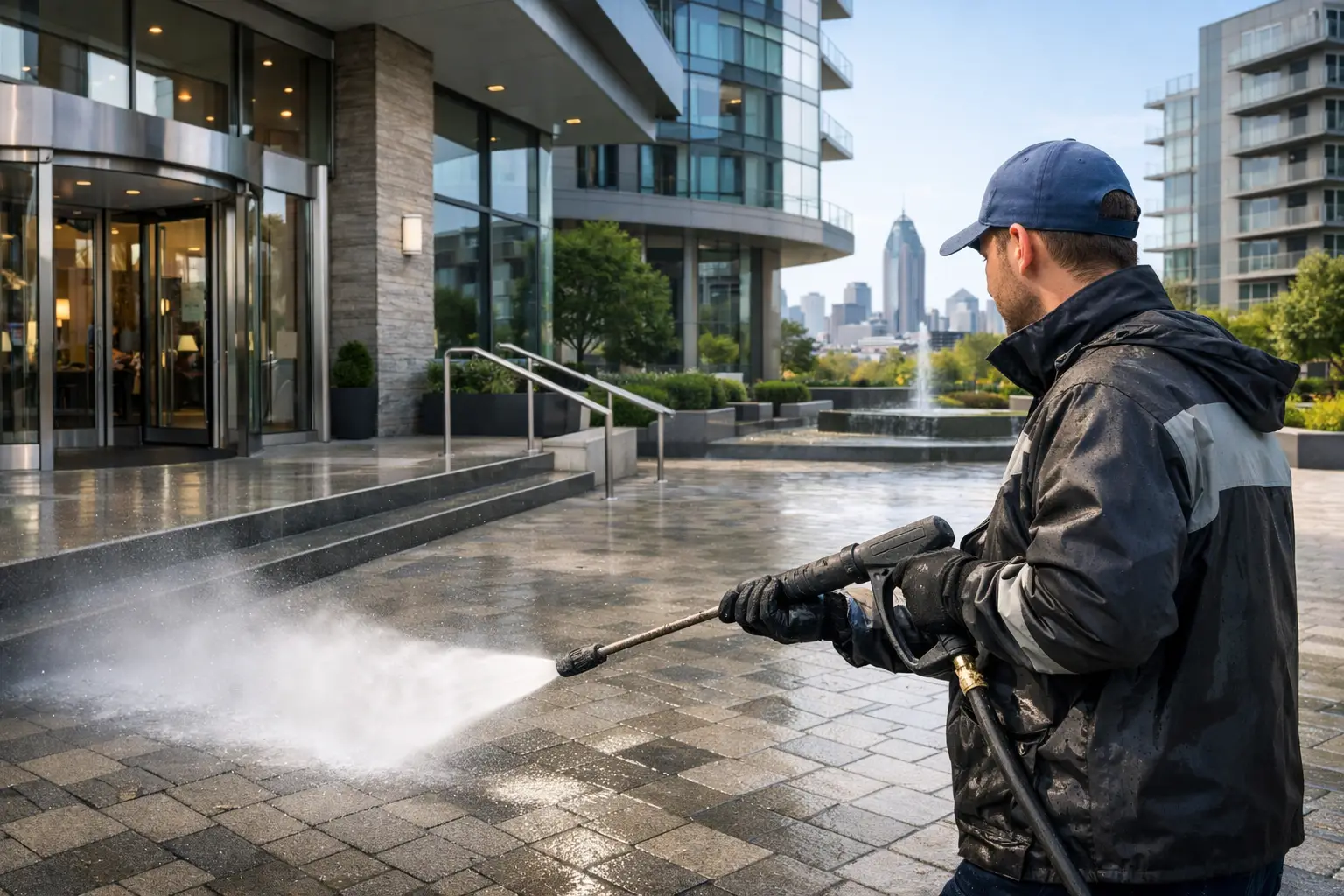
A darkened sidewalk at the entrance, an oil-stained loading dock, or interlocking pavers covered in grime immediately change how a building is perceived. In commercial real estate, commercial pressure washing in Montreal isn’t just about aesthetics—it’s a maintenance intervention that protects surfaces, enhances a building’s image, and prevents the buildup of stubborn dirt that becomes harder to remove later.
In a real estate portfolio where façades, parking lots, pedestrian walkways, and outdoor common areas are exposed to freeze-thaw cycles, urban dust, and traffic residue, a simple surface cleaning isn’t always enough. The right method must be tailored to the material, the level of soiling, and the site’s operational context. This is where the difference between a makeshift wash and a well-executed commercial cleaning service becomes clear.
Why commercial pressure washing in Montreal requires a proper method
In Montreal, outdoor surfaces face more than just the passage of time. De-icing salts, fine particles, tire marks, moss, pollution, and organic waste quickly become embedded. By spring, many buildings show dull or stained surfaces that give an impression of neglect, even when the interior is perfectly maintained.
The challenge is that overly aggressive pressure washing can cause as much damage as neglect. Incorrect pressure settings can mar concrete, erode paver joints, damage certain coatings, or spray water into sensitive areas. Conversely, insufficient pressure or poor technique leaves contaminants in place, requiring a repeat cleaning.
In commercial settings, the goal isn’t just to clean quickly—it’s to achieve a clean, uniform, and lasting result without disrupting occupants, customers, or site operations.
Which surfaces benefit most from commercial pressure washing
Needs vary by property type. For commercial buildings, main entrances, sidewalks, low façades, parking lots, loading zones, and waste enclosures are often the first surfaces to address. In multi-unit residential buildings and condominiums, walkways, landings, retaining walls, curbs, common areas, and interlocking pavers require regular attention to maintain a clean and safe appearance.
Some surfaces respond well to controlled mechanical cleaning. Raw concrete, outdoor pavers, certain slabs, masonry walls, and many outdoor installations quickly regain their appearance with the right combination of pressure, flow, and treatment. Others require more caution. More porous surfaces, weakened joints, painted materials, or areas near openings should be assessed before the cleaning begins.
This is often where property managers save time by working with a specialized provider. Instead of applying the same approach everywhere, the work is adjusted to the site’s specific conditions.
Interlocking pavers, concrete, and high-traffic zones
Interlocking pavers are a good example. They collect dirt on the surface and within the joints. Effective cleaning significantly improves their appearance, but it must preserve the integrity of the entire system. If the joints are already weakened, an overly intense intervention can displace sand and accelerate deterioration.
Concrete may seem more forgiving, but it easily shows marks if the wand lingers too long in one spot. In high-traffic areas, oil or rust stains don’t all respond the same way. Sometimes, pressure washing must be combined with targeted treatments rather than relying solely on pressure.
Low façades and building entrances
Façades at ground level are particularly exposed to splashes, dust, and seasonal deposits. Regular maintenance prevents surfaces from taking on a permanently gray or stained appearance. For building entrances, the stakes are both visual and operational. It’s the first area seen by visitors, tenants, clients, or partners.
When to schedule commercial pressure washing
The best timing depends on the building and its use. In many cases, spring is the most logical time to restore surfaces after winter. Salts, abrasives, and residue accumulated during the cold season often leave persistent traces. A spring intervention quickly restores a cleaner look to the entire property.
Summer and early fall are ideal for preventive maintenance, especially in high-traffic sites. Commercial buildings with terraces, docks, reception areas, or active delivery zones may require more frequent cleaning. The frequency depends on foot traffic, activity type, and visual standards.
There are also one-time interventions. After construction, landscaping work, façade renovations, or exterior restoration, pressure washing removes dust, mud residue, material traces, and construction-related deposits. In this context, it often fits into a broader restoration strategy.
What a decision-maker should check before hiring a provider
In commercial pressure washing, price alone rarely reflects service quality. What matters is the ability to clean effectively with a consistent method and minimal disruption to site operations.
A good provider starts by assessing surfaces, access points, splash risks, water management, and scheduling constraints. On an occupied property, coordination is key. It’s important to avoid shifting the problem onto users, blocking circulation without a clear plan, or leaving partially cleaned areas during peak activity.
Expectations must also be discussed openly. Some stains come out completely. Others fade without disappearing entirely, depending on their age or the material. A reputable supplier doesn’t promise the impossible. They explain what’s realistic and what isn’t.
Normal limitations of pressure washing
Pressure washing delivers excellent results, but it doesn’t erase all signs of wear. A discoloured slab, a cracked surface, or a sunken paver won’t return to like-new condition with cleaning alone. Similarly, deeply embedded stains may require additional treatments, and sometimes partial restoration is the best option.
This nuance matters for property managers. An honest assessment is better than a quick promise followed by disappointing results.
Outdoor maintenance that supports building operations
When outdoor surfaces are well maintained, the benefits go beyond appearance. Access points are more welcoming, common areas project a more polished image, and the entire site appears better managed. For a business, this influences perceptions of professionalism. For a condominium or multi-unit building, it contributes to tenant satisfaction and the perceived value of the property.
There’s also a preventive logic at play. The longer contaminants remain on surfaces, the harder they are to remove. Regular maintenance limits heavy buildup and helps preserve materials in better overall condition. From a budgetary standpoint, it’s often more cost-effective than a late-stage, heavy-duty restoration.
In Greater Montreal, where buildings must contend with a demanding climate and intensive use, pressure washing is part of a true maintenance strategy. This is especially true for managers who want to consolidate interior, exterior, and post-construction cleaning with a partner capable of consistent service. This operational logic guides specialized companies like Nickel & Krome.
Choosing an approach tailored to the site, not a one-size-fits-all solution
Every property has its constraints. A street-level business doesn’t have the same needs as an industrial park. A condominium with interlocking pavers, landscaped curbs, and pedestrian access requires different planning than a building with docks and heavy traffic. The right service is based on a precise reading of the terrain, materials, and expected results.
When commercial pressure washing in Montreal is well planned, it doesn’t just make things clean for a few days—it credibly restores surfaces, supports the building’s presentation, and simplifies long-term management. For a decision-maker, it’s often the difference between reactive maintenance and a property that remains visibly under control.
The right time to act is usually before grime becomes the new normal for the site.
Apply this guide to your property
Review the scope, access requirements and service details for Commercial pressure washing in Montreal, Laval, and the North Shore.