
Properly managed common-area cleaning
Common-area cleaning requires method, frequency, and follow-up. Here’s how to keep a building clean, safe, and well-presented.
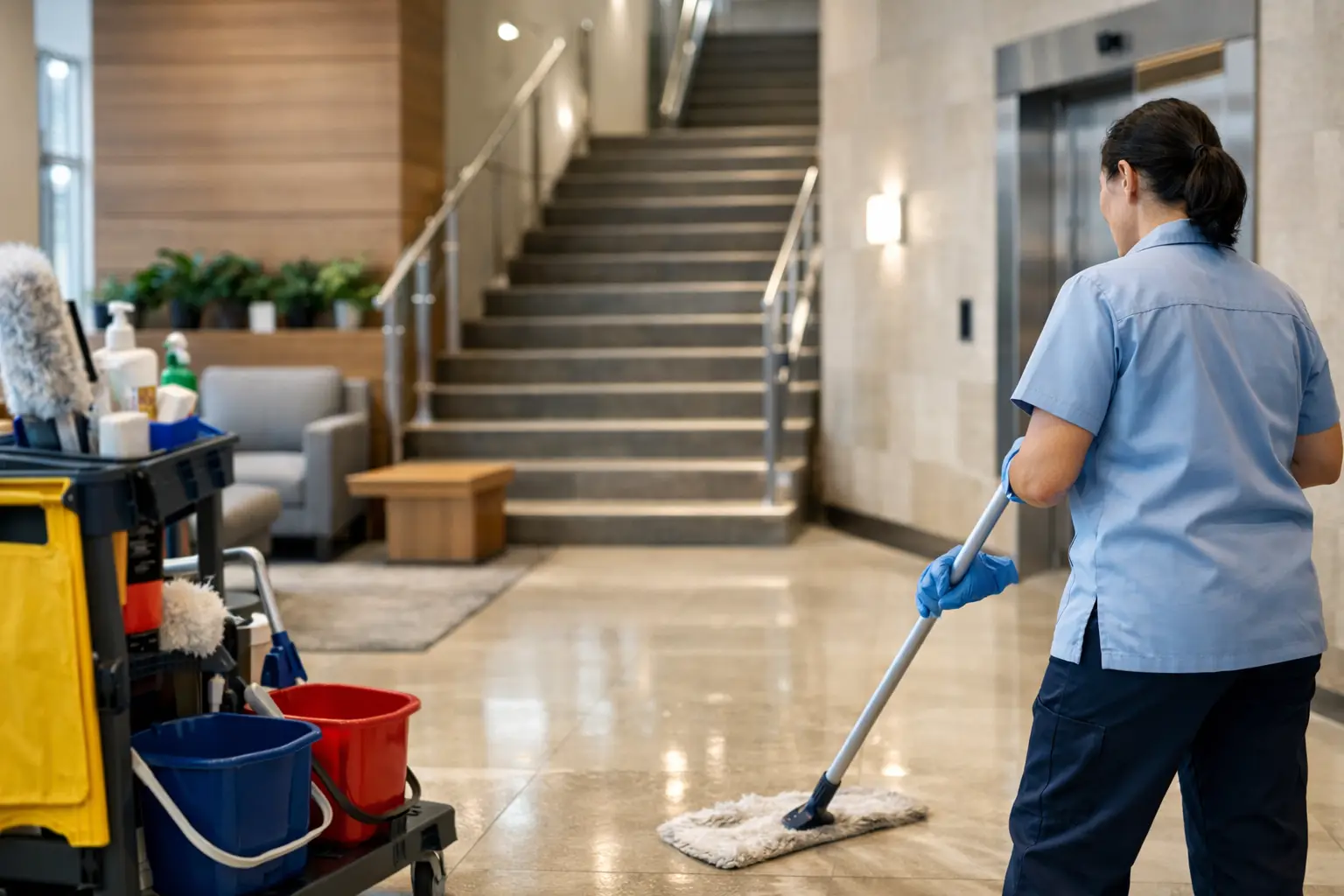
A neglected lobby, a stairwell with marks, or an elevator with visible stains are enough to tarnish the perception of a building. In multi-unit residential, commercial, or mixed-use buildings, cleaning common areas is more than just a maintenance task. It’s a direct lever on the building’s image, occupant satisfaction, and the durability of surfaces.
For property managers or maintenance supervisors, the stakes are concrete. They must maintain a consistent level of cleanliness, limit premature wear, manage unexpected issues, and prevent maintenance from becoming a source of complaints. In this field, the difference rarely lies in the promise. It’s about method, frequency of intervention, and quality of execution.
Why common-area cleaning requires a real method
Common areas bear the brunt of all traffic. They absorb entries and exits, moisture, dirt tracked in from outside, handprints, residue in corners, and wear from daily movement. Irregular maintenance quickly gives an overall impression of neglect, even if the rest of the building is well-kept.
This is especially true in lobbies, corridors, stairwells, elevators, vestibules, mail rooms, laundry rooms, and shared spaces. Each of these zones has its own constraints. An entryway floor must be clear and safe. An elevator requires careful attention to vertical surfaces. A stairwell needs regular focus on corners, stair nosings, and handrails.
The right level of maintenance depends on the type of building, its foot traffic, and the season. A small, low-traffic residential building won’t have the same needs as a high-density condo or a commercial building with daily traffic. Applying the same routine everywhere often leads to either overpaying or under-maintaining.
Which zones should be included in effective maintenance
A poorly defined contract almost always creates blind spots. The problem doesn’t appear right away, but complaints soon arise over specific details—dull entryway windows, lingering odours, sticky floors, cobwebs in corners, or buildup near baseboards.
A consistent maintenance plan must cover all visible areas and high-contact zones. This typically includes floors, entryway mats, handrails, doorknobs, mailboxes, accessible glass surfaces, mouldings, ledges, baseboards, elevators, stairwells, and common rooms. Depending on the building, it may also include garages, waste rooms, or immediate outdoor access points.
The key point is simple: a clean common area isn’t just about a quick sweep. It relies on a logical sequence of dusting, picking up, washing, targeted disinfection, and a final visual check. Without this rigour, some surfaces may look acceptable from a distance but remain dirty up close.
Zones that get dirty faster than you think
Doorknobs, light switches, elevator buttons, handrails, and door frames quickly accumulate grime. Yet these points are often treated too hastily or overlooked between visits. They’re precisely the elements occupants touch and notice the most.
Corners, undersides of stairs, edges of mats, and threshold grooves are also telltale signs of the true quality of service. A thorough cleaning doesn’t stop at central, visible surfaces. It addresses the areas where dirt builds up and where the impression of neglect sets in first.
How often should you intervene
The ideal frequency depends on foot traffic volume, weather, flooring type, and the site’s cleanliness standards. In winter, entries and corridors degrade faster due to water, calcium, and abrasives. After even minor renovations, fine dust spreads throughout the building. In a well-occupied condo, some zones may require multiple weekly cleanings.
There’s no universal schedule. In some buildings, twice-weekly maintenance is enough. In others, daily visits to main access points and elevators are necessary. The most effective approach is to adjust frequency by zone rather than imposing a uniform schedule. The main entrance and elevator don’t always have the same needs as secondary floors.
This method avoids two common mistakes. The first is paying for unnecessary tasks in low-traffic areas. The second, more costly in the long run, is letting critical surfaces deteriorate until they require major restoration.
What a reliable provider should bring to the table
A good provider doesn’t just sell hours. They should translate the building’s needs into a clear intervention plan. This means defining zones, specifying tasks, recommending a realistic frequency, and executing consistently.
Consistency matters more than talk. In common areas, occupants notice immediately if quality varies from one visit to the next. A building may look spotless for two weeks, then lose its shine quickly if follow-up isn’t rigorous. This is often where managers end up dealing with avoidable returns, oversights, or redo work.
A specialized provider must also understand more demanding contexts. After renovations, for example, routine maintenance isn’t enough. A targeted restoration is needed to remove fine dust, window streaks, residue on frames, and floor grime. This is a different job than simple upkeep.
Signs of poorly calibrated maintenance
When a building looks clean in the morning but tired by midday, the issue often stems from timing or scope. When occupants repeatedly report the same issues—odours, elevator stains, dirt near the entrance—it’s rarely an isolated incident. It usually means the service doesn’t match the site’s reality.
Another useful indicator is the condition of surfaces over time. A dull floor, clogged grout, or saturated entryway mats show that maintenance may be happening, but preservation isn’t. Good maintenance also delays visible wear and more costly corrective work.
Common-area cleaning in high-demand buildings
In Montreal, Laval, and the North Shore, buildings face highly variable conditions depending on the season, occupancy type, and ongoing work. Salt, humidity, mud, construction dust, and heavy traffic put common areas to the test. Standard maintenance quickly shows its limits.
That’s why managers often look for a partner who can cover multiple needs without multiplying service providers. Regular common-area cleaning, post-construction restoration, and maintenance of certain outdoor surfaces all follow the same logic: keeping the building presentable, functional, and cohesive.
At Nickel & Krome, this specialized approach precisely meets the needs of environments where execution must be precise. Not just to make things look clean at first glance, but to maintain stable quality over time—even when site conditions are more technical.
How to better manage this expense without complicating oversight
For the client, simplicity matters as much as quality. Well-managed maintenance relies on a clear framework from the start. You need to know who does what, how often, at what level of detail, and how adjustments will be handled. When these elements aren’t defined, every oversight becomes a discussion.
The most useful approach is to think in terms of expected results. An entrance should stay neat and safe. Accessible windows should maintain a clean appearance. Floors should be free of visible stains. High-contact points should be treated regularly. This logic avoids overly vague or unnecessarily complex task lists.
It’s also important to accept that a building evolves. A change in occupancy, a harsher winter, occasional renovations, or increased foot traffic may require adjustments. A good maintenance system isn’t rigid. It should adapt to the building’s reality without starting from scratch.
Common-area cleaning is often judged on details, but its effects go much further. It reassures occupants, protects the property’s image, and reduces the impression of neglect. When the method is right, you barely talk about cleaning anymore. You talk about a building that holds its standard, day after day.
Apply this guide to your property
Review the scope, access requirements and service details for Recurring common-area cleaning for condos and managed buildings.