
Underground Parking Garage Cleaning Guide
A practical guide to underground parking garage cleaning for property managers, condo buildings and commercial sites: method, frequency, safety and long-term surface protection.
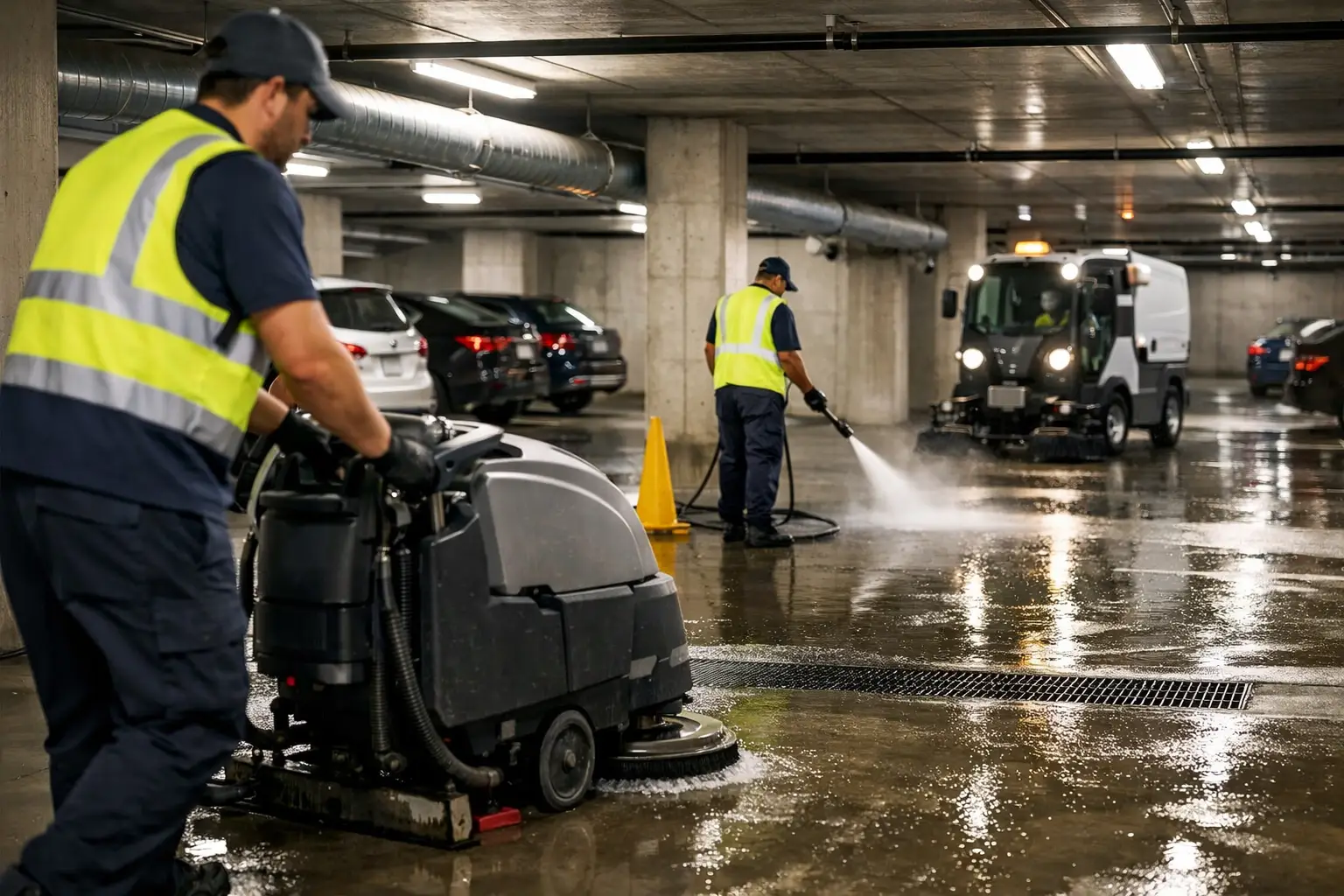
An underground parking garage that is poorly maintained quickly becomes visible — and noticeable. Moisture odors, black dust spreading into lobbies, oil marks expanding across the concrete, abrasion caused by sand, and winter salt buildup all create real issues for property managers, condo buildings and commercial properties.
Underground parking garage cleaning is not only about appearance. It affects safety, the image of the building and the long-term condition of the surfaces.
In an indoor parking area, dirt does not stay on the surface. It settles into concrete, moves toward drains, collects in corners, around columns and along curbs. The longer maintenance is delayed, the heavier the intervention becomes, the higher the risk of deterioration, and the more expensive the restoration can be. The right approach is to treat the garage as a technical building area, with a method adapted to its actual use.
Why underground parking garage cleaning requires a real method
An underground parking garage faces a combination of conditions rarely found in other common areas. Vehicles bring in water, calcium, mud, gravel, hydrocarbons and fine debris. This is combined with constant traffic, sometimes limited ventilation, and sensitive equipment such as drains, motorized doors, extinguishers, sprinklers or electrical charging stations.
A quick pass is not enough. Sweeping without capturing fine dust can put particles back into the air. Washing without removing heavy debris first can create mud. Using too much water in a poorly drained area can move the problem instead of solving it. Proper cleaning must follow a logical sequence, with the right products, equipment and intervention rhythm for the site.
Priority areas to clean in an underground parking garage
Not all garages get dirty the same way. Access ramps are often affected first, especially after snow, thawing and freeze-thaw periods. Salt, gravel and water accumulate there quickly. Main traffic lanes collect compacted dust and tire marks.
Parking spaces have another profile. They often contain oil, antifreeze or mechanical fluid stains, sometimes old and already absorbed into the concrete. Blind spots, column bases, edges and wall-side areas concentrate deposits that routine passes often leave behind.
Drains must also be included in the maintenance plan. A garage can look visually cleaner while still remaining risky if drainage points are obstructed.
The right intervention sequence
The first step is a site assessment. The team must check the level of soiling, identify active stains, observe water flow toward drains and confirm access constraints. Depending on building occupancy, the work may need to be done by zones, overnight, early in the morning or according to a schedule coordinated with property management.
Next comes mechanical pre-cleaning. This step removes sand, heavy dust, debris and abrasive particles before any washing. It is essential, especially after winter in the Montreal, Laval and North Shore region, where the salt-gravel mix acts like sandpaper on surfaces and is quickly redistributed by vehicle tires.
The washing phase depends on the level of soiling. On some surfaces, mechanical scrubbing with recovery is enough. In other cases, targeted pressure washing is more effective, as long as it is controlled properly to avoid spreading contaminants. Greasy stains often require localized treatment before machines pass through. The key is to recover dirty water whenever possible and avoid simply pushing deposits toward the drains.
Finishing also matters. A visual inspection makes it possible to correct missed areas, check edges, corners and intersections, and ensure traffic can resume safely. In an occupied environment, the quality of execution depends not only on the visible result, but also on the ability to complete the work without unnecessarily disrupting the building.
How often should an underground garage be cleaned?
There is no single frequency that applies to every building. A small residential garage with low traffic does not need the same approach as a dense condo building or a commercial site with frequent vehicle movement. The right schedule depends on traffic, season, occupant profile, delivery areas and the condition of the concrete.
In practice, light periodic maintenance helps limit buildup between deeper cleanings. After winter, a more complete intervention is often needed to remove salt, abrasives and heavy residue. In higher-traffic buildings, a second major cleaning during the year may be justified.
Waiting until the garage looks visibly dirty is rarely the best strategy. Visible dirt often appears after deterioration has already started.
Costly mistakes to avoid
The most common mistake is underestimating the impact of salt and fine particles. Many parking garages are cleaned too late, once residue has already marked the surface or affected drains.
Another mistake is choosing an approach that is too light for a technical environment. Surface cleaning may improve appearance for a few days without treating the underlying problem.
There is also a balance to maintain between speed and results. A rushed intervention may seem cost-effective at first, but if it leaves deposits along edges, around column bases or in sloped areas, the site will deteriorate again quickly. On the other hand, cleaning too aggressively, with the wrong pressure or product, can damage markings, joints or coatings.
What a property manager should verify before hiring a provider
The provider must understand that an underground parking garage is not just a floor to wash. They must be able to work in an occupied building, plan access, manage critical zones and use equipment adapted to height, circulation and ventilation constraints.
The method should be clear. How will stains be treated? Are drains included? Will dirty water be recovered? Can the intervention be done in phases if the garage cannot be fully emptied? These questions are more useful than a general promise of cleanliness.
For property managers and condo syndicates, consistency matters as much as one-time performance. A reliable partner does not only show up when the situation becomes critical. They help maintain the site at a stable standard, with a coherent schedule and a realistic understanding of the building’s needs.
Cleaning as a preservation tool
A clean parking garage improves the building’s image, but that is only part of the benefit. Proper maintenance limits the spread of corrosive residue, reduces abrasive wear and helps maintain safer circulation conditions for occupants and maintenance teams.
It also makes surface inspection easier. Cracks, infiltration points and defects are easier to see when the floor is not covered by layers of deposits.
This is where maintenance logic becomes more important than simple cleaning logic. In many cases, a well-calibrated maintenance program costs less than a heavy restoration after several seasons of neglect. For a property manager, that means fewer surprises, fewer complaints and better overall building condition.
When to call a specialized team
Specialized intervention becomes relevant as soon as an underground parking garage combines heavy traffic, winter residue, mechanical stains and operational constraints. This is especially true in multi-unit buildings, large condo properties and commercial sites where the image of the property and continuity of operations matter as much as the final result.
Nickel & Krome brings this field-based approach: adapting the method to the building, working with discipline and delivering a clean result without complicating site management.
For property managers, this is often what separates a decent one-time cleaning from a truly controlled maintenance approach.
An underground parking garage should never be seen as an extra. It is a sign of serious building management, proper prevention and respect for occupants. When maintenance is done at the right time, with the right method, the entire building benefits beyond the garage floor.
Apply this guide to your property
Review the scope, access requirements and service details for Sweeping, washing and restoring underground parking lots.
View the documented occupied-garage project in Montreal (French)