
Underground Parking Garage Maintenance Priorities
Set garage maintenance priorities around dust, salt, vehicle traffic, drainage and access, with a cleaning plan adapted to the building and the season.
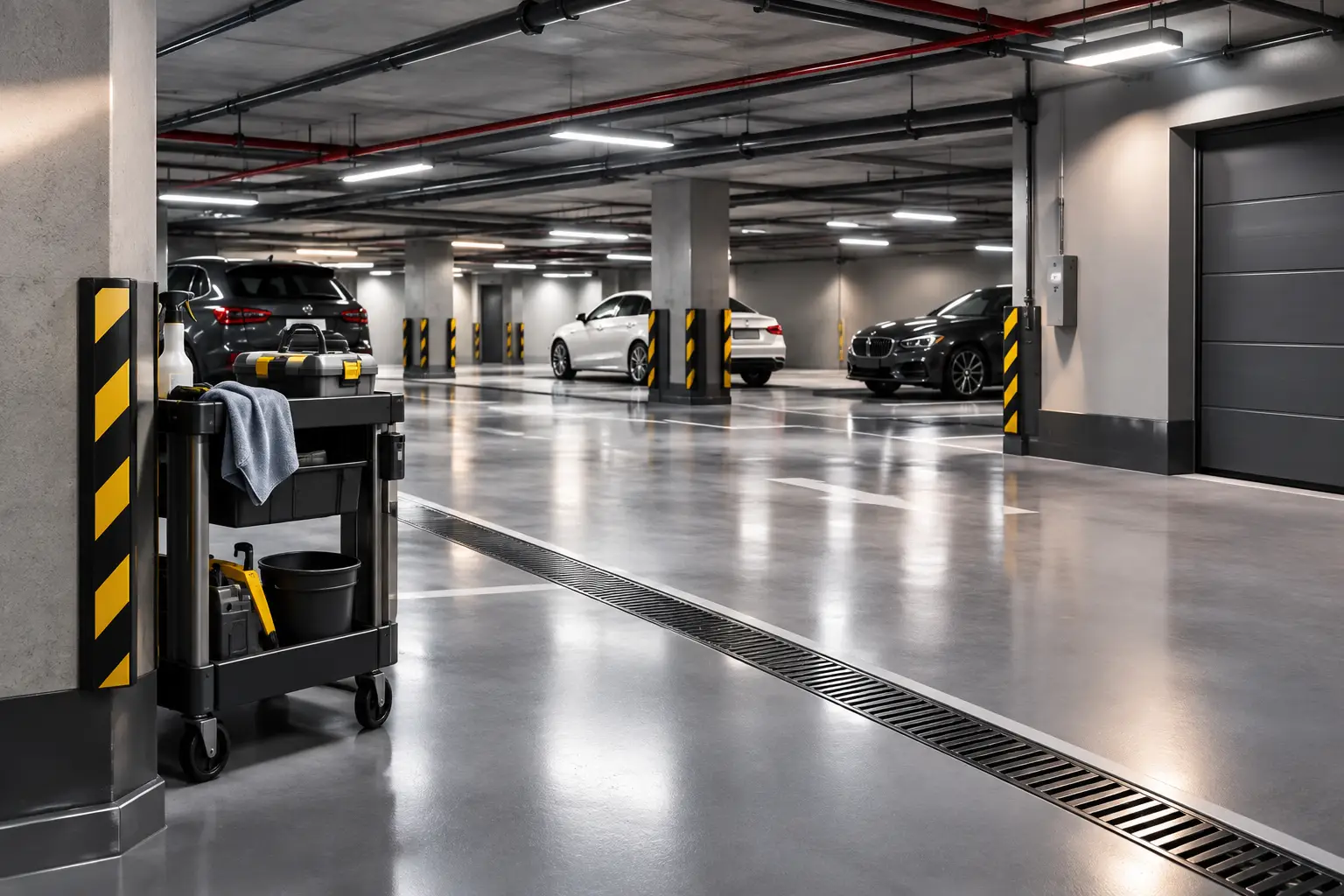
A basement garage may appear clean at first glance, yet problems are already accumulating: abrasive sand near entrances, black stains at turns, stagnant water around drains, fine dust on pipes, and a persistent odour near the waste room. For a property manager or condo board, the cleaning priorities of a basement garage are not limited to sweeping. They include safety, the lifespan of surfaces, and the perception of residents from the moment they arrive at the building.
The proper order of operations depends on the traffic, the season, the ventilation, and the overall condition of the garage. A condo building with several vehicles entering and exiting every day does not have the same needs as a low-traffic parking lot in the evening. Some tasks must be integrated into regular building janitorial services; others require specialized cleaning with the appropriate equipment.
Priority Cleaning Tasks for a Basement Garage
The first priority is to control what quickly creates a risk or a complaint. In Quebec, spring is often the most demanding period. The meltwater brings salt, sand, calcium, and road residue into the aisles. Once dried, these deposits become a dust that moves with tires, settles on walls, and dulls the floors.
You must then protect the elements that are expensive to repair: drains, concrete flooring, floor markings, garage doors, baseboards, columns, and ventilation systems. Finally, the cleaning must preserve a safe circulation and a consistent appearance with the rest of the building. A pristine lobby loses its effect if the garage is dirty, damp, or smelly.
1. Remove sand, salt, and debris before they become embedded
Mechanical sweeping or vacuuming of circulation areas remains the foundation of an operational cleaning. Entrances, ramps, turns, parking spaces near elevators, and pedestrian paths require extra attention, as tires concentrate dirt there. The goal is not just visual: sand acts as an abrasive under wheels and shoes, which accelerates the wear of surfaces.
After winter, a complete wash may be necessary to remove salt stains and stuck residue. However, you must take into account the capacity of drains and the building's water management rules. Washing too quickly, without adequate sweeping or flow control, can move the dirt toward the drains rather than remove it. An experienced team evaluates the access, drainage, and sensitive areas before choosing the method.
2. Keep drains functional and wet areas under control
A clogged drain quickly turns a small leak into a puddle, then into a slip hazard. In a basement garage, water can also carry oil, dust, and fine particles to the lowest points. Property managers should regularly check the grids, gutters, and approaches to drains, especially after heavy rain, rapid melting, or construction within the building.
Areas where water always returns require separate follow-up. Cleaning does not fix a slope, a leak, or a mechanical problem, but it helps identify the source more clearly and avoid dirt masking the situation. A follow-up photo, a note in the file, and quick communication with the person responsible for maintenance can prevent more costly work.
3. Treat oil stains without promising the impossible
Vehicle leaks are frequent in condo and multi-residential garages. A quick response reduces the spread and improves the appearance of the floor, especially in common areas or near visitor parking spaces. Depending on the type of stain, the age of the concrete, and the existing floor covering, targeted degreasing can give good results.
You must, however, be transparent: an old oil stain absorbed deeply into porous concrete does not always completely disappear. The desired result is then to reduce the mark, remove the surface residue, and prevent new accumulation. For recurring cases, it is useful to document the location so that the management can inform the concerned resident or plan a more thorough restorative cleaning.
4. Clean pedestrian access points and contact areas
Residents often judge the garage based on the few places they use directly: entrance door, lobby, elevator, stairwell, intercom, and corridor leading to the units. These areas accumulate footprints, dust, shoe prints, and marks on the doors. They must be included in the routine of building janitorial services, even if the full cleaning of the parking lot is done at a different frequency.
Signage, convex mirrors, buttons, ramps, and fire-rated doors also require careful cleaning. These are small details, but they contribute to a sense of a well-maintained building. In an occupied building, a consistent cleanliness in these areas reduces negative comments more effectively than a spectacular but rare intervention.
What frequency to plan for cleaning?
The frequency depends on the site conditions. In a residential garage with high traffic, entrances and pedestrian paths may require weekly attention, or more during snow and rain periods. Sweeping the aisles and removing debris can be planned every two weeks or according to real usage. A deep cleaning is often relevant in spring, then as needed in the fall before the arrival of sand and humidity.
A clinic, commercial, or office parking lot may require a different schedule, concentrated around peak hours or high traffic periods. The best program is not the one that plans the most passes. It is the one that targets the areas that actually degrade, respects the hours of occupation, and allows for clear follow-up when an incident occurs.
What a good building janitorial service includes for a garage
Building janitorial services do not simply mean sweeping the corridors. It includes planned maintenance of common areas, observation of recurring problems, and reliable communication with management. In a basement garage, this can include picking up trash, sweeping entrances, cleaning doors and contact points, maintaining pedestrian areas, and reporting clogged drains, oil stains, and unusual damage.
Specialized interventions complement this routine: floor washing, targeted degreasing, cleaning of low walls, columns, and areas marked by salt. To avoid surprises, the mandate should specify the covered surfaces, the method used, access restrictions, and how water and residues are managed. A price without clear work scope often creates unrealistic expectations.
Reduce complaints before they become a management issue
Garage-related complaints are rarely formulated in the same way. A resident may talk about odour, another about dust on their vehicle, water near their unit, or dirt in the elevator. These observations often point to the same causes: poorly maintained circulation areas, accumulated residue, infrequent cleaning, or lack of follow-up after a specific event.
A simple log helps identify trends. Note the affected areas, the date, weather conditions, the type of problem, and the action taken. This information allows adjusting the schedule rather than repeating the same fixes. It also facilitates communication with the cleaning provider, the board, and residents.
Who maintains the common areas of a condominium? A qualified building janitorial company handles the tasks outlined in the contract and reports issues that fall under maintenance or specialized work. The provider's role is not to hide a building problem, but to maintain cleanliness and give management a concrete view of the building's condition.
For managers, boards, and property owners in Montreal, Laval, and the North Shore, the team at Nickel & Krome S.E.N.C., NEQ 3381837957, offers building maintenance and basement garage cleaning focused on on-site follow-up. To plan an intervention or review the cleaning frequency of a building, you can contact the team at +1 514-974-3311. A well-maintained garage is not noticed by a promise; it is recognized when residents move through it without thinking about it, and when management receives fewer calls about it.