
Restorative Commercial Cleaning in Laval: A Guide
Plan restorative commercial cleaning in Laval by assessing surfaces, accumulated dirt, access and business hours before defining the work and follow-up.
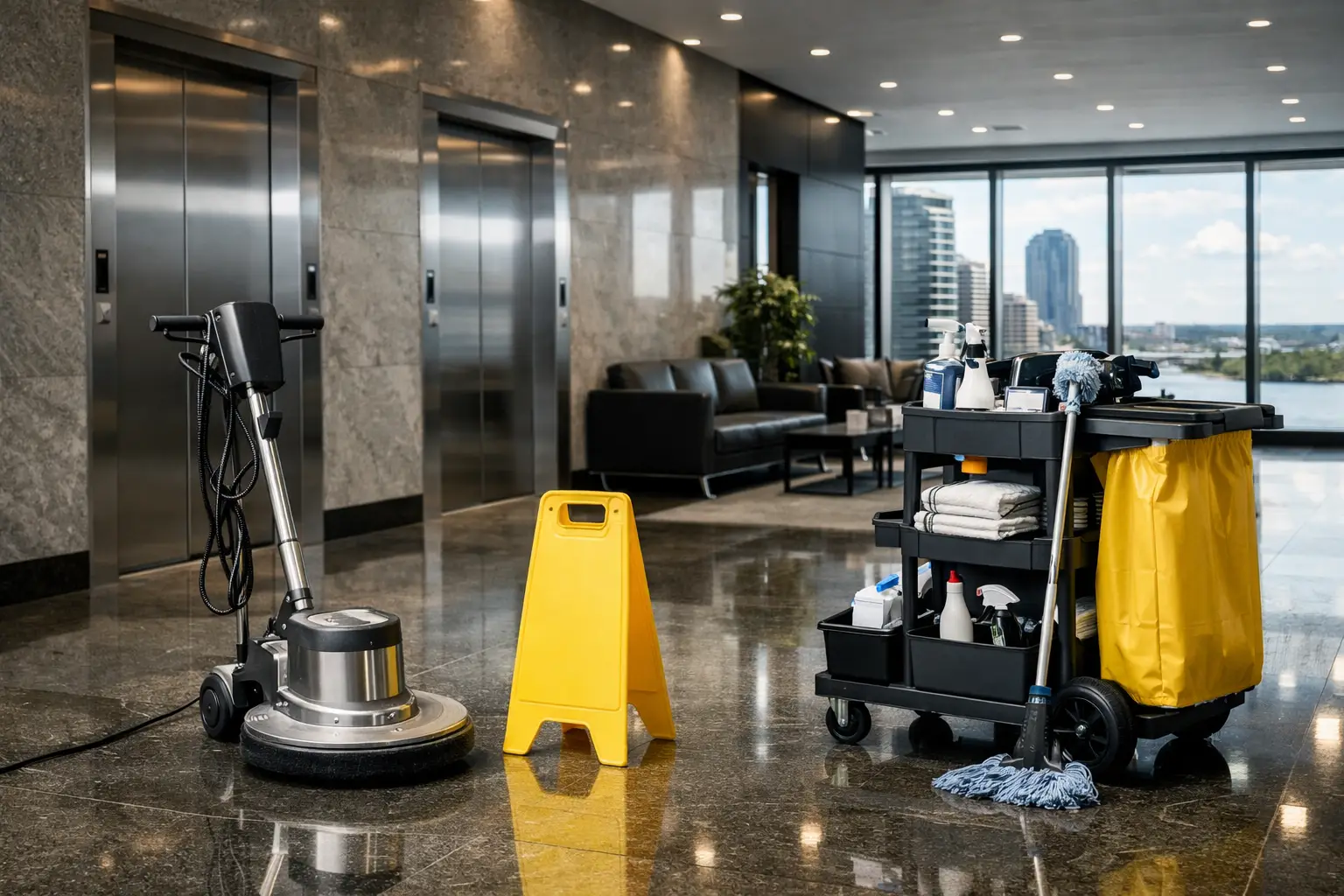
A commercial space may appear finished, but the restorative cleaning may still be incomplete. Fine dust on the baseboards, marks on the windows, residue of grout on the floor, odours in the waste room or marks on the service elevator: these are often the details that delay an opening or create a bad first impression. This commercial restorative cleaning guide for Laval is for property managers, owners and contractors who must deliver a clean, functional and presentable space after renovations, a move or a period of intensive occupation.
When commercial restorative cleaning is needed
Restorative cleaning does not correspond to regular commercial cleaning. It is required when a space has undergone a visible transformation or use that goes beyond what a regular cleaning pass can correct. After a renovation, for example, surfaces accumulate very fine dust, adhesive traces, paint splatters and material residues. In a business that changes tenants, it is often necessary to treat the marks left by display cases, reception areas, restrooms and floors.
In Laval, this intervention is frequent before an opening, a handover, an inspection, a rental visit or the reoccupation of a space by a new tenant. It may also target the common areas of a commercial building: lobby, corridors, stairwell, elevator, recycling room, loading dock or underground parking garage.
The right time depends on the condition of the construction site. An intervention too early exposes already cleaned surfaces to a new layer of dust. Too late, it may slow down the installation of furniture, equipment or goods. In most cases, the final cleaning is planned when the work generating the most dust is completed and as the finishing teams gradually leave the site.
What is included in commercial restorative cleaning in Laval
A serious restorative cleaning begins with a thorough site assessment. An empty office, a clinic, a retail space and a food store have neither the same surfaces nor the same constraints. It is necessary to identify the materials, access to water, permitted hours, areas still under construction and spaces that will be visible upon opening.
The intervention generally includes complete dusting of high and low surfaces, cleaning of frames, doors, handles, switches, baseboards and accessible ventilation grilles. Windows, mirrors, glass partitions and interior windows must be treated carefully, since the traces become very noticeable under commercial lighting.
Floors require an appropriate method. A ceramic floor may require the removal of grout film or construction marks. A vinyl floor may be marked by the movement of materials. Concrete, carpets and specialized finishes each have their limits. Using an overly aggressive product or a poorly adjusted machine may leave a dull finish, circular marks or a surface more difficult to maintain in the future.
Restrooms, rest areas and storage spaces should not be treated as secondary areas. They directly affect the comfort of employees, customers and tenants. A waste or recycling room that has not been thoroughly cleaned may also retain odours that spread through the corridors and give the impression that the entire building lacks follow-up.
Post-construction or tenant change: two different realities
The cleaning after construction aims first at the residues related to the work: gypsum dust, paint traces, silicone, tape, protective stickers and dirt brought by boots, carts and materials. It requires a methodical progression, usually from top to bottom, to avoid contaminating already finished surfaces again.
After a tenant leaves, the challenge is often different. More localized stains, accumulated dust behind equipment, floor marks, grease in certain areas and dirt related to daily use are often found. A preliminary inspection then allows distinguishing what belongs to cleaning, repair or replacement. Cleaning will not correct a cracked ceramic tile, flaking paint or a floor with a worn-through finish.
The order of work that avoids rework
The quality of a restorative cleaning depends a lot on the sequence. Starting by cleaning the floors before dusting the ceilings, light fixtures or door frames almost always creates additional work. Fine dust falls and traces reappear on freshly cleaned surfaces.
The most effective approach is to clear away remaining debris and materials, dust high areas, then treat the walls, doors, windows and fixed equipment. Restrooms and service areas follow, before the deep cleaning of the floors. A final inspection allows correcting the details that easily escape the first pass: window corners, fingerprints on handles, residue near the baseboards, dust in the tracks or marks under direct lighting.
In an occupied building, this organization must also take into account the flow. Corridors, elevators and entrances remain high-traffic areas, even when a space is undergoing restorative cleaning. Protecting and cleaning these areas at the right time reduces complaints from other occupants and preserves the building's image.
The areas that make a difference during handover
Decision-makers often look first at the entrance, windows and floors. Customers, on the other hand, quickly notice the marks on the doors, odours, restrooms and counters. However, the less visible areas are those that reveal the real level of work: inside cabinets, tops of frames, corners of ceilings, grilles, baseboards, window tracks and spaces behind doors.
In commercial businesses located in a complex or a condominium, it is also necessary to check shared access areas. Construction residues may end up in the elevator, lobby, stairwell or underground parking garage. Who cleans the common areas of a condominium or a commercial building? A janitorial services team or a specialized cleaning company may handle these areas according to an agreement with the property manager, in coordination with the work done in the space.
A well-executed restorative cleaning also protects the equipment. Thresholds, handles, elevator panels, ventilation grilles and fire doors require appropriate products and tools. The goal is not simply to shine a surface, but to remove dirt without damaging finishes, joints or mechanisms.
How to choose a restorative cleaning team
Price counts, but it should not be the only criterion. An inaccurate quote may omit important areas or plan too little time for a space that requires several steps. Before assigning the work, ask how the team evaluates the surfaces, what is included, which areas are excluded and how touch-ups will be handled before the handover.
It is also useful to specify the site constraints: access via a dock or elevator, presence of other tenants, permitted working hours, availability of electricity and water, waste disposal, parking and safety rules. These details influence the course of the intervention and avoid delays on the scheduled day.
For property managers, reliability is also measured in follow-up. Who maintains a building after the restorative cleaning? According to needs, a building janitorial services team may continue with the regular maintenance of lobbies, corridors, waste rooms, garages and other common areas. This continuity limits the quick return of dust, marks and complaints.
Nickel & Krome S.E.N.C., NEQ 3381837957, supports property managers, businesses and contractors for restorative cleaning, post-construction cleaning and building maintenance in Laval, Montreal and on the North Shore. The team evaluates the actual conditions of the building to organize an intervention adapted to the surfaces, hours and sensitive areas. To discuss a space or a building, it is possible to contact the team at +1 514-974-3311.
Preparing the space before the team arrives
Good preparation reduces delays and improves the result. Wet work, such as painting or grouting, must be sufficiently dry. Large construction waste, tools, boxes and unused materials should be removed or grouped. It is also necessary to indicate fragile surfaces, restricted areas, alarms, access points and delivery expectations.
If the space must open quickly, it is better to prioritize the areas that have an immediate effect on the customer experience: entrance, window, counter, waiting room, restrooms and floors. This does not mean neglecting the backroom or service areas, but planning the intervention according to the real schedule rather than leaving decisions to the last minute.
A successful commercial restorative cleaning gives the space the appearance of a ready-to-work area, not simply a newly cleaned construction site. When surfaces are clean, access is well maintained and details have been checked, the opening or handover is done with less pressure and much less rework.
From the guide to your project
To check the scope, access and intervention conditions, consult our service: Commercial cleaning.