
Commercial Cleaning on the North Shore
Plan cleaning for North Shore businesses around customer traffic, opening hours and surface care, with a clear scope and consistent on-site follow-up.
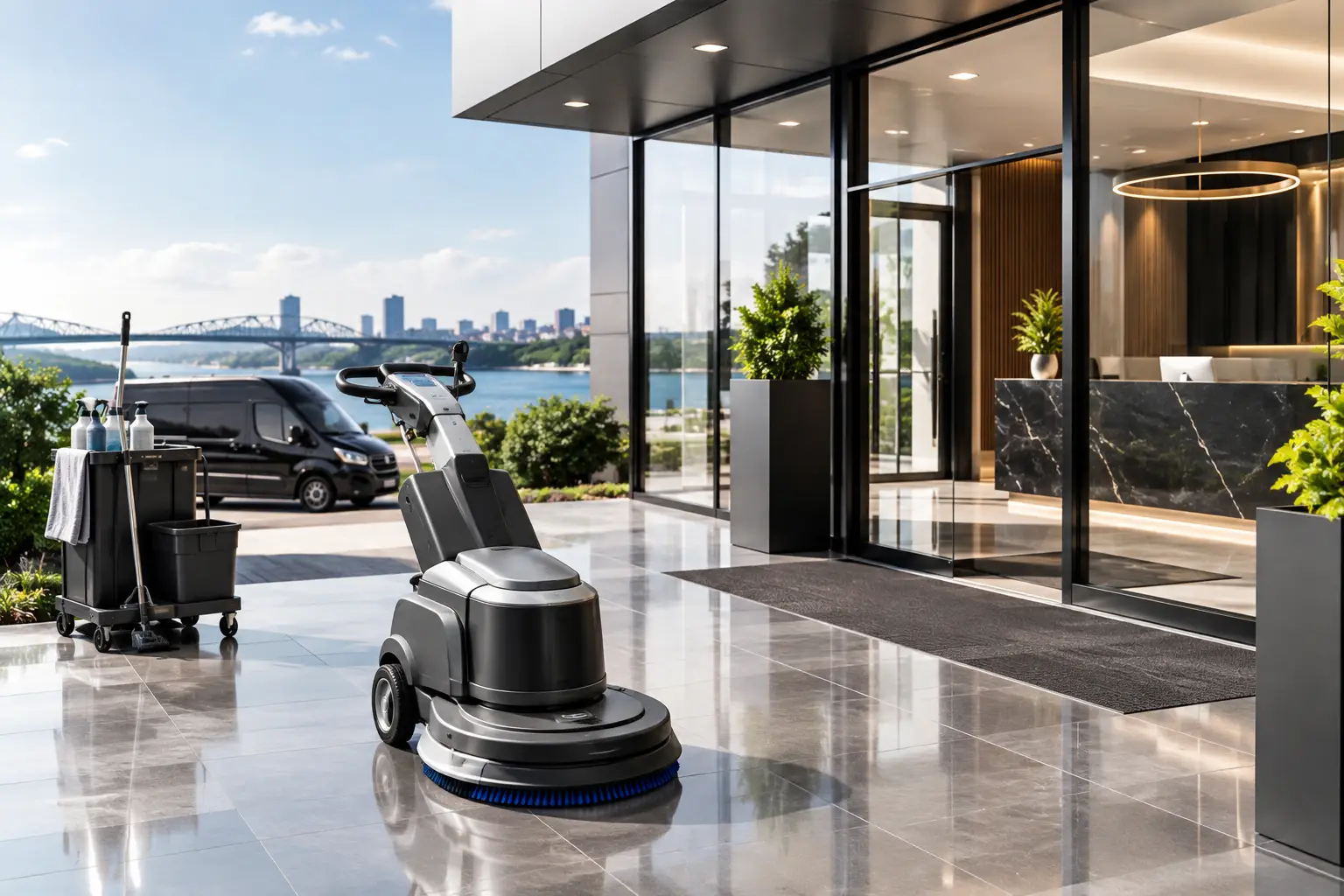
A marked entrance window, a dull floor at the entrance, or a neglected bathroom can quickly change the perception of a business. Commercial cleaning on the North Shore goes beyond sweeping after business hours: it must protect the customer experience, support employees, and maintain a functional space despite real traffic.
For a property owner, a property manager, or a maintenance supervisor, the challenge is rarely finding someone to clean once. The real issue is obtaining measurable consistency, respected schedules, and a team that understands the areas that get dirty quickly. In a store, a clinic, an office with reception, or a local business, visible details have direct consequences on the establishment's image.
Commercial cleaning must follow the rhythm of the business
A business does not have the same needs as a residence or an empty building. Entrances accumulate water, calcium, and salt during winter. Contact surfaces are marked during busy periods. Bathrooms must remain presentable without disturbing customers. As for floors, they endure shopping carts, boots, trolleys, and the movement of staff.
An effective maintenance plan therefore begins with observing the site. It is necessary to know the opening hours, the most occupied periods, the layout of the space, and the access used by the maintenance team. Cleaning can take place early in the morning, after closing, or according to a frequency adapted to certain areas. For example, a clinic with high traffic often requires increased attention to waiting rooms, restrooms, and door handles. An office will rather require regular maintenance of shared desks, kitchens, and reception areas.
The frequency depends on traffic, season, and the use of spaces. A weekly maintenance may be sufficient for small offices with low traffic. On the contrary, a commercial entrance or a public bathroom may require several passes per week, or even daily follow-up. Choosing a too low frequency seems economical at first, but the stains accumulate and restorative cleaning becomes more costly.
The areas that most influence customer perception
Customers do not always distinguish between a single spot and a lack of regular maintenance. They remember the overall impression. That is why some areas must be treated as operational priorities.
The entrance, the vestibule and interior windows give the tone from the first seconds. A saturated carpet, floor marks, or a glass door covered in fingerprints damage the presentation, even when the rest of the space is well maintained. In businesses where reception is central, the counter, visible surfaces, and waiting area must receive particular attention.
Bathrooms are also decisive. They must be clean, stocked, and free of odours. The work is not only about emptying a bin: it includes cleaning fixtures, walls near sinks, mirrors, dispensers, and the floor. A structured check prevents small problems from becoming a source of complaints.
Staff rest areas deserve the same rigor. A poorly maintained kitchen or dining area can attract odours, leave residue on counters, and create irritants for the team. When employees notice that their environment is consistently maintained, they are also more likely to keep the space in order between visits.
A good supplier works with a clear scope
Commercial cleaning becomes frustrating when no one knows exactly what is planned. To avoid misunderstandings, a scope of work must specify the areas, tasks, frequency, and expectations related to more demanding periods. The property manager must know if interior windows, baseboards, doors, bins, carpets, and bathrooms are included, and at what frequency.
This clarity is particularly useful when a space evolves. After light renovations, a reconfiguration, or a difficult winter period, regular maintenance may not be enough. A targeted restorative cleaning then allows taking control of floors, wall traces, fine dust, and accumulated residues. Post-construction cleaning also requires a distinct method: dust settles in corners, frames, visible ducts, and high surfaces, beyond obvious areas.
It is also necessary to distinguish between appearance cleaning and cleaning that protects materials. Some floors require specific products and equipment. A poor product can leave a film, make a surface slippery, or accelerate wear. In a business, speed is important, but it should not replace the method.
Commercial cleaning on the North Shore: the criteria to check
Before delegating the maintenance of your spaces, it is useful to evaluate the real ability of the supplier to manage a commercial environment. Proximity counts, especially when an additional intervention is needed, but it does not replace on-site organization.
Ask concrete questions about the follow-up of work, procedures in case of absence, time slots, and products used. Check also that the team is comfortable with the constraints of your building: controlled access, alarm, shared spaces, parking, service elevator, or occupied areas during cleaning. A reliable team does not require you to monitor each pass to get the desired result.
In many sectors of the North Shore, businesses are integrated into mixed buildings, professional centres, or rental complexes. Cleaning must then take into account common corridors, shared entrances, and periods when residents, patients, customers, or employees circulate at the same time. Poorly planned intervention can disrupt operations. Well-coordinated intervention is almost invisible, except for the level of cleanliness it leaves behind.
Professional equipment also makes a difference. A broom and a universal product are not sufficient to properly maintain high-traffic floors, windows, sanitary spaces, or surfaces affected by winter conditions. The equipment must be chosen according to the type of surface and the task to be performed, without adding excessive moisture or leaving visible residues.
Who maintains common areas and commercial spaces in a building?
In a commercial or mixed building, maintenance is generally entrusted to a building janitorial services company or a commercial cleaning company. Its role is to maintain the spaces specified in the contract: halls, corridors, stairs, elevators, waste rooms, recycling rooms, underground parking garages, and, according to the mandate, the commercial spaces themselves.
Building janitorial services include more than a regular cleaning. It is based on a routine adapted to traffic, waste management, seasons, and the building's particularities. For a condominium, common areas are usually cleaned by a team authorized by the condo board or the property manager. The objective is to maintain a clean, safe, and consistent environment for residents, visitors, and commercial occupants.
This approach is also relevant for property owners who own multiple properties. By grouping the maintenance of common spaces and commercial spaces according to a single plan, they reduce forgotten areas and facilitate follow-up. This does not mean that all spaces receive the same treatment: a waste room, an entrance hall, and a clinic require different methods.
When should a specialized intervention be requested?
A specialized intervention is justified when regular maintenance no longer corrects the problem. This is often the case after renovations, before an opening, after a tenant leaves, or when floors, windows, and surfaces show visible accumulation. Persistent odours, construction dust, and stubborn marks in corridors or garages are also signals to treat quickly.
The Nickel & Krome team intervenes with businesses, buildings, and property managers in Montreal, Laval, and the North Shore with an on-site follow-up approach. To evaluate a building maintenance, concierge, or restorative cleaning mandate, the company is registered under NEQ 3381837957 and can be contacted at +1 514-974-3311.
A well-maintained business should not require constant reminders. When priority areas, frequency, and responsibilities are clearly established, cleanliness becomes a reliable part of your operations rather than a concern to resolve every week.