
How to Maintain a Commercial Entrance Lobby
Maintain a commercial entrance lobby with a routine for floors, mats, glass and touchpoints, adjusted to traffic, weather and your building's materials.
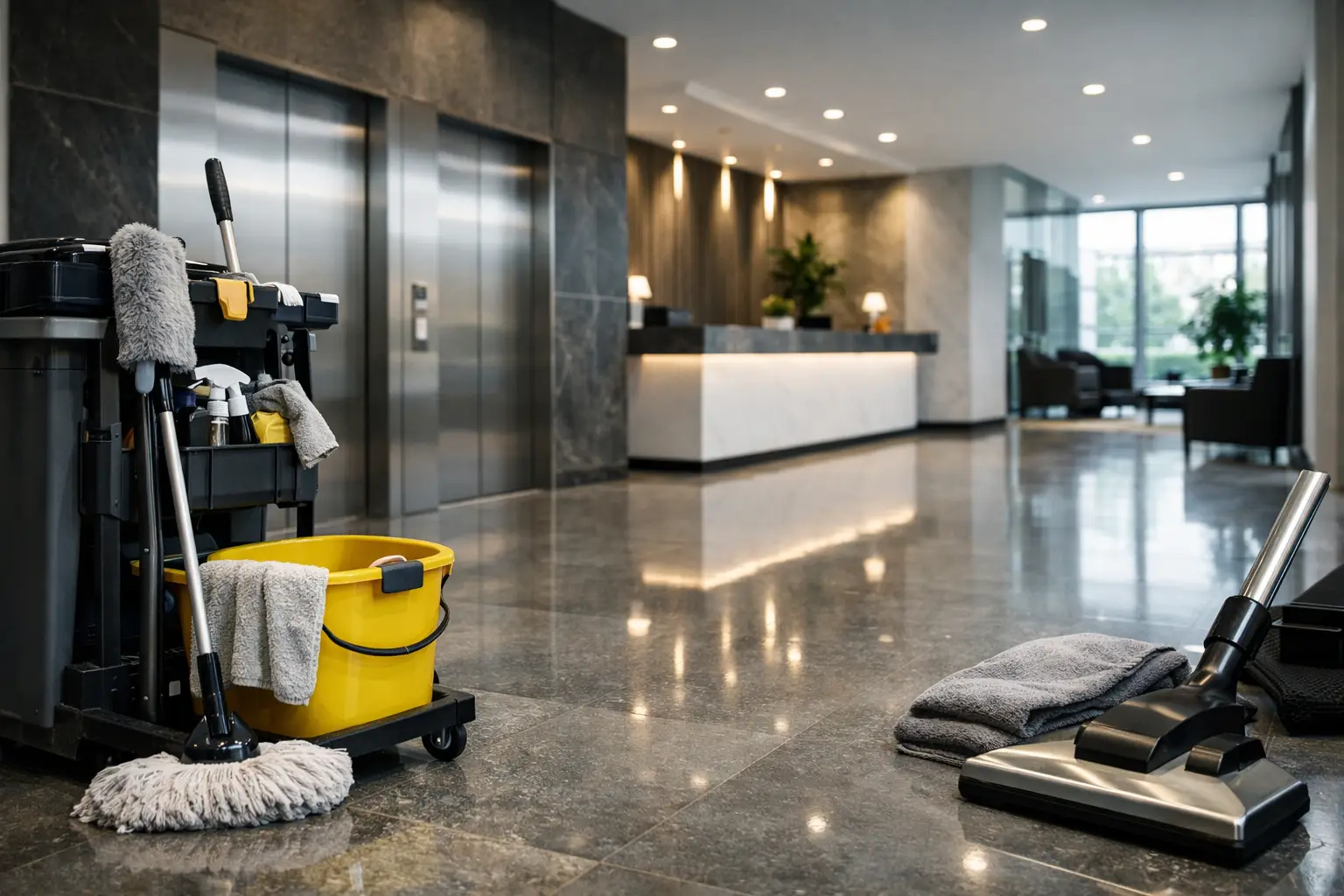
A hall marked by salt, glass doors full of fingerprints or a carpet that retains moisture quickly gives the impression that the whole building is not being properly maintained. Knowing how to maintain a commercial entrance hall is not just about sweeping: it involves managing a high-traffic area, protecting the finishes, and maintaining a consistent appearance between visits.
For a business, an office building, a clinic, a school, or a condominium, the entrance hall is the first space seen by customers, residents, suppliers, and visitors. It is also a place where dirt quickly accumulates. A well-adapted maintenance plan reduces complaints, limits floor stains, and helps preserve the perceived value of the building.
Start with the real sources of dirt
A hall does not get dirty in the same way in all buildings. A clinic receives visitors throughout the day and requires special attention to contact points. The entrance of a multi-unit building tends to accumulate shoe prints, pet hair, delivery-related traffic, and debris from the underground parking. In a business, it is often the storefronts, door handles, and floor near the entrance that deteriorate first.
Before setting a frequency, it is necessary to observe real movements for a few days: peak hours, access to the underground garage, most used doors, presence of an outdoor carpet, nearby construction or frequent deliveries. This on-site assessment avoids paying for poorly targeted maintenance or, conversely, letting the most visible areas deteriorate between visits.
Winter in Montreal, Laval, and on the North Shore changes the needs completely. Floor cleaning becomes more frequent, but the choice of products and methods is as important as the frequency. An incorrectly diluted product can dull a surface, leave a sticky film, or make the floor slippery.
How to maintain a commercial entrance hall on a daily basis
Daily maintenance mainly aims to remove what immediately affects the appearance and safety. It should be quick, systematic, and focused on visible areas. A hall that remains clean continuously often requires small, regular interventions rather than a single intensive cleaning at the end of the day.
Sweeping or vacuuming the entrances, corners, thresholds, and edges of carpets removes abrasive particles before they are crushed into the floor. Next comes the appropriate cleaning for the floor covering - ceramic, vinyl, stone, polished concrete, or other finish. Glass doors, door handles, intercoms, and elevator buttons also need to be checked, as even a few marks can give an impression of neglect.
The entrance carpets deserve particular attention. They retain a large amount of water and dirt, provided they are long enough, well placed, and maintained. A saturated carpet no longer protects the floor: it transfers moisture and residues inward. Its vacuuming, straightening, and periodic cleaning are an integral part of hall management.
Here are the elements that a property manager should be able to check during a quick inspection:
- a floor without debris, sticky spots, or slippery areas;
- clean entrance glass and door handles;
- dry, flat, and clear carpets;
- baseboards, door frames, and corners without dust accumulation;
- a neutral smell, without an overpowering fragrance that masks a problem.
Adjust the frequency to the traffic
There is no universal frequency. A small office with few visitors can function with a full maintenance several times a week, supplemented by a check of the entrances. A very busy condominium entrance, a clinic, or a public business may require daily intervention, or several targeted passes during peak times.
The right question is not just “how many times a week?”, but “when does the hall start to look neglected?”. If the stains are visible every day before noon, increasing the quality of the cleaning in the evening will not solve everything. It is necessary to plan for an additional intervention, review the carpets, or adjust the management of doors and access.
After a storm, a de-icing, a major delivery, or construction, a spot cleaning is often necessary. Waiting for the next regular visit may allow salt to damage surfaces or spread dust through the corridors and elevators. This ability to intervene makes a difference in buildings where image and safety cannot wait.
Protect materials from premature wear
Effective maintenance should not only make the floor clean for a few hours. It should help preserve the materials. The hall's surfaces are used every day, and repeated errors cost dearly: too wet cleaning, inappropriate product, abrasive equipment, or residue left on the floor.
Polished finished floors require maintenance that preserves the shine without unnecessarily adding layers of product. Stone or ceramic entrances require attention to the joints and mineral deposits. For vinyl floors, it is necessary to limit abrasive dirt and avoid products that leave a film. In all cases, drying is as important as cleaning, especially in areas where people enter with wet shoes.
Walls and baseboards are often forgotten until the marks from bags, carts, or shoes become obvious. A weekly check allows these traces to be corrected before they set in. Light fixtures, display panels, letterboxes, and decorative frames should also be included in a periodic maintenance cycle, without necessarily being treated every day.
Reduce complaints with visible follow-up
Complaints about a hall rarely come from a single incident. They appear when residents or visitors notice the same problems repeatedly: stained carpets, bad smell, dull floor, marked glass, or trash near the entrance. Consistency is more reassuring than a single occasional deep cleaning.
A useful building janitorial plan specifies the areas, tasks, hours, and exceptions. It should also include a simple mechanism for reporting an emergency: a spill, a leak, broken glass, vomit, dust after construction, or unusual melted snow accumulation. The property manager does not need to monitor every detail, but must know that these situations will be treated with clear follow-up.
Communication between the maintenance team and the administration is particularly important after construction. A post-construction cleaning in a hall goes beyond removing visible dust. It requires removing fine residues, stains on the glass, marks on the floors, and debris that can move through common areas. An incomplete restoration quickly leads to complaints from occupants.
Who maintains the common areas of a building?
In a condominium, a rental building, or a commercial building, common areas are generally maintained by a building janitorial or commercial cleaning team hired by the property manager, the condo board, or the owner. This service typically includes the maintenance of entrances, corridors, elevators, stairwells, waste rooms, recycling rooms, and, depending on the contract, interior garages.
The right supplier does not just execute a list of tasks. They must understand the priorities of an occupied building: secure access, agreed working hours, professional equipment, attention to sensitive areas, and the ability to correct a problem before it becomes recurring. For property managers looking for a field partner in Montreal, Laval, or on the North Shore, the Nickel & Krome team offers building maintenance and specialized interventions with this operational logic. NEQ 3381837957 - +1 514-974-3311.
A well-maintained entrance hall should never attract attention for bad reasons. When it remains dry, clean, bright, and consistent with the building's level, residents notice it little - but they feel every day that the building is being taken care of.
From the guide to your project
To check the scope, access, and conditions of intervention, consult our service: Commercial cleaning.