
Assessing Post-Construction Cleaning Needs
Assess post-construction cleaning by surface, remaining residue, access and handover schedule to define a realistic scope before requesting a quote.
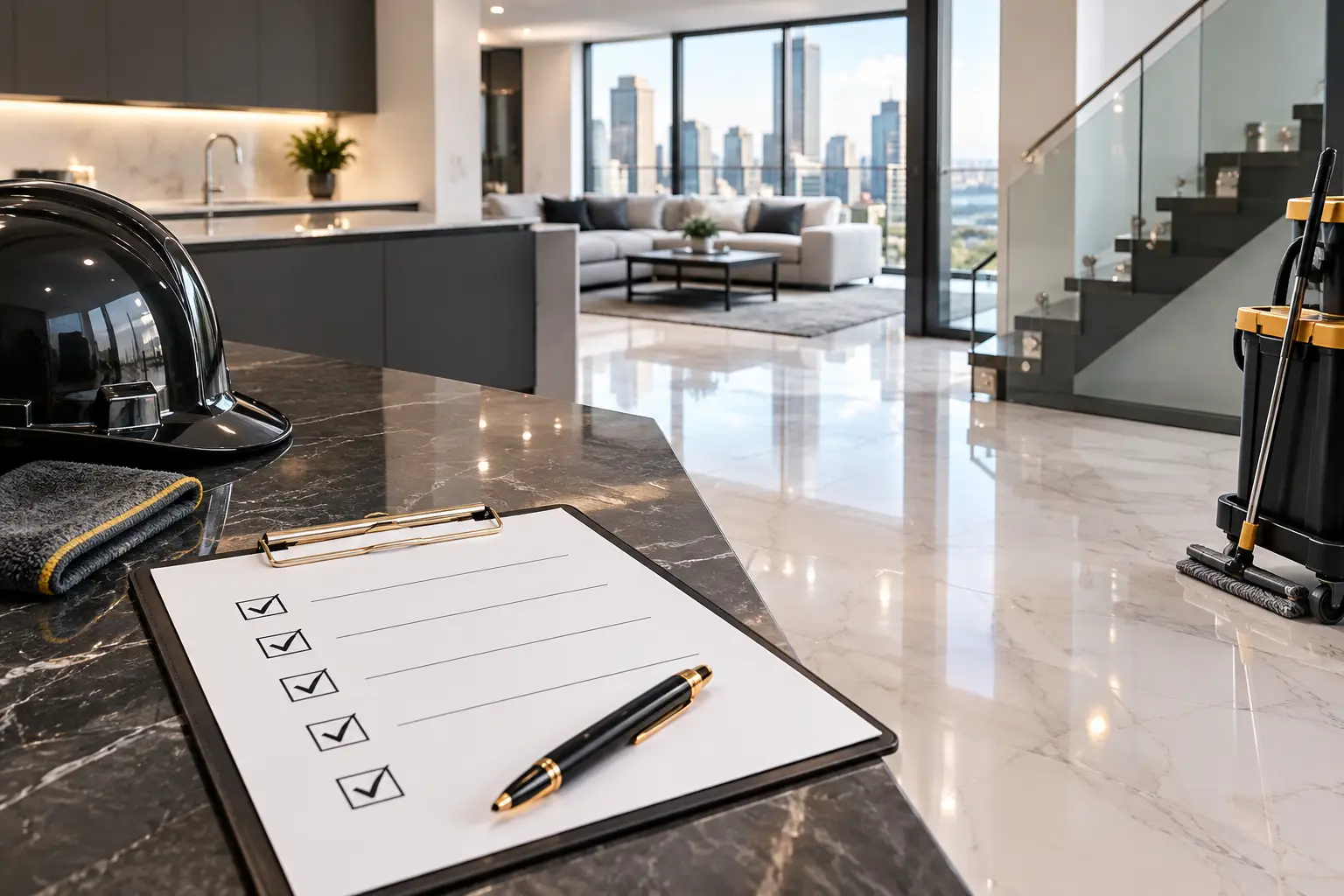
A construction site may appear to be finished when the building is not yet truly ready. Fine dust on baseboards, silicone residue on windows, grout residue in bathrooms, stickers on doors or footprints in corridors can delay a handover and create a bad first impression. A post-construction cleaning evaluation allows you to confirm, area by area, that the spaces are clean, safe and ready for occupation or handover to the property manager.
For a general contractor, a property manager or a condo board, this step avoids rushed team returns, complaints on the first days and poorly coordinated follow-ups. It also helps clearly define what still belongs to post-construction cleaning, correction of work, or regular building maintenance.
Why evaluate the cleaning before handover
End-of-construction cleaning is not just about picking up visible debris. The work often leaves several types of residues: gypsum dust, a fine film on surfaces, paint splashes, cement, glue, tape, fingerprints on windows, wood shavings and accumulated dirt in less visible areas.
Without a structured inspection, some problems go unnoticed until the occupants arrive. In a condo or a multi-unit building, it is often the common areas that reveal the most quickly a lack of finishing: dusty entrance hall, marked elevator, stained stairs, poorly cleaned stairwell or a waste room left with odours and construction residue.
A good evaluation also distinguishes between cleanable dirt and a construction defect. A scratched window, a surface burned by a product or a damaged floor should not be treated as a simple cleaning task. This distinction protects the budget, avoids unnecessary discussions and speeds up corrections with the right person involved.
Post-construction cleaning evaluation: areas to inspect
The inspection must follow the real path of users, then cover technical or less frequently used spaces. It is preferable to do the tour with sufficient lighting and when construction generating dust is completed. Evaluating a cleaning while subcontractors are still cutting, drilling or moving materials leads almost always to rework.
Entrances, halls and common areas
The entrance immediately sets the tone. Check glass doors, frames, handles, intercoms, mailboxes, walls, baseboards, light fixtures and floor coverings. Corners, moldings and under benches or carpets often retain dust that is not noticeable at first glance.
In corridors, the evaluation must focus on the uniformity of the result. A clean floor in the centre but dusty along the walls remains incomplete. Paint traces, wheel marks, glue residue and window splashes are particularly frequent after the work.
Elevators, stairs and fire doors
Elevators are sensitive areas because they concentrate traffic, reflections and fingerprints. Walls, buttons, door thresholds, door rails and ceilings must be inspected. It is also necessary to check that the products used have not left a film or traces on stainless steel.
In stairwells, look at the steps, landings, handrails, window sills, extinguishers and corner of the landing. Construction dust accumulates quickly there, especially if the stairs were used to transport materials. Fire doors must be clean without their mechanisms, joints or regulatory labels being damaged.
Units, offices and commercial spaces
In units, the inspection usually starts at the top: ceilings, light fixtures, walls, frames, cabinets, countertops, appliances, baseboards and floors. This method avoids re-soiling already treated surfaces.
Kitchens and bathrooms require closer attention. Joints, faucets, sinks, showers, toilets, fans and glass surfaces must be free of dust, caulk residue, glue and grout residue. A shiny surface is not automatically clean: a touch on a countertop, a frame or the top of a door often reveals what the eye misses.
Garages, waste rooms and technical spaces
The underground garage is often inspected too late, when it receives a large part of the building's dirt. Check the traffic paths, corners of walls, drains, doors, panels, accessible mechanical rooms and areas around the docks. Depending on the inspection findings, a pressure wash or targeted restoration may be required, but this decision depends on the finishes, access to water and drainage available.
Waste rooms and recycling rooms must be clean before commissioning. Odours, spill trails on the floor and wall traces become quickly a source of complaints in an occupied building. A thorough inspection also checks handles, thresholds, baseboards and surfaces behind the bins.
How to judge the quality of the result
A useful evaluation does not just say that it is "clean" or "not clean." It describes the location, type of residue and expected correction. For example: visible dust on the baseboard in the corridor on the third floor, glue residue on the window of the entrance hall door, paint residue on the elevator threshold or dirt in the garage drain.
The main criterion is simple: surfaces must be free of construction residue, without traces left by the cleaning itself. Windows must be clean, floors uniform, contact areas disinfected when required and waste removed. Materials must also be respected. A too aggressive product can dull stone, mark a floor or attack a metallic finish.
It is wise to document discrepancies with dated photos and a list of corrections. This helps the contractor, the cleaning team and the property manager work from the same expectations. For large projects, a preliminary inspection before official handover allows details to be corrected without occupancy pressure.
When to call a specialized team
A post-construction cleaning team is particularly useful when the work has touched several units, common areas, windows, floors or the garage. It becomes necessary also when there are fine dusts, persistent residues, an approaching handover deadline or a building that must accommodate residents, employees, customers or students.
The final cleaning can be done in phases. A first intervention removes debris and heavy dust. A second, after the real end of the work, treats details, windows and finished surfaces. This approach can sometimes cost a little more than a single pass, but it reduces reworks if the construction remains active between the two stages.
After handover, the building generally moves from post-construction cleaning to building janitorial services. Who maintains a building? A property maintenance team takes care, according to the agreement, of entrances, corridors, elevators, stairwells, waste rooms, garages and other common areas. What does a building janitorial service include? It includes scheduled maintenance, tours adapted to traffic, maintenance of shared spaces and follow-up on recurring issues.
To clearly answer another common question: who cleans the common areas of a condominium? The condo board or the property manager usually hires a building janitorial service company capable of intervening regularly, reporting anomalies and respecting residents' hours.
In Montreal, Laval and on the North Shore, the Nickel & Krome team supports contractors and property managers in post-construction cleaning, restoration and operational maintenance of buildings. The company, NEQ 3381837957, can be contacted at +1 514-974-3311 to discuss an inspection, a targeted rework or the transition to regular maintenance.
The right time to evaluate is not when complaints start. It is just before the building comes into use, when every detail can still be properly corrected and the building can be handed over with the expected quality.