
Underground parking garage cleaning in Laval
Underground parking garage cleaning in Laval for buildings, condos, and businesses. Remove salt, dust, oil stains, and stubborn deposits.
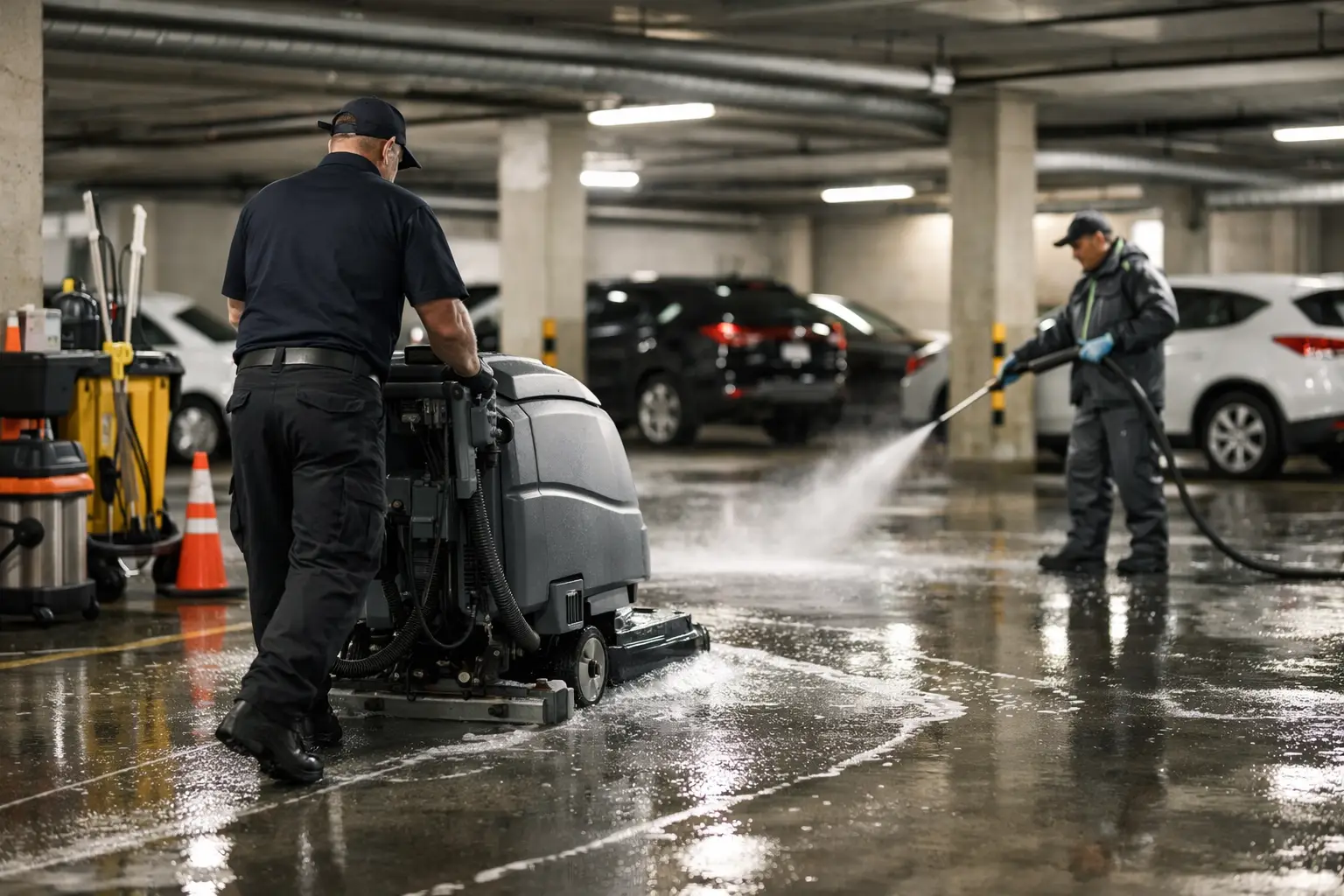
A subterranean parking garage rarely deteriorates overnight. More often, it’s the gradual buildup that causes problems: de-icing salt tracked in by vehicles, fine dust, black streaks along traffic lanes, greasy puddles near parking spots, and dirty water pooling around drains. When these residues linger too long, underground parking garage cleaning in Laval becomes an essential maintenance task—not just a matter of appearance.
For property managers, condo boards, or commercial owners, the stakes are real. A clean garage reduces complaints, enhances the building’s image, and helps preserve surfaces. In a confined, high-traffic environment with ventilation systems, signage, columns, walls, and technical equipment, cleaning must be methodically planned.
Why underground parking garage cleaning isn’t just a quick rinse
A subterranean garage collects different contaminants than an outdoor space. In winter and spring, salt and abrasives embed themselves in concrete pores and settle around joints, baseboards, and low points. The rest of the year, you’ll mostly find dust, tire particles, oil stains, rust residue, and debris carried in by traffic.
The challenge is that not all grime behaves the same way. Some residues come off easily with controlled high-pressure washing. Others require targeted degreasing, water recovery, or multiple mechanical passes. In an underground garage, the quality of the result depends less on raw power than on the right combination of equipment, pressure, intervention sequence, and residue management.
This is what sets a specialized cleaning apart from a rushed job. If dirty water is merely shifted from one area to another, drains become overloaded, or corners are overlooked, the visual improvement won’t last. The space may look clean at first glance, but deposits remain where they accumulate fastest.
What to expect from underground parking garage cleaning in Laval
In a commercial or multi-residential context, the goal isn’t a short-lived cosmetic effect. A well-executed underground parking garage cleaning in Laval aims for a genuine reset of traffic surfaces and parking areas.
This includes removing salt deposits, significantly reducing grey or black films on concrete, cleaning curbs and areas near columns, and improving the overall condition around pedestrian access points, stairwells, and elevator entrances. Depending on the site’s condition, localized grease stains and lower walls exposed to splashes can also be treated.
That said, some old stains, deep oil marks, or concrete wear defects won’t disappear completely. A reputable provider will be upfront about this. The right service delivers a clean, lasting result without overpromising on already compromised surfaces.
The areas that need the most attention
Not all sections of a garage accumulate grime at the same rate. Access ramps often concentrate water, melted snow, salt, and abrasive particles. Main aisles bear the brunt of traffic. Intersections, turns, and areas near barriers accumulate more black rubber and compacted dust.
Spots close to walls often show fine but persistent deposits. Around drains, you’ll typically find sludge, heavy residue, and stagnant dirty water. Technical spaces, adjacent waste rooms, or delivery zones may require a more targeted approach due to greasy or organic grime.
When the job is well prepared, these differences are accounted for from the start. A sloped ramp isn’t treated like a flat aisle, and a residential parking area isn’t cleaned the same way as a service dock. This site-specific approach saves time and dramatically improves the final result.
How often should cleaning be scheduled
There’s no one-size-fits-all frequency for every building. It depends on traffic volume, occupancy type, season, and the level of cleanliness expected by the site operator. In many cases, a major seasonal cleaning after winter serves as the baseline, since that’s when salt deposits are heaviest.
For condo buildings, multi-unit complexes, or high-traffic commercial properties, a more frequent schedule may be justified. Some managers prefer a full reset in spring, followed by lighter intermediate maintenance later in the year. Others schedule spot cleanings before inspections, relocations, or after renovations.
The right rhythm is the one that prevents heavy buildup. The longer you wait, the more demanding the cleaning becomes, the longer the intervention takes, and the greater the risk that some stains set in permanently. In practice, consistency often costs less than late-stage remediation.
How a well-planned underground parking garage cleaning in Laval unfolds
Preparation is as important as the cleaning itself. First, assess site access, level configurations, drain locations, internal traffic flow, available time slots, and occupant constraints. In an occupied building, coordinating with management or maintenance avoids unnecessary disruptions.
On-site, the process typically starts with clearing the areas to be treated and, if needed, pre-cleaning larger debris. Next comes surface treatment with the right equipment: mechanical scrubbing, controlled pressure washing, localized degreasing, and dirty water evacuation based on the garage’s layout.
The difference is in the details. Curbs, corners, wall bases, columns, and areas around access points must not be overlooked. This is often where the impression of cleanliness is made. A garage may seem acceptable in the middle of aisles but still feel neglected in peripheral zones if the job was done halfway.
Constraints specific to commercial and multi-unit buildings
In an underground garage, cleaning quickly isn’t enough. You also need to minimize disruption to occupants, traffic flow, and building operations. This is especially true for condos, rental properties, and commercial buildings where access must remain functional within strict timeframes.
This often means working in sections, following a predefined schedule, and communicating clearly about temporarily closed zones. In some cases, nighttime or off-peak interventions are preferable. In others, breaking the job into smaller phases helps avoid displacing too many vehicles at once.
The method chosen also depends on the building itself. A newer garage with good drainage and minimal staining won’t require the same intensity as an older basement with heavy buildup, limited ventilation, and high traffic. A good provider adjusts their approach to the site rather than applying a one-size-fits-all solution.
What decision-makers should check before hiring a provider
The first point is real expertise. Underground parking garage cleaning isn’t the same as standard building janitorial services. It requires specialized equipment, the ability to work on large mineral surfaces, and an understanding of building constraints.
The second point is operational reliability. A manager needs a provider who sticks to the planned sequence, protects sensitive access points, and delivers consistent results across the entire garage. Punctuality, execution quality, and clear communication matter just as much as the cleaning itself.
The third point, though simple, is often decisive: the scope of service. For a property portfolio in Laval or the Greater Montreal area, working with a company familiar with local realities, winter cycles, and the demands of commercial and multi-unit buildings is invaluable. It’s in this operational mindset that specialists like Nickel & Krome take on demanding assignments.
A clean garage also protects the building’s image
An underground garage is sometimes seen as purely functional. Yet for tenants, condo owners, employees, clients, or contractors, it’s often one of the first spaces used daily. A dirty, stained, poorly maintained area quickly conveys an impression of neglect.
Conversely, a thoroughly cleaned garage strengthens the perception of a well-managed building. While it doesn’t replace the maintenance of other common areas, it clearly contributes to the site’s overall quality. For a decision-maker, it’s a simple lever: improve a high-use space without major renovations, with visible impact right after the job is done.
The best time to act isn’t necessarily when the situation becomes critical. Often, it’s just before. When traces start to set in, a dull film covers the surfaces, and winter has left its deposits, a well-planned cleaning allows you to regain control before the garage starts to look permanently neglected.
Apply this guide to your property
Review the scope, access requirements and service details for Sweeping, washing and restoring underground parking lots.
View the documented occupied-garage project in Montreal (French)