What is specialty cleaning?
What is specialty cleaning? Discover the services involved, use cases, and criteria for choosing a reliable provider.
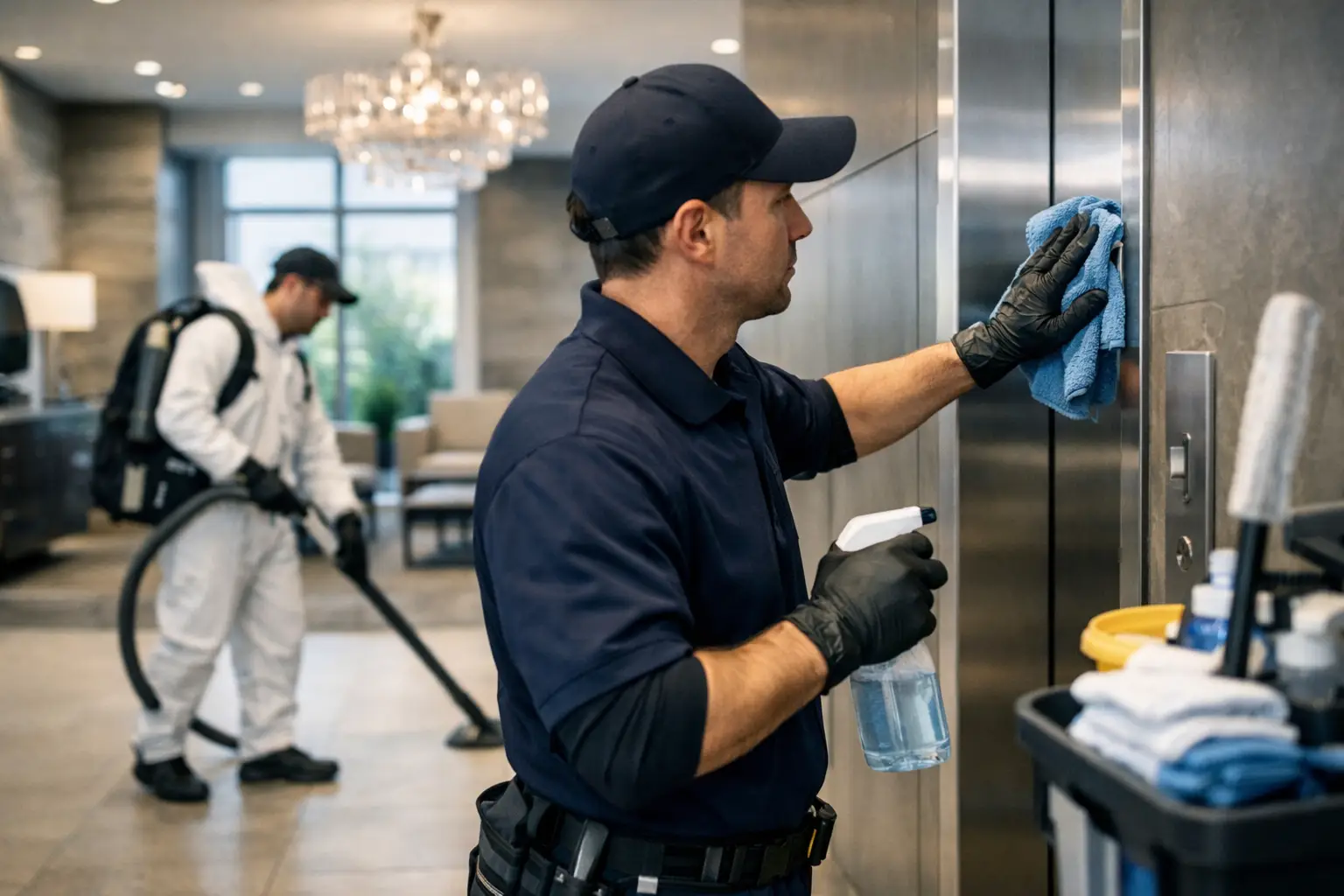
A spotless building lobby at 8 a.m., a construction site delivered without residual dust, interlocking pavers scrubbed clean without damage: these are the moments when you truly understand what specialty cleaning is. We’re not talking about a routine maintenance pass here. We’re talking about technical, scheduled interventions tailored to a specific context, executed at a level that must stand up to scrutiny.
For property managers, maintenance supervisors, or general contractors, the distinction matters. Standard cleaning aims for everyday cleanliness. Specialty cleaning, on the other hand, addresses surface constraints, safety requirements, tight deadlines, or restoration needs. It’s called for when generic methods risk falling short—or worse, causing damage.
What exactly is specialty cleaning?
Specialty cleaning refers to cleaning services that require a specific method, adapted equipment, and real expertise. It’s deployed where routine maintenance no longer suffices, either because the environment is more demanding or because the goal is more precise.
In a commercial building or multi-unit property, this can include maintaining high-traffic common areas, post-construction cleaning, finalizing a construction site, stripping away construction residue, pressure washing exterior surfaces, or performing technical cleaning in areas that must quickly regain a high standard of presentation.
The difference lies less in the word “cleaning” and more in the word “specialty.” The provider isn’t just executing a task—they’re assessing the type of grime, the material composition, the right process, the optimal timing, and the expected outcome. It’s a matter of execution logic, not just presence on-site.
How specialty cleaning differs from standard maintenance
Standard janitorial service follows predictable routines: emptying bins, mopping floors, cleaning washrooms, disinfecting high-touch points, and maintaining cleanliness on a recurring basis. This is essential, but it’s not the same mission.
Specialty cleaning often steps in when the level of dirt, surface fragility, or time constraints demand a more rigorous approach. After construction, for example, fine dust infiltrates everywhere, material residue clings to surfaces, and certain elements must be treated without scratching or degradation. On interlocking paver surfaces, overly aggressive washing can displace polymeric sand or mar the surface. In building common areas, routine maintenance can maintain general condition, but it won’t correct months of accumulated grime.
In short, specialty cleaning doesn’t replace routine maintenance. It complements it, reinforces it, or takes over during more sensitive phases.
When specialty cleaning becomes essential
In practice, this type of service is most often needed when a building is in a particular phase or when the space usage creates constraints beyond the ordinary.
Post-construction and final site cleanup
This is likely the most telling case. After construction, a space may appear finished but isn’t truly ready for occupancy. There’s gypsum dust residue, adhesive traces, paint splatters, construction film, window streaks, and deposits in corners, baseboards, and visible ducts.
Specialty cleaning transforms a technically finished space into a presentable, usable one. For a contractor, it’s a matter of delivery. For an owner or manager, it’s about image and immediate usability.
Common areas and high-traffic buildings
In condominiums, rental properties, and commercial buildings, certain zones wear faster than others. Entrances, lobbies, elevators, stairwells, hallways, and covered parking areas quickly accumulate dust, stains, salt, mud, and fine debris.
When routine maintenance no longer maintains a good appearance, a specialty intervention can restore the space. It’s often more cost-effective than waiting for visible deterioration, especially in buildings where the look of common areas influences overall site perception.
Technical exterior cleaning
Pressure washing and interlocking paver cleaning also fall into this category—provided they’re done correctly. Not all exterior surfaces are treated the same way. Pressure, temperature, product selection, and application angle must be adapted to the material and its condition.
The goal isn’t just to “make it clean.” It’s to remove what needs to be removed without damaging the surface, joints, or surroundings.
Why decision-makers prioritize it
For residential audiences, “cleanliness” often evokes comfort. In a commercial or property context, it also relates to risk management, asset presentation, and operational smoothness.
A poorly cleaned site after construction can delay occupancy or require rework. Neglected common areas can fuel occupant complaints. A dirty entrance façade or encrusted outdoor space can give the impression of poor upkeep, even if the building is well-managed otherwise.
Specialty cleaning has operational value. It helps deliver, maintain, correct, or enhance a space’s condition during phases where an average result isn’t acceptable. That’s precisely why property managers and maintenance supervisors seek providers capable of consistent execution—not just good intentions.
What a top specialty cleaning provider must master
Not all cleaning providers are structured for this type of mandate. The real issue isn’t just availability—it’s the ability to execute correctly under variable conditions.
First, there must be precise needs assessment. A strong provider doesn’t apply the same protocol to light post-construction cleanup, full restoration, or seasonal exterior cleaning. They know how to ask the right questions, identify sensitive surfaces, and define a clear scope.
Next, there must be method. This includes equipment selection, intervention order, protection of already-treated zones, residue management, and deadline adherence. On a construction site, for example, intervening too early or in the wrong sequence can force a do-over.
Finally, there must be reliability. In this field, a service that’s merely adequate but unpredictable creates more friction than it resolves. Decision-makers want a partner who arrives at the right time, with the right execution level, and without last-minute adjustments.
How to know if you need specialty cleaning
The simplest criterion is this: if routine maintenance no longer achieves the expected level of cleanliness, presentation, or restoration, you likely need a specialty service.
It’s also the case if surfaces require special treatment, deadlines are tight, construction has just wrapped up, or the visual quality of the space directly impacts occupancy, public reception, or occupant satisfaction.
There’s also an often-overlooked factor: the cost of “good enough.” A non-specialty service may seem sufficient on paper but become more expensive if corrections, rework, or consequences of incomplete work are needed. In many cases, a well-calibrated intervention from the start is better than a series of follow-ups.
A valuable approach for commercial and multi-unit properties
In markets like Montreal, Laval, and the North Shore, managers often juggle multiple realities at once: building image, tenant turnover, occasional renovations, seasonal maintenance, and access constraints. Specialty cleaning makes sense in this environment because it allows precise needs to be met without improvisation.
That’s also why interest grows in a partner capable of covering multiple types of interventions, indoors and out. When the same provider already understands the site’s logic, expected standards, and client expectations, management becomes simpler and results more consistent. It’s on this basis that companies like Nickel & Krome build their value: on-site execution designed for the real estate and commercial contexts that demand more than general maintenance.
Specialty cleaning isn’t “more”—it’s “adapted”
There’s sometimes a misconception that specialty cleaning is simply a pricier version of standard cleaning. In reality, the difference isn’t in the effort—it’s in the fit between need and method.
A well-executed standard service remains perfectly suited to many contexts. But as soon as you need restoration, construction residue removal, technical exterior surface treatment, or maintenance of high-exposure spaces, a more precise approach is required. That’s where specialty cleaning becomes not just useful, but logical.
If you manage a building, a construction site, or common spaces, the right question isn’t just “Is it clean?” It’s “Is it clean to the expected standard, using the right method, at the right time?” That’s often the answer that determines a site’s perceived quality.
Apply this guide to your property
Review the scope, access requirements and service details for Commercial cleaning services for offices and managed buildings.