How Specialized Equipment Transforms Commercial Cleaning
Specialized equipment elevates the quality, speed, and safety of commercial, post-construction, and exterior cleaning. Learn why the right tools make all the difference.
A lobby may look clean at first glance, yet still hide fine construction dust in the grout lines, baseboards, or stairwells. This is where specialized equipment truly makes a difference. In commercial buildings, multi-unit residences, and post-construction sites, the quality of the result rarely depends solely on the team’s goodwill. It hinges on the right methods, tailored products, and machines capable of properly treating each surface.
For property managers or general contractors, the question isn’t whether cleaning is necessary—it’s about determining the right level of intervention to restore spaces, preserve materials, and meet deadlines. Standard maintenance works for routine tasks. But when dealing with construction dust, embedded residue, grimy exterior surfaces, or high-traffic common areas, a technical approach is required.
Why specialized equipment really matters
In commercial cleaning, the cost of poor tool selection is often underestimated. An inadequate machine prolongs interventions, leaves residue, and can even damage flooring. Conversely, the right specialized equipment delivers more uniform, faster, and safer results.
This is especially true after construction work. Fine dust from plaster, concrete, or material cuts doesn’t behave like surface dirt. It settles everywhere, circulates in the air, and quickly returns if suction, capture, and finishing aren’t performed in the correct sequence. On these types of jobs, the gap between visually acceptable cleaning and truly professional restoration often comes down to the right tools.
The same principle applies outdoors. Interlocking pavers, concrete, curbs, and certain façade surfaces react differently to pressure, heat, or detergents. An overly aggressive approach can mar the surface or displace joint materials, while a weak one fails to solve the problem. Specialized equipment protects as much as it cleans.
Which projects require specialized equipment
Not all buildings need the same level of intervention. However, certain situations clearly demand superior technical means.
Post-construction and end-of-site cleaning
This is the most obvious example. Construction residue often combines heavy dust, fine particles, glue stains, protective films, splatters, and scattered debris. It requires adapted vacuums, precision accessories, appropriate washing machines, and sometimes specialized tools for windows, frames, floors, and delicate surfaces.
The critical point is finishing. A space may seem ready for handover, but if window sills, light fixtures, exposed ducts, or tile corners retain traces, the overall impression drops immediately. For contractors or managers, this can delay occupancy or complicate final inspections.
Common areas and high-traffic buildings
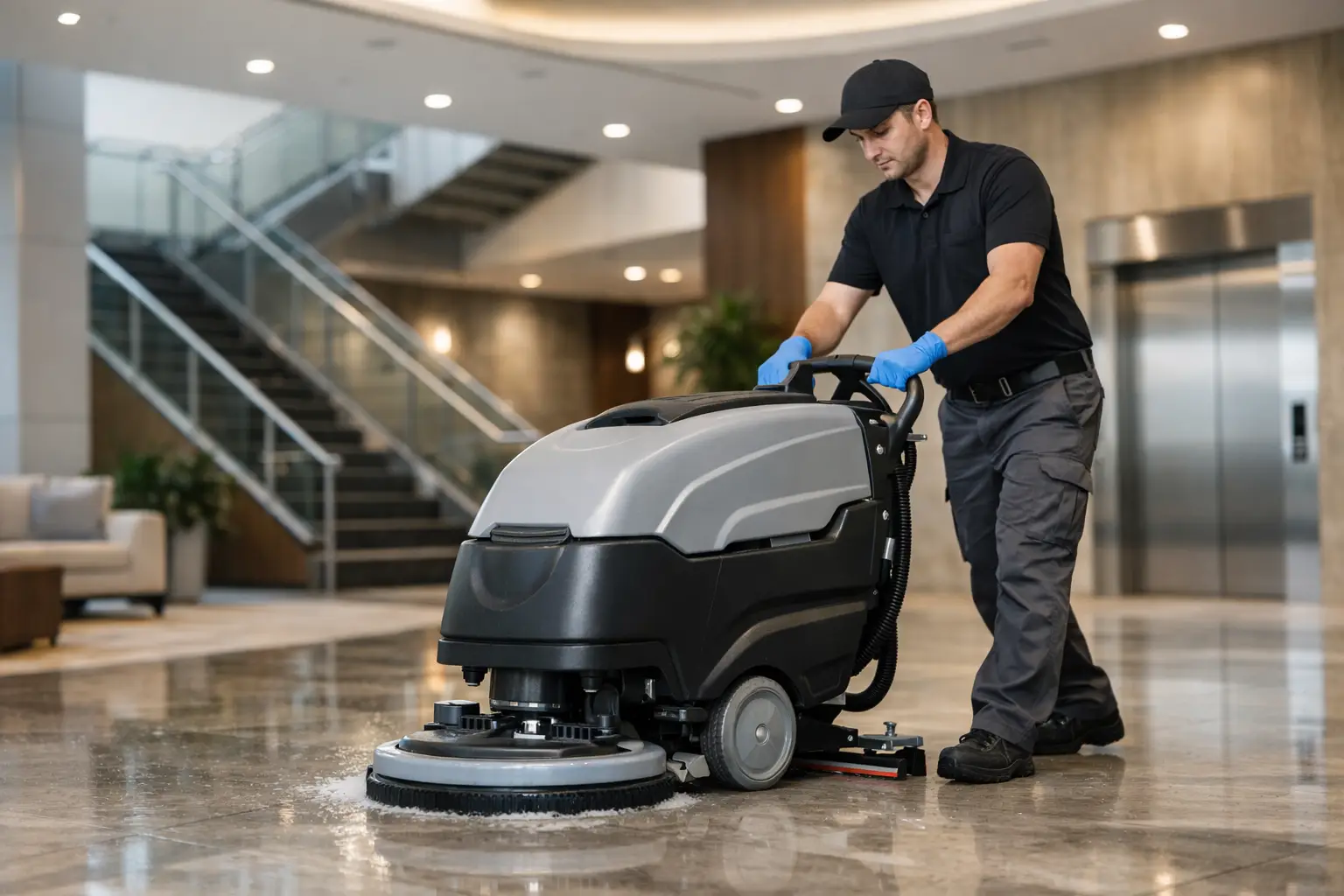
In corridors, vestibules, stairwells, and elevators, the challenge isn’t just aesthetic—it’s about maintaining consistent cleanliness despite repeated foot traffic, moisture, salt, floor marks, and normal wear. Depending on the materials, a ride-on scrubber, single-disc machine, or higher-performance vacuum system may be necessary.
The right choice depends on cleaning frequency, total surface area, and type of soiling. In a well-occupied building, the goal isn’t to perform a one-time deep clean that impresses for a day. The goal is to maintain presentation levels week after week.
Exterior cleaning and pressure washing
Pressure washing may seem straightforward, but in practice, it’s a matter of calibration and experience. Pressure, flow rate, angle, working distance, and nozzle type drastically affect the outcome. On interlocking pavers, architectural concrete, or surfaces near commercial entrances, drainage, overspray, and occupant safety must also be considered.
Specialized equipment is useful here because it allows the intervention to be adapted to the surface rather than applying the same force everywhere. This often distinguishes effective cleaning from rushed work.
What the right equipment changes on-site
The first difference is visible in the final result. Floors dry better, marks are minimized, dust returns less quickly, and details are sharper. For a commercial building, this directly impacts the perception of occupants, visitors, and tenants.
The second difference is time. A well-equipped provider doesn’t just work faster—they operate in a logical sequence with fewer re-dos and surprises. For a site handover, an active business, or an occupied building, this ability to intervene efficiently is as important as the visual outcome.
The third difference relates to durability. Certain surfaces degrade less when cleaned with the right tools. This is a key consideration for owners and managers looking to avoid turning maintenance into a source of premature wear.
Specialized equipment doesn’t mean a one-size-fits-all approach
This is a crucial point. Having good machines isn’t enough if the site analysis is flawed. Two buildings may appear to have the same type of dirt, yet require different approaches based on flooring, building age, usage intensity, and access constraints.
For example, intensive post-construction cleaning in a vacant commercial space isn’t planned the same way as restoration in an already-occupied condo. In the first case, work can proceed more freely. In the second, factors like resident movement, noise, schedules, and sensitive zone protection must be considered.
The same applies outdoors. A heavily soiled surface doesn’t always require higher pressure. Sometimes, the right pretreatment, dwell time, or rinsing method does the real work. Equipment is then used to execute a strategy properly, not to compensate for a poor approach.
How to spot a truly equipped provider
A reputable provider doesn’t treat specialized equipment as a vague selling point. They can explain which type of intervention suits the job, why certain surfaces require special precautions, and how they plan to organize the site.
This clarity is invaluable for decision-makers. It helps determine whether the company understands the site’s realities or is offering the same solution for every problem. In commercial and real estate sectors, operational reliability often comes down to simple details: zone protection, intervention sequence, residue management, dust control, and deadline adherence.
Companies like Nickel & Krome stand out in these contexts when tackling concrete, technical, and demanding needs without wasting time on vague promises.
The real benchmark: measurable results
Ultimately, equipment has no value in itself—it’s valuable only if it improves the outcome. A manager isn’t looking for an impressive machine; they’re seeking common areas that stay presentable, a handover-ready construction site, exterior surfaces restored to standard, and a partner who understands building constraints.
That’s why specialized equipment must always be tied to three simple criteria: quality of finish, surface protection, and schedule control. If any of these elements are missing, the intervention loses part of its value.
In Greater Montreal, where commercial buildings, condos, and transforming sites often demand high expectations, this level of execution isn’t a luxury—it’s a baseline requirement for cleaning that meets the space’s standards.
When a job calls for more than routine maintenance, it’s best to ask the right question upfront: Does the provider bring the right tools, or just good intentions? That’s often where the difference lies between a space that’s merely cleaned and one that’s truly restored.
Apply this guide to your property
Review the scope, access requirements and service details for Commercial cleaning services for offices and managed buildings.