Residential Building Cleaning in Montreal
Residential-building cleaning in Montreal for condos and multi-unit properties, with stable common-area upkeep and structured service follow-up.
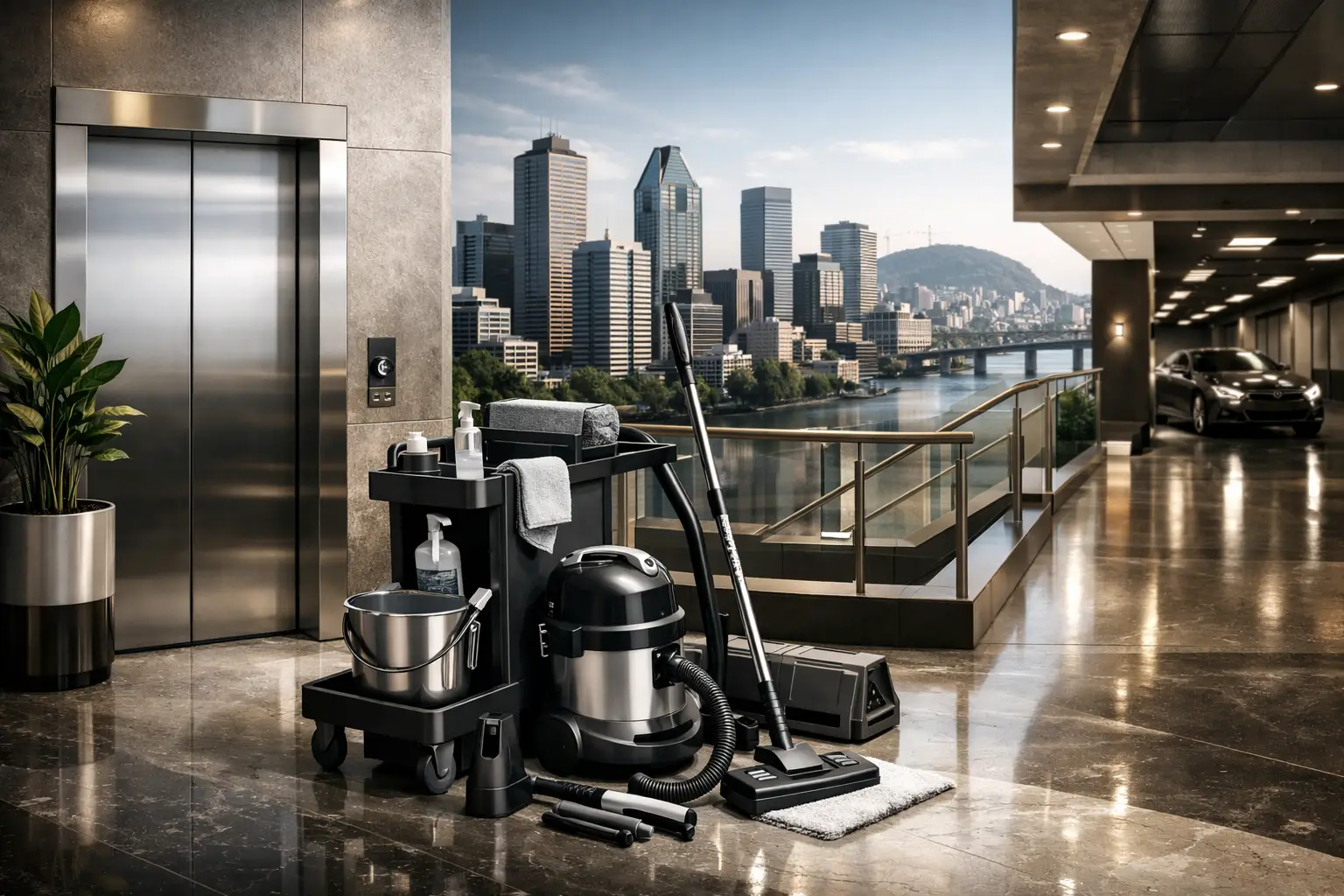
A corridor marked after a rainy day, an odour developing in the waste room, or fingerprints left on elevator panels can quickly affect how a building is perceived. Residential-building cleaning in Montreal therefore involves more than sweeping. For a condo, rental property, or multi-unit building, it is operational upkeep that supports the resident experience and the property's presentation. Condo-tower maintenance in Montreal frames that scope around occupancy and building access.
Property managers and condo boards need a team that understands shared zones, peak periods, and recurring building conditions. Well-organized building concierge service helps maintain the premises according to the approved scope, with more structured follow-up on priorities and observed issues.
What residential-building cleaning covers in Montreal
In a building context, residential cleaning mainly refers to spaces used collectively by occupants. It is not recurring housekeeping inside individual homes or apartments. The common-area cleaning scope focuses on shared and technical zones that shape the building's day-to-day presentation. When a mandate covers all recurring building zones, residential-building maintenance provides the appropriate generic framework.
Service may include the entrance lobby, corridors, stairwells, elevators, glass doors, handrails, floors, waste and recycling rooms, and underground parking. Depending on the property, shared laundry rooms, mailrooms, storage areas, or exterior access points may also require defined follow-up.
Frequency depends on the number of units, traffic, season, and actual use. A smaller quiet building does not have the same needs as a tower with several elevators, daily deliveries, and a busy garage. Montreal winters also bring salt, water, and abrasive residue into entrances and corridors. A fixed schedule is useful, but the approved plan may need to account for periods when high-traffic areas deteriorate faster.
Who maintains a building and its common areas?
A building concierge or maintenance company looks after the shared spaces of a condominium, rental property, or multi-unit building. Its role is to complete the defined tasks, report visible field conditions, and maintain a consistent presentation between visits.
In practical terms, who cleans condominium common areas? A team assigned to the building under a scope agreed with the manager or condo board. That scope should identify the zones, frequency, cleaning methods, products suited to the surfaces, and the process for communicating urgent or unusual conditions.
This distinction matters. A provider that treats a managed building like a private residence may underestimate the site's operating realities: rapid soil buildup in vestibules, overflowing waste, marks on elevator walls, dust in stairwells, and tire residue in underground parking. Building service is designed around consistent execution, not a short-lived visual effect.
Areas that require the closest follow-up
The entrance lobby matters because it creates the first impression, but less visible zones also require attention. A neglected waste room can allow odours and residue to affect adjacent common areas. Its scope may require frequent visits, accessible-surface cleaning, attention around containers, and clear limits for waste-handling responsibilities.
Elevators and corridors are equally revealing. Marked mirrors, dirty buttons, dusty baseboards, or tracked floors can make maintenance look inconsistent. In high-traffic properties, these elements should be checked according to actual use rather than only a theoretical calendar.
Underground parking presents another operating challenge. It collects dirty water, calcium, mud, dust, sand, and tire marks. Planned underground parking cleaning must account for drains, access, parked vehicles, circulation constraints, and the condition of the floor.
Useful frequency instead of a standard package
A practical maintenance program begins with a reading of the building. How many entrances are used? Is there an on-site concierge? Are waste rooms accessible to every resident? Are corridors carpeted or finished with hard flooring? Are construction work, moves, or deliveries frequent?
For some condominiums, two or three visits per week may be sufficient for the defined common areas. Other properties may require daily attention when traffic is high or several shared zones remain open continuously. The useful frequency is the one that supports more stable common-area upkeep and better-structured follow-up without imposing unnecessary visits.
Recurring upkeep must also be separated from one-time resets. Detailed floor washing, interior glass cleaning, a garage intervention, or treatment of a heavily soiled waste room does not replace weekly work. Conversely, a regular routine may not be enough after a major move, damage, construction work, or a demanding winter period.
After work: when routine cleaning is not enough
Gypsum dust, adhesive residue, paint splashes, and construction materials require a distinct post-construction cleaning scope. In a new or renovated building, a superficial pass can leave particles in corners, on baseboards, inside elevators, and around accessible ventilation grilles.
A specialized team works in stages: removing visible residue, detailed dusting, washing suitable surfaces, and finishing circulation areas. The required level depends on construction progress and the handover date. Starting too early can create rework, while waiting too long may complicate the final reset before occupancy.
For general contractors, property managers, and condo boards, the objective is to return the included spaces according to the approved scope so they are ready for the planned inspection or occupancy.
How to choose a reliable building-maintenance team
Price matters, but it cannot by itself establish the quality of a building-maintenance service. Before assigning common areas to a company, a decision-maker should verify the clarity of the work scope, proposed schedule, process for unexpected requests, and field follow-up.
It is also useful to ask how the team handles particular zones: waste rooms, elevators, stairwells, entrance mats, parking areas, and underground garages. The answers should be specific. A provider familiar with managed buildings can explain what is included, how often it is completed, and when a separately scoped intervention may be required.
Communication is equally important. A manager benefits when the provider reports visible damage, unusual buildup, a spill, or a condition outside the approved maintenance scope. This field observation does not replace the manager's role, but it supports more orderly day-to-day coordination.
Field support across Montreal, Laval, and the North Shore
Nickel & Krome S.E.N.C. supports property managers, condo boards, building owners, and maintenance leads with common-area cleaning, building concierge service, commercial cleaning, and post-work resets. Availability and scope are confirmed for each address and mandate in Montreal, Laval, and the North Shore.
The company, registered under NEQ 3381837957, uses a defined operating scope, professional equipment, and follow-up focused on shared spaces. To discuss recurring building upkeep, an underground garage, or a specialized cleaning need, contact Nickel & Krome at +1 514-974-3311.
A well-maintained building should not depend on a last-minute reset. When common areas are followed methodically, the work is easier to understand, document, and adjust as the property changes.
View condo-tower maintenance in Montreal
Apply this guide to your property
Review the scope, access requirements and service details for Condo tower cleaning across Montreal.