Professional Office Maintenance Guide
A practical guide to office maintenance for reception areas, workstations, washrooms, meeting rooms and professional buildings.
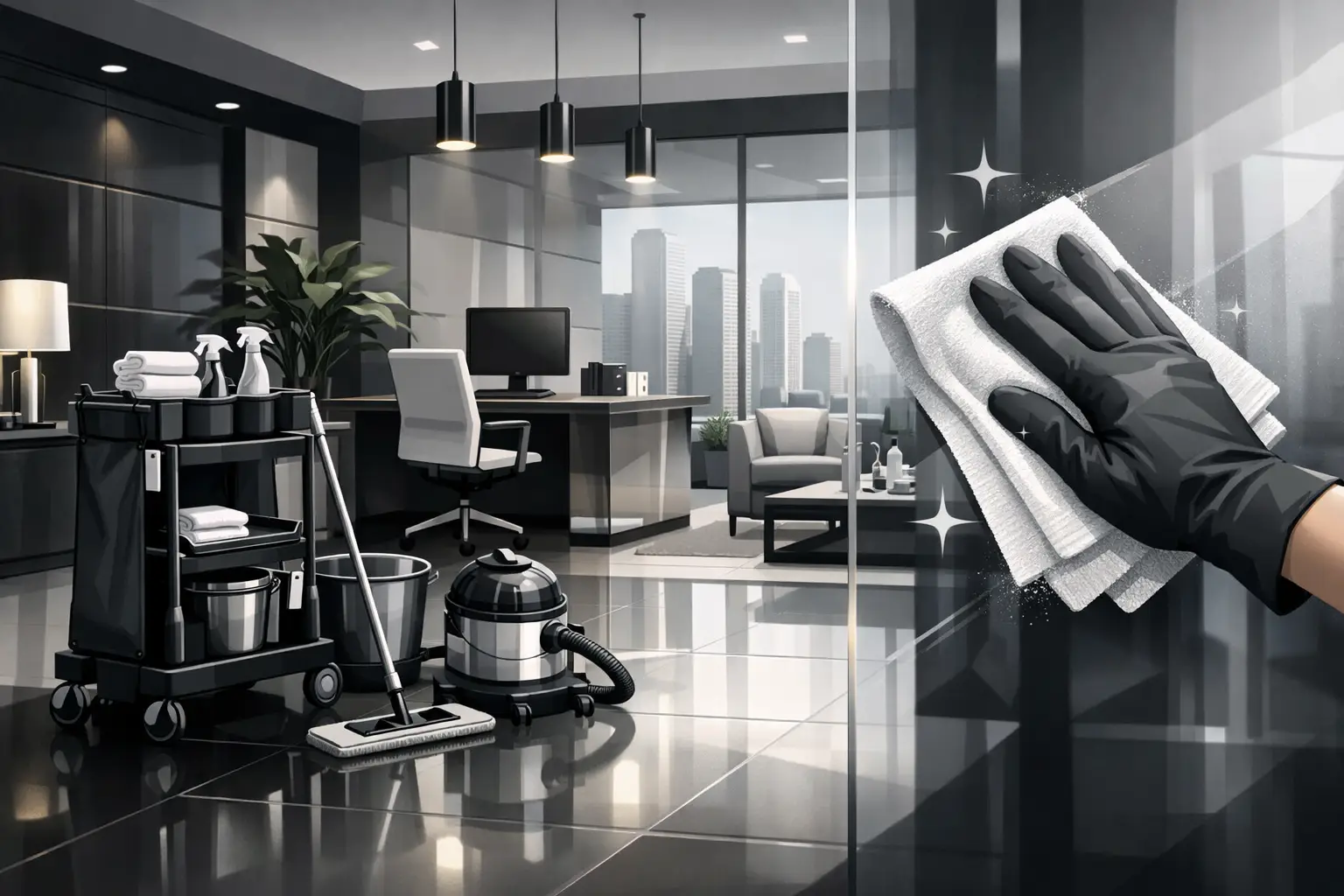
A professional office can lose credibility quickly when the entrance is dusty, meeting rooms carry marks from the previous day or washrooms are maintained only when complaints appear. Office maintenance is not only about emptying bins or vacuuming visible surfaces. It supports the image of the business, the comfort of employees and the confidence of clients who visit the premises.
For property managers, clinic administrators, professional firms and commercial tenants, the challenge is consistency. Offices are used every day, but not every zone wears at the same speed. A good maintenance plan separates visible presentation, hygiene, traffic patterns and periodic deeper work.
What professional office maintenance includes
Office maintenance usually includes reception areas, corridors, workstations, meeting rooms, kitchenettes, washrooms, glass doors, high-touch surfaces and floors. Depending on the site, it can also include common building areas, elevators, stairwells and shared entrances.
The goal is to keep the workplace presentable without disrupting operations. That means working around business hours, respecting sensitive areas and using products and methods adapted to the materials present.
Reception and client-facing spaces
The reception area sets the tone. Dust on furniture, marks on glass, dirty mats or dull floors affect the first impression immediately. These areas should receive regular attention because they represent the business before anyone speaks.
For professional offices, clinics and service firms, a clean reception area also reassures visitors. It signals that the site is managed seriously and that details matter.
Workstations and shared work areas
Workstations require a balanced approach. The cleaning team should remove visible dust, maintain floors, empty bins where included and wipe accessible surfaces without disturbing personal documents or equipment. Clear rules help avoid confusion.
In shared work areas, the focus is often on surfaces touched repeatedly during the day: handles, switches, counters, tables and shared equipment. These details have a direct impact on perceived cleanliness.
Washrooms, kitchens and break areas
Washrooms are one of the strongest indicators of maintenance quality. They require consistent cleaning, restocking where applicable, odour control and attention to sinks, partitions, mirrors, handles and floors. A rushed pass is easy to notice.
Kitchenettes and break areas need similar discipline. Spills, crumbs, fingerprints, bins and counters can make a clean office feel neglected if they are not handled regularly.
Floors, carpets and high-traffic patterns
Floor care depends on the surface. Carpeted corridors, vinyl, ceramic, sealed concrete and entrance mats each require different methods. In winter, moisture, salt and grit increase the maintenance load and can damage finishes if they remain too long.
High-traffic zones should be monitored more closely than quiet corners. A single uniform frequency may be too little for entrances and too much for low-use rooms.
How often should offices be cleaned
The right frequency depends on occupancy, operating hours, visitor traffic, weather and the standard expected by management. Some offices need daily service. Others need several visits per week with periodic deeper work.
The best indicator is stability between visits. If washrooms, entrances or meeting rooms decline too quickly, either the frequency or the scope is not calibrated correctly.
What to verify before choosing a provider
Look for a provider that understands professional environments. Reliability, discretion, schedule respect and clear communication matter as much as the visible result. The team should know what can be touched, what should be left alone and how to report issues without creating extra work for management.
Nickel & Krome works with office, commercial and property-management clients in Montreal, Laval and the North Shore. The goal is practical: keep professional spaces clean, steady and ready for the people who use them every day.
Choose the right service for your offices
The office-cleaning service explains recurring scope. Use the Montreal office-cleaning service for urban offices and distributed portfolios, the Downtown / Ville-Marie page when security, loading, and freight elevators dominate, or the Laval office-cleaning service for professional centres and parking-based access.
For a useful proposal, provide the zones, occupancy, work windows, credentials, alarms, elevators, finishes, expected cadence, and reporting requirements.
Apply this guide to your property
Review the scope, access requirements and service details for Professional office cleaning.