Private School Maintenance Guide
A practical private school maintenance guide covering methods, frequencies and checkpoints to keep facilities clean, safe and credible every day.
Private school maintenance requires clear methods, adjusted frequencies and practical checkpoints to keep facilities clean, safe and credible every day.
A parent notices in seconds what a manager may sometimes see too late: marked entrance glass, an odor in a washroom block, persistent dust on baseboards or tracks in corridors. In a school, these details affect the image of the institution as much as the comfort of students and staff.
This private school maintenance guide sets a simple framework: what to clean, how often, with what level of requirement and how to maintain consistent quality without making management heavier.
A private school does not have the same constraints as a standard office. Traffic is more intense, sensitive areas are more numerous and tolerance for slippage is low. The real subject is therefore not only cleaning, but organizing maintenance that holds over time.
Why private school maintenance requires a method
In a school, maintenance affects several groups at the same time: students, teachers, administrative teams, parents, visitors and sometimes external providers. Each uses the spaces differently. A classroom gets dirty through repeated use, a lobby through traffic, a cafeteria through spills, and washrooms through concentrated use during short periods.
The main risk, when the system is poorly calibrated, is treating the entire building at the same level even though needs vary widely by zone. The result is that some surfaces are overtreated while others are neglected. A good maintenance plan therefore starts with a clear hierarchy of spaces.
The school calendar must also be considered. Peaks in soiling do not happen only in winter. Back-to-school periods, exams, open houses, sports activities and occasional work all change the maintenance load. A school that looks well maintained under normal conditions can deteriorate quickly if no adjustment is planned.
Private school maintenance guide: priority areas to treat
The entrance, reception and circulation zones are the first areas people notice. They are also high-traffic surfaces. Floors, entrance mats, glass, handles, handrails and reception counters must remain visually clean. Here, the objective is twofold: present a serious image of the school and limit the spread of dirt into the rest of the building.
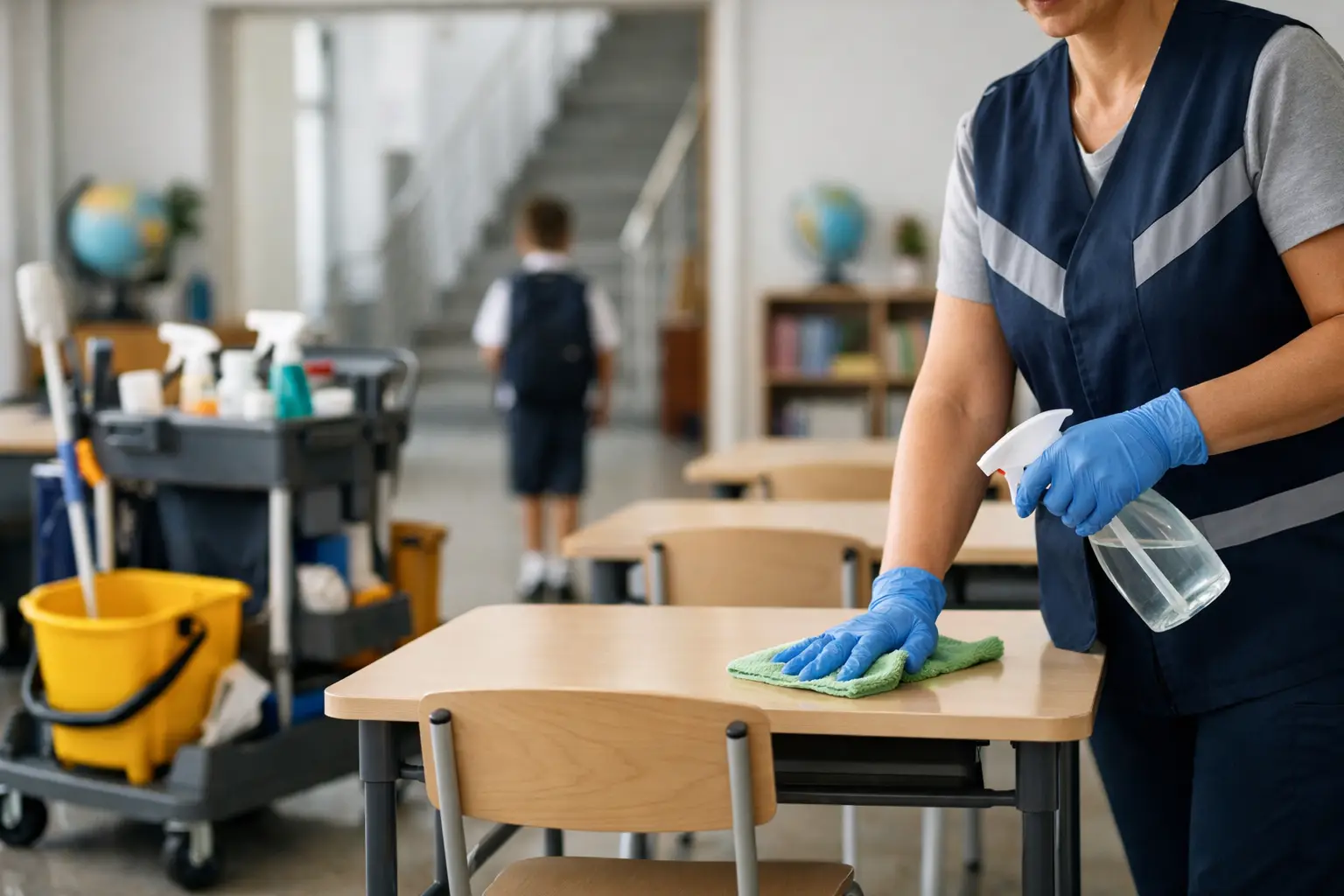
Classrooms require a more regular than spectacular approach. What matters is consistency: clean floors, desks without visible marks, emptied bins, wiped contact points, boards and window ledges kept free of dust. These are spaces where discreet buildup suddenly becomes visible. If the daily pass is approximate, the overall perception drops very quickly.
Washrooms are the truth test. In a private school, their condition directly influences the perception of quality. It is not only a question of odor or disinfection. Consumables must be replenished, partitions, sinks and toilets kept free of marks, and the floor maintained during peak periods. A washroom that is clean at 7:30 a.m. but deteriorated by 11:00 a.m. loses much of its value.
The cafeteria, break areas and multi-purpose rooms require special attention to food residue, stains and contact surfaces. Gyms, locker rooms and technical rooms have other constraints: humidity, specific dust, odors and floors under heavy stress. Here again, the right maintenance level depends on actual use, not a uniform package.
Defining the right frequencies without overloading the budget
A common mistake is thinking in number of visits rather than expected standard. Two schools of similar size can have very different needs depending on occupancy rate, student age, sports activities, exterior access and season.
In practice, some tasks fall under almost unavoidable daily maintenance: entrances, halls, corridors, washrooms, occupied classrooms, cafeteria areas and waste removal. Others can be scheduled weekly or periodically, such as detailed interior glass cleaning, baseboard treatment, deep cleaning of certain vertical surfaces or more intensive maintenance of less-used rooms.
The right balance is determined by three criteria: visibility, hygiene risk and speed of deterioration. A busy main stairwell deserves more attention than a room rarely used. On the other hand, a discreet but technically sensitive area, such as certain washrooms or locker rooms, should not be undertreated simply because it is less visible.
What a maintenance scope should include
For a provider to execute correctly, the framework must be precise. An effective maintenance scope describes the zones, frequencies, expected tasks and required result level. It also specifies access constraints, schedules, sensitive periods and who validates the work.
The idea of result is essential. Saying a floor must be washed is not enough. It must be clear what clean means: no visible marks, treated corners, no buildup under accessible furniture and a uniform appearance after service. Without that level of detail, interpretations vary from one team to another.
It is also useful to distinguish routine maintenance, periodic interventions and full resets. A private school that schedules deeper work during holidays or quieter periods avoids placing expectations on daily maintenance that it cannot absorb alone.
The checkpoints that actually make a difference
Quality follow-up should not be limited to a general impression. A few simple checkpoints provide a much more reliable reading. Entrances must remain clean all the way into corners and around mats. Washrooms must be checked for cleanliness, odor and consumable levels. In classrooms, lower areas, ledges and contact surfaces often reveal execution gaps.
Gradual details also need to be monitored: marks on glass, dust on ventilation grilles, marks on doors, dirty floor joints and buildup on baseboards. These defects do not immediately shout, but they quickly create an impression of loosened standards.
Another often underestimated point is traceability. Knowing when an area was treated, by whom and according to which standard makes management easier. In the event of a complaint, important visit or unexpected event, this follow-up avoids gray areas.
Routine maintenance, reset work and after-work cleaning
All schools experience periods when standard maintenance is no longer enough. After small work, at the end of summer, after a minor incident or when a room changes use, a reset may be required. This can include stripping certain floors, intensive surface cleaning, removal of fine dust, detailed glass cleaning and treatment of residue that does not come off during standard service.
This is an important point for school leadership and property managers: assigning this work to an unequipped provider wastes time and often produces uneven results. Reset work requires a method, adapted products and a rigorous sequence. This is especially true after construction, where dust resettles quickly if the protocol is not properly built.
In this type of context, a specialized partner like Nickel & Krome can be relevant when the institution needs a more technical response than classic janitorial maintenance, especially for reset phases or areas with high operational requirements.
How to choose a provider for a private school
Price alone rarely gives the right answer. The most important point is the provider’s ability to maintain consistent execution. In a school, punctuality, team stability, understanding of sensitive zones and the ability to absorb occasional needs matter as much as the rate.
Ask how inspections are organized, what adjustment margins exist during peak periods and how urgent requests are managed. A good provider can clearly explain what belongs to daily, periodic and exceptional work. If they promise everything, everywhere, all the time, be careful.
It is also better to choose a partner capable of speaking in operational terms rather than simple cleaning terms. School leaders need a contact who understands circulation, safety, room occupancy and calendar constraints. Service quality is measured as much in anticipation as in the intervention itself.
Private school maintenance guide: avoiding the most common mistakes
The first mistake is underestimating entrances and washrooms. These are the most judged zones and often the first to deteriorate. The second is failing to adjust the system to the season. During wet periods, floors require much tighter management. The third is believing that one large occasional cleaning can compensate for irregular daily maintenance. In reality, it only temporarily catches up.
Another trap is the absence of a validation contact on the client side. Even with a good provider, there must be someone who communicates schedule changes, problem areas and upcoming events. When no one pilots the process, small gaps become habits.
A well-maintained private school does not rely on a spectacular action. It relies on a demanding, readable routine adapted to real use. When frequencies are right, sensitive zones are treated with discipline and reset work is planned at the right time, cleanliness stops being a catch-up issue and becomes a visible daily standard.
Apply this guide to your property
Review the scope, access requirements and service details for Expert Institutional Cleaning in Montreal.