
Pressure Washing vs Manual Cleaning
Pressure washing vs manual cleaning: compare efficiency, risks, cost and best uses to choose the right method for your surfaces.
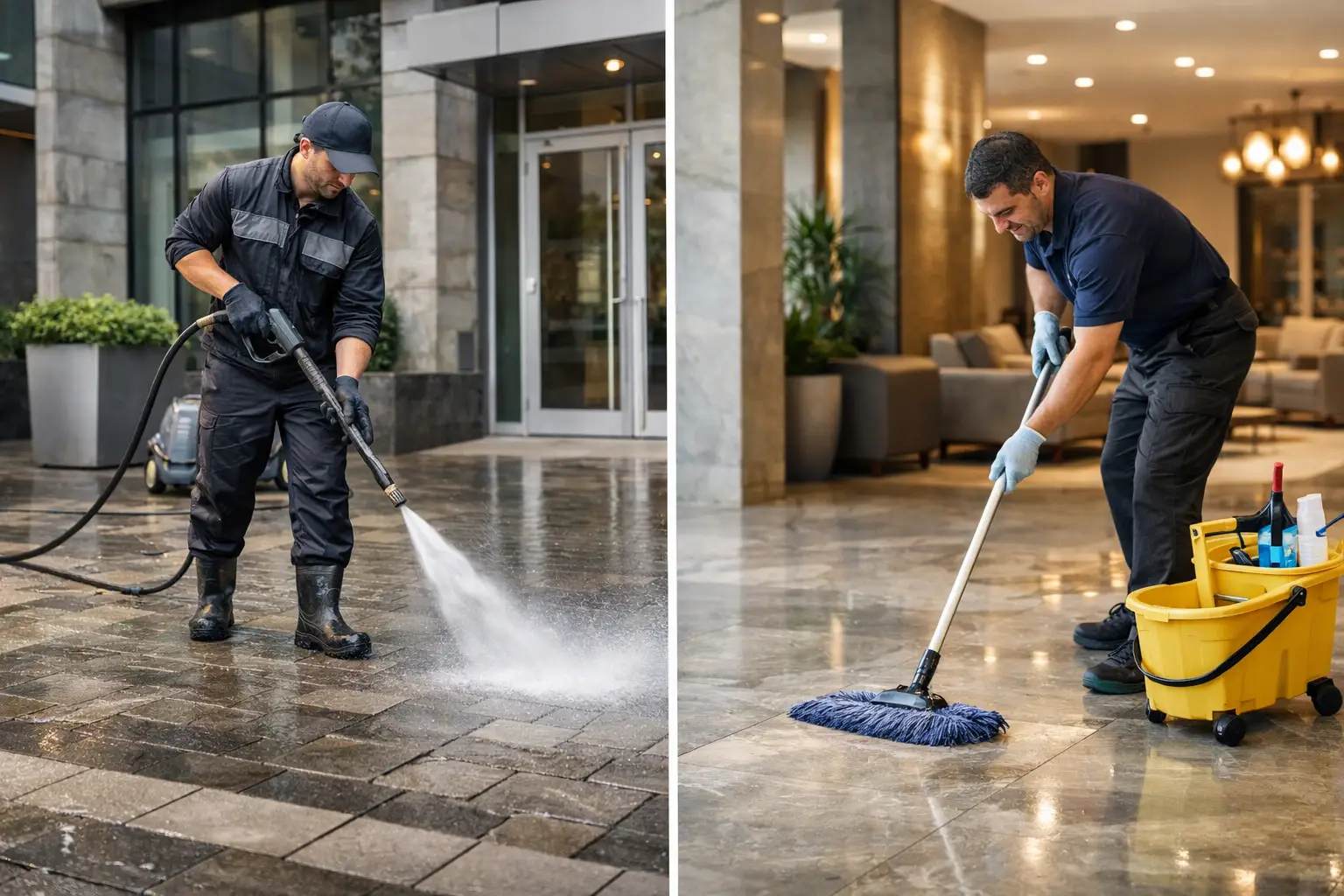
A building entrance marked by black deposits, a sidewalk that holds dirt, interlocking pavers dulled after winter: in the field, choosing between pressure washing vs manual cleaning is not a matter of aesthetic preference. It directly affects the result, surface durability, intervention time and even the image of the building.
For a property manager, condominium syndicate or maintenance lead, the right question is not “which method cleans better?” but rather “which method fits this surface, this level of soiling and this operating context?” That is where the difference is made.
Pressure washing vs manual cleaning: a real question of method
Pressure washing uses the force of projected water to detach embedded dirt, remove surface residue and speed up treatment of large areas. It is a fast method, especially suited to exterior mineral or hard surfaces such as concrete, certain low walls, sidewalks, curbs and interlocking pavers when the intervention is properly calibrated.
Manual cleaning relies on the mechanical action of brushes, pads, squeegees, cloths or products applied with control. It takes more time, but it allows a precise, localized and less aggressive approach. On fragile materials, delicate finishes or detailed zones, it often remains the safest solution.
Opposing the two methods absolutely would be a mistake. In commercial and multi-unit environments, they are often complementary. The right choice depends on the material, accessibility, type of soil and expected finish level.
When pressure washing has the advantage
On exterior surfaces exposed to weather, pressure washing saves time in a way that is hard to match. Attached dust, dried mud, organic marks, post-work residue or deposits accumulated over several months come off more effectively with pressurized action than with simple manual brushing.
For a commercial site or condominium, this advantage is concrete. A large driveway, circulation area, paved backyard or service zone can be brought back to standard quickly, with a clear visual result. When work must be done within a short window, before a business opens, an inspection, an important delivery or a site restart, speed matters as much as cleaning quality.
Pressure washing is also useful when soiling is irregular but widespread. Manual cleaning over hundreds of square feet becomes costly in labor and inconsistent in output. In that case, water pressure offers better productivity.
That said, the effectiveness of pressure washing depends on its setting. Poorly adapted pressure can mark the material, move joint sand, damage certain painted surfaces or promote water infiltration in sensitive areas. A high-performing method remains one that is controlled.
The limits of pressure washing
The main risk of pressure washing is believing it works for everything. It does not. On treated wood, certain older coatings, weakened joints or already cracked surfaces, pressurized water can do more harm than good.
The immediate environment also has to be considered. In an occupied common area, near glass entrances, equipment, parked vehicles or electrical elements, pressure washing requires serious preparation. The goal is not only to clean fast, but to clean without creating collateral damage.
Finally, pressure does not always replace treatment. Some grease stains, paint residue, rust marks or construction deposits require products, dwell time or complementary manual work. Pressure alone does not solve everything.
When manual cleaning remains the better choice
Manual cleaning has a clear advantage wherever precision is required. On baseboards, thresholds, corners, detailed vertical surfaces, architectural elements or sensitive finishes, it allows measured action. Where pressure washing treats the surface in volume, manual cleaning treats the material with finesse.
It is often the right approach after construction, when different surfaces coexist and each requires a specific method. Removing fine residue, working near joints, frames, aluminum, glass or freshly installed materials requires a level of control that pressurized intervention does not always allow.
Manual cleaning is also relevant when the objective is not only to “strip dirt,” but to obtain a more uniform finish. Some soiling needs to be detached gradually without attacking the substrate. In this context, patience often gives a better result than power.
The limits of manual cleaning
Its main weakness is simple: it takes time. On large exterior surfaces, manual cleaning quickly becomes less cost-effective. For a manager who has to maintain several buildings or restore an entire site, this constraint quickly affects both budget and deadlines.
It can also be less effective on deeply embedded soil. When deposits have been in place for a long time, manual action alone can require significant effort for a partial result. In that case, the real cost is not only time spent, but the gap between effort and the cleanliness level obtained.
What should guide the choice on a building or commercial site
The first criterion is the nature of the surface. Raw concrete, an exterior sidewalk or properly installed interlocking pavers do not call for the same intervention as decorative cladding, a delicate facing or an edge composed of several materials. Always look at the substrate before choosing the method.
The second criterion is the type of soil. Surface dust, seasonal accumulation, organic deposits, traffic marks or construction residue do not react the same way. The more embedded the dirt and the larger the area, the more pressure washing becomes relevant. The more localized the stain or sensitive the material, the more manual cleaning regains the advantage.
The third criterion is site use. On a main entrance, busy common area or visible facade, the final visual quality matters a lot. On a technical zone, the goal may be more functional. This difference influences the expected detail level and therefore the preferred method.
The fourth criterion is risk. Aggressive cleaning on the wrong surface can cost far more than a slower but adapted intervention. In property asset management, preserving materials is part of cleaning.
The best approach is often mixed
In practice, the best results often come from combining both. A main surface can be treated by pressure washing, then sensitive zones, edges, details or stubborn residue can be corrected manually. This logic reconciles output and control.
This is especially true on complex sites such as multi-unit buildings, condominiums or commercial properties with active circulation. A ramp, threshold, pedestrian parking area and landscaped border are not treated exactly the same way, even if all of them are part of one mandate.
A specialized company knows how to adjust the intervention to the real site, not to a method imposed in advance. That is where execution makes the difference.
Pressure washing vs manual cleaning: think result, not only process
Comparing pressure washing vs manual cleaning only on speed or price is too narrow. What matters to a decision-maker is the result obtained, how it holds over time, absence of damage and ease of execution. A method that looks cheaper on paper can become the most expensive if it must be redone or damages the surface.
In Greater Montreal, with freeze-thaw cycles, salt, construction dust and wear in common areas, exterior surfaces require a precise reading. Good cleaning is not only visible on the same day. It also prepares what comes next: better presentation, less residual accumulation and more coherent maintenance over the seasons.
At Nickel & Krome, this field logic guides specialized interventions: choosing the right method, at the right level, for the right substrate. It is often less spectacular than a facade before-and-after, but much more useful for a manager who wants reliable work.
When you have to choose between speed and precision, the right answer is often simpler than it looks: choose the method that respects the surface while meeting the site’s standard.
Apply this guide to your property
Review the scope, access requirements and service details for Commercial pressure washing in Montreal, Laval, and the North Shore.