
Prepare a Building Before Pressure Washing
Preparing a building before pressure washing reduces risk, protects surfaces and helps deliver a clean, durable and controlled result.
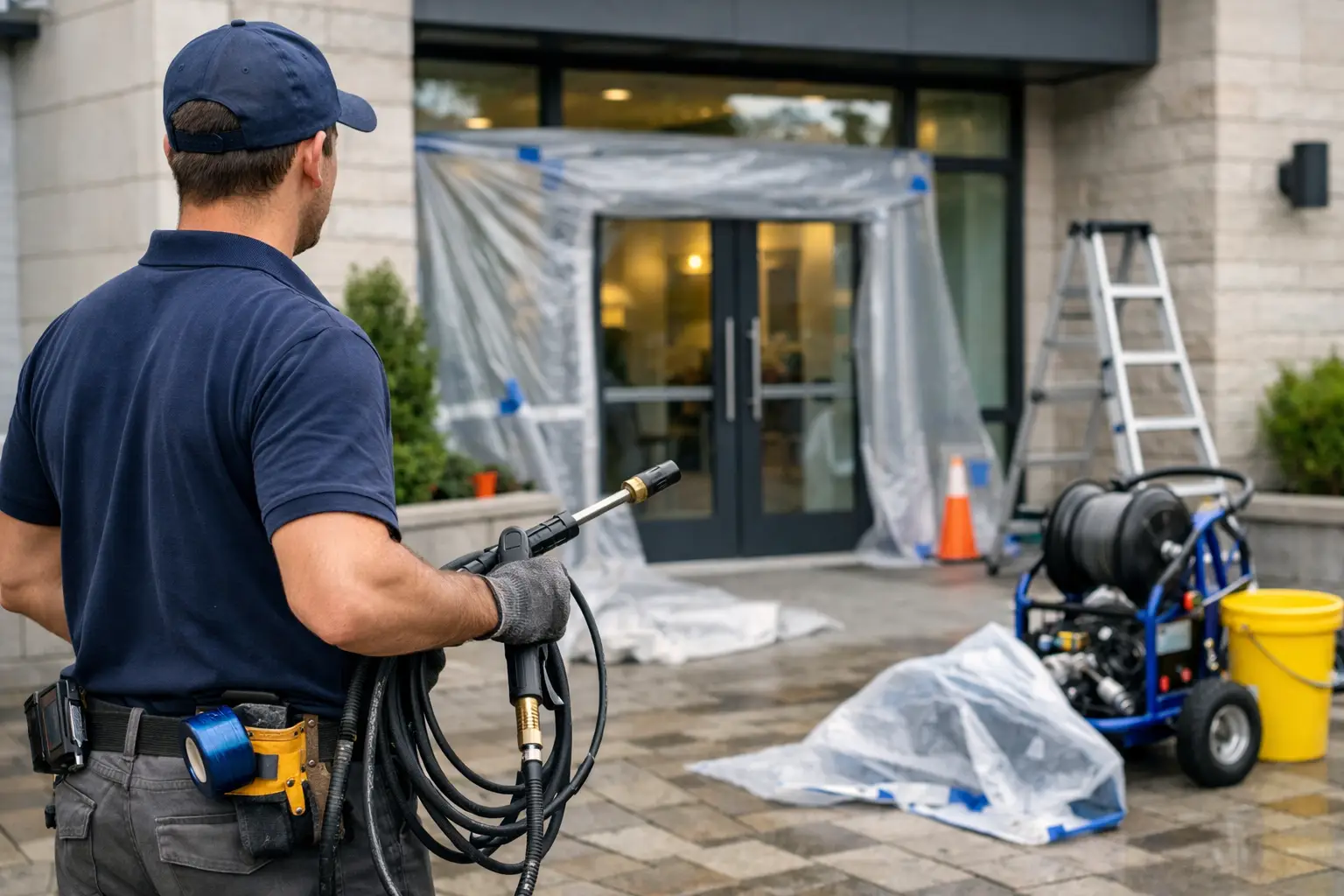
Preparing a building before pressure washing reduces risk, protects surfaces and helps deliver a clean, durable and controlled result.
Poorly prepared pressure washing rarely leaves only an aesthetic problem. On a commercial building, multi-unit property or end-of-project site, a lack of preparation can lead to water infiltration, overspray on glass, damaged joints or an uneven result that forces the work to be repeated. Preparing a building before pressure washing is therefore not a detail.
It is a control step that affects safety, finish quality and the durability of surfaces.
For a property manager or maintenance lead, the goal is simple: prevent an exterior cleaning intervention meant to improve the property from creating new issues to correct. Preparation identifies sensitive zones, organizes access, protects vulnerable elements and adapts the method to the type of surface. The more exposed, occupied or mixed the building is, the more this phase matters.
Why preparing a building before pressure washing changes the result
Pressure alone does not clean intelligently. It removes dirt, but it can also expose or worsen an existing weakness. A tired joint, cracked perimeter seal, already weakened cladding or peeling paint will not react to pressurized water the same way.
This is where preparation makes the difference. It helps determine what can be washed with direct pressure, what should be treated at lower intensity, and what may require another approach. On some buildings, the facade is uniform and the intervention stays simple. On others, brick, aluminum, concrete, signs, soffits, glass and technical equipment are all present. In that case, applying one single method is rarely a good idea.
Preparation also has an operational role. It reduces interruptions, prevents oversights and helps anticipate water management, access and zones that need to be secured. On an occupied site, this is often what separates a smooth job from an intervention that disrupts users.
The preliminary building inspection
Before any equipment is installed, the building has to be read properly. This starts with a visual review of facades, access points, heights and the general condition of surfaces. Deposits do not all have the same nature. Urban dust, organic marks, black runoff beneath metal components or construction residue are not treated the same way.
This inspection is also used to identify weak points. Deteriorated masonry joints, cracks, possible water-entry points around openings, exterior lighting, outlets, cameras, electrical boxes and signs must be identified before washing begins. On an older building, this step is even more important because some finishes tolerate excessive pressure poorly.
The objective is not only to observe the existing condition. It is to decide where to work, with which angle, which distance and which intensity. Good washing rarely starts with the machine. It starts with the diagnosis.
Checking materials and their limits
Exterior materials do not all react the same way to water and pressure. Raw concrete generally tolerates sustained mechanical action better than some painted claddings, flexible joints or already aged surfaces. Interlocking pavers, for example, can lose jointing material if the nozzle is too aggressive or too close.
On a commercial property or condominium, repairs already completed on certain sections also matter. A recently repaired area, new caulking or paint touch-up may require a more cautious treatment. This is exactly the kind of detail that only appears when the building is evaluated before the intervention.
Securing the surroundings before washing
A building is not prepared in isolation. Its surroundings matter as much as its facade. Before pressure washing, circulation zones must be cleared, outdoor furniture moved or protected, pedestrian paths marked and the impact on nearby parked vehicles reviewed. In a commercial site, access management is essential to avoid unnecessarily disturbing occupants, customers or teams on site.
Ground surfaces also require attention. When water carries dirt away, some areas can become slippery. Water paths must be planned, overspray controlled and risks reduced during the intervention. On a busy site, the selected washing window can make a real difference. Early morning, outside peak hours or in localized phases, the operation becomes easier to control.
Preparing the surroundings also helps avoid dirtying what has just been restored. Poorly controlled facade washing can throw residue onto storefronts, doors, guardrails or entrances. The logic is simple: protect what you do not want to clean twice.
Protecting sensitive building components
When discussing preparation, protecting sensitive components is often the most underestimated step. Yet it is the one that limits incidents the most. Exterior outlets, lighting systems, intercoms, cameras, detectors, control boxes and ventilation zones must be covered or isolated according to their configuration.
Openings require the same discipline. A poorly adjusted door, a window with weakened sealing or a technical hatch that is not watertight can let water in if the washing angle is wrong. The risk is not theoretical. On some buildings, repeated spray in the wrong place is enough to create an interior problem.
Finishing elements must also be considered. Signs, stickers, window films, painted metal frames and decorative parts do not all tolerate the same cleaning intensity. Here again, the right method depends on the material, its condition and the level of soiling. This is not excessive caution. It is clean execution.
Preparing a building before pressure washing according to site use
The method changes depending on whether the site is an active business, an occupied condominium, a rental building or a post-construction property. On a commercial property, the image of the site must be protected as much as the installations. Work often takes place under visibility, customer access and operational-continuity constraints.
In a multi-unit building, occupants should be informed in advance, especially if balconies, windows or secondary access points are involved. Preparation then also becomes coordination. A resident who leaves a fragile item on a balcony or a window slightly open can complicate the work and increase risk.
At the end of a project, the challenges are different. Facades may carry dust, grout, mud or handling residue. They may also be new or freshly finished. The goal is to achieve a clean result without stressing recent materials. In this context, a specialized company like Nickel & Krome works with a restoration mindset, not a standardized approach.
Considering weather and schedule
Preparation is not only about the building. It is also about the intervention window. Pressure washing just before a major temperature drop, during strong wind or under excessive sun can complicate the work. Depending on the products used and surfaces treated, some conditions reduce effectiveness or increase the risk of marks.
Scheduling also matters. If painting, masonry, caulking or landscaping work is planned right after, the steps must be coordinated. The order of interventions has a direct impact on the final result and the maintenance budget.
What a professional checks before starting
A serious provider does not simply arrive with a machine and a hose. They check water access, required supply, the possibility of working at height if needed, the right nozzle type, the actual useful pressure and site-specific precautions. They also evaluate the washing sequence so dirty water does not pass back over areas already cleaned.
It may be useful to test a small discreet section when there is doubt about the surface. This is especially true on painted surfaces, composite cladding or older areas that have already been through several maintenance cycles. The test confirms the right combination of distance, pressure and technique.
This professional assessment saves time, but more importantly, it avoids costly mistakes. Successful exterior cleaning is not the one that goes fastest. It is the one that restores the property without causing rework, claims or peripheral damage.
When preparation reveals that pressure washing is not the only solution
Sometimes, while preparing a building before pressure washing, it becomes clear that the real need goes beyond simple cleaning. Joints to repair, oxidation stains, construction deposits, efflorescence or buildup in exterior common areas may require a complementary intervention.
This is common on commercial buildings and managed properties exposed over several seasons. The right decision is not always to increase pressure. Sometimes the treatment must be adjusted, the work divided into phases or surface cleaning combined with targeted restoration and protection of certain elements. This ability to adapt is often what separates acceptable service from truly controlled work.
A well-prepared building washes better, cleaner and with fewer surprises. For a manager, that means less friction, a better presentation of the property and an intervention that respects both the building and its daily operations. When preparation is done properly, pressure washing becomes a real maintenance tool, not another risk to supervise.
Apply this guide to your property
Review the scope, access requirements and service details for Commercial pressure washing in Montreal, Laval, and the North Shore.