
Operations guide
Post-move service-area cleanup in Downtown Montreal
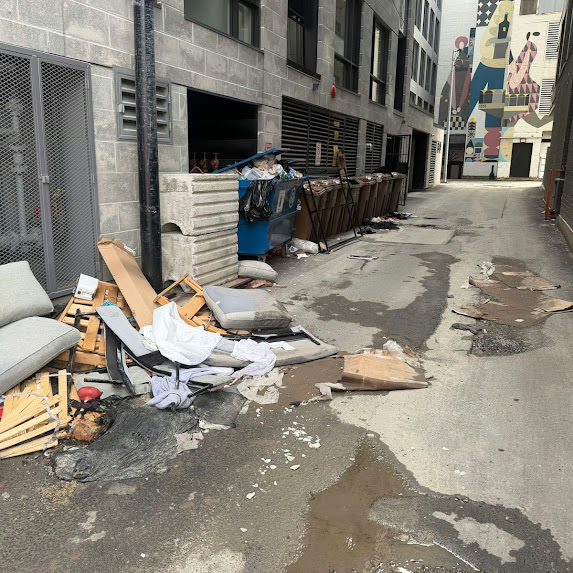
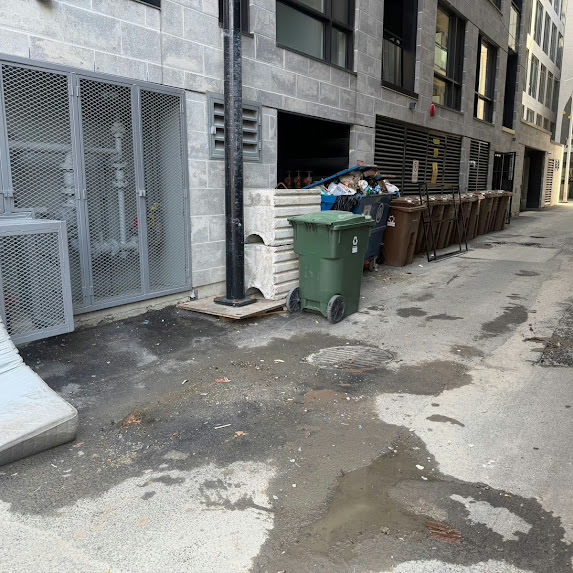
Authorized real photographs of a service area at a managed Ville-Marie condo tower; the documented result is the clearing of the main circulation path.
Direct answer
After a move in a downtown tower, putting a service area back in order requires confirmed access, a clear decision about what stays and what leaves, removal from the main circulation path, then sweeping and washing of reachable surfaces. The documented result should not promise that permanent floor marks or every stored item will disappear.
A service area can become difficult to use quickly after a move: furniture beside containers, items with no confirmed destination, packaging, waste, and reduced circulation around doors or equipment. In a Ville-Marie condo tower, this work involves coordination as much as cleaning because access, elevators, loading areas, and disposal authority must be confirmed before the team arrives.
This guide is based on a real intervention completed on July 1, 2026, at a managed condo tower in the René-Lévesque and Maisonneuve sector. Publication of the photographs was authorized with the mural and exterior context visible. The images document one precise improvement: the main circulation path was cleared. They do not claim that every item disappeared or that the surface was restored to like-new condition.
For a recurring commercial mandate in this area, see commercial cleaning in Downtown Montreal. This article remains an educational guide and one-time case; it is not a second local service page.
Documented case: clearing a service area after a move
Before the intervention, furniture, objects, and debris occupied a substantial part of the service area and the route used between the building, containers, and access lane. The work took place at a managed condo tower in the general René-Lévesque and Maisonneuve sector of Downtown Montreal. The exact address and client identity are not published.
Confirmed work included moving selected items on site, grouping materials near the containers, transporting items off site, disposing of waste, sweeping, and washing the reachable area. The sequence matters. Moving items without confirming their destination can transfer the obstruction, while washing before the route is cleared can slow the work and leave inaccessible patches.
After the intervention, the main path is visibly more open and the area is easier to read. Some material remains visible near the containers, and that limit is stated directly. The documented result is a circulation area put back in order, not a claim of complete emptying, disinfection, or full floor restoration.
The comparison also appears in the Nickel & Krome project portfolio. The same images are shown without content editing or artificial upscaling, using their original dimensions and separate before-and-after captions.
- Project completed July 1, 2026
- Managed condo tower in Downtown Montreal / Ville-Marie
- On-site movement, grouping, off-site transport, and disposal confirmed
- Sweeping and washing confirmed
- Result limited to visible and verified facts
Prepare access, responsibilities, and the work window
Downtown service areas are rarely independent from the rest of the building. They may share access with deliveries, a garage, a loading area, a freight elevator, or a door controlled by security. Preparation starts with a work window in which movement can occur without blocking residents, suppliers, or municipal collection activity.
The manager must also confirm who can authorize items to leave. A cleaning team should not decide on its own that furniture, a parcel, or equipment has been abandoned. A list, photographs, or an on-site decision reduces the risk of removing something that still belongs in the building.
Destination matters as much as handling. Some objects may be grouped in an agreed area, while others require off-site transport or an appropriate disposal stream. Volume, weight, stairs, distance to the vehicle, and permitted hours all affect the scope and time required.
For managers responsible for several properties, property management services can frame contacts, access, and responsibilities by site instead of treating every post-move reset as an improvised emergency.
- Confirm the person authorized to decide what stays and what leaves
- Photograph the area and identify the route that must remain accessible
- Reserve the elevator, loading area, or service entrance if required
- Verify security, delivery, and collection windows
- Separate items moved on site, transported off site, and disposed of
- Confirm water, drainage, and electrical access
- Define the expected result and limits of the existing surface
Separate sorting, on-site movement, removal, and cleaning
The word cleanup can hide several distinct operations. Sorting identifies categories and destinations. On-site movement reorganizes the area without taking the item off the property. Off-site transport removes an item from the building. Disposal confirms that it enters an accepted waste or recovery stream. Sweeping and washing then address the surfaces that have become reachable.
This distinction protects the manager’s expectations. A floor-cleaning assignment does not automatically include handling large furniture. Conversely, removing objects does not guarantee that old marks, oil stains, embedded residue, or surface defects will disappear after routine washing.
In the documented project, some items were moved or grouped near the containers while others were transported off site. Waste disposal was included. The after photograph therefore presents an honest result: improved circulation with material still present in the designated container area.
A written scope should identify unusual categories, heavy objects, materials that cannot enter ordinary collection, and any restriction imposed by the building. It should also state who covers disposal charges when they are not included.
| Operation | Decision required | Useful evidence | Limit to avoid |
|---|---|---|---|
| Move on site | Where may the item remain? | Marked zone or manager instruction | Creating another obstruction |
| Transport off site | Who authorizes removal? | Approved list or photograph | Removing an item still required |
| Disposal | Which stream accepts the material? | Collection instruction or receipt if required | Promising an unconfirmed stream |
| Sweeping | Which surfaces are reachable? | Photograph after clearing | Hiding still-blocked areas |
| Washing | Are water and drainage available? | Agreed method and area | Promising removal of permanent marks |
Sweeping, washing, and visible limits of the result
Sweeping removes dust, fragments, and mobile material that become reachable after handling. It also makes the floor condition easier to inspect before washing. This sequence avoids turning dry debris into slurry and helps identify obstacles that still need a decision.
Washing depends on the substrate, water access, drainage, temperature, and building rules. In a service area, residue should not be pushed toward a pedestrian route, doorway, equipment, or drain that is not intended to receive it. The method has to remain proportionate to the observed condition.
In this case, washing followed clearing and sweeping. The after photograph still shows marks and surface variation. They may come from prior use, the coating, or deposits that would require a separate method. The photographs therefore do not promise an even finish on every future assignment.
A useful closeout note records what was done, what remains, areas that were inaccessible, and steps that require further authorization. That precision prevents a functional reset from being mistaken for surface rehabilitation.
Coordination in a Ville-Marie condo tower
A condo tower combines residents, movers, delivery teams, maintenance staff, collection schedules, and sometimes ground-floor businesses. The service area must remain understandable to people working on different schedules. Managers can reduce accumulation by defining where temporary items belong and when they must be removed.
Residential building upkeep covers the recurring continuity of an occupied property. Condo common-area cleaning focuses on specific shared areas. A post-move reset remains a one-time intervention that can support those scopes without replacing them.
The René-Lévesque and Maisonneuve sector presents common downtown constraints: traffic, limited loading space, controlled access, collection windows, and the need to keep a usable route. Each address must still be qualified separately. This service coverage does not imply that Nickel & Krome has a physical office in Ville-Marie.
For an estimate, photographs should show the whole area, exit route, largest objects, stairs or thresholds, and the floor condition. Include the building type, desired date, access hours, and the person who will authorize disposal decisions.
Ville-Marie collections and verification of current rules
Collection rules are not identical for every item or address. The City of Montreal publishes an official page about collections in Ville-Marie with schedules, accepted materials, and sector instructions. The manager or authorized representative should check that information before placing materials beside containers or on public property.
Private handling and cleaning do not replace municipal rules. Depending on the material, volume, and building, another recovery stream or off-site disposal may be needed. Placing an item beside a container does not automatically confirm that the next collection will accept it.
Before the intervention, compare the item list with current instructions and identify what must remain on private property until transport. This step reduces unnecessary movement and helps keep the circulation route open after the team leaves.
Operational perspective: close the assignment with proportionate evidence
A before-and-after comparison is useful when it shows the same general angle and includes a precise description. Here, it confirms that the main route was cleared. It cannot establish the destination of every visible item or the origin of every floor mark. The text should complete the photograph without making the image say more than it proves.
The manager can request a short closeout note: items moved on site, objects transported off site, disposed material, sweeping, washing, observed limits, and recommendations. This record is more useful than a broad promise, especially when several suppliers or residents later use the same service area.
To reduce another accumulation, the building needs a post-move responsibility: area inspection, removal deadline, contact person, and procedure for unauthorized items. Those measures belong to building management and must reflect its rules; cleaning begins once scope and authority are clear.
Public photographs should also protect the client. Use a general sector instead of an address when disclosure is unnecessary, do not identify residents, and confirm permission when distinctive elements such as a mural are visible. This approach shows real work without turning operational evidence into an exaggerated commercial claim.
Frequently asked questions
- Can you clean a service area after a move in Downtown Montreal?
- Yes, subject to access, volume, authorization, and a confirmed destination for the items. Photographs, the exit route, and the available work window help define the scope.
- Is moving furniture automatically included?
- No. On-site movement, off-site transport, and disposal are separate operations. Each must be authorized and priced according to volume and constraints.
- Will washing remove every floor mark?
- No. Results depend on the surface, age of the marks, and permitted method. Routine washing is not complete surface restoration.
- Which photographs should be sent for a quote?
- Send an overview, the exit route, large objects, thresholds or stairs, container access, and visible floor conditions once the main areas can be seen.
- Why check Ville-Marie collection rules?
- Accepted materials, schedules, and procedures can change. The owner or manager should verify current municipal instructions before leaving items for collection.
Official sources and references
Official sources verified July 11, 2026.
This information is provided for general purposes. Schedules, accepted materials, responsibilities, and procedures may vary by address, building type, and current rules. Verify the applicable official instructions and obtain authorization from the owner or manager before moving or disposing of any item.