
Polymeric sand replacement in Montreal: when and why to act
Polymeric sand replacement in Montreal: signs it’s time to act, why climate and usage accelerate wear, and how to ensure a lasting repair for interlocking pavers.
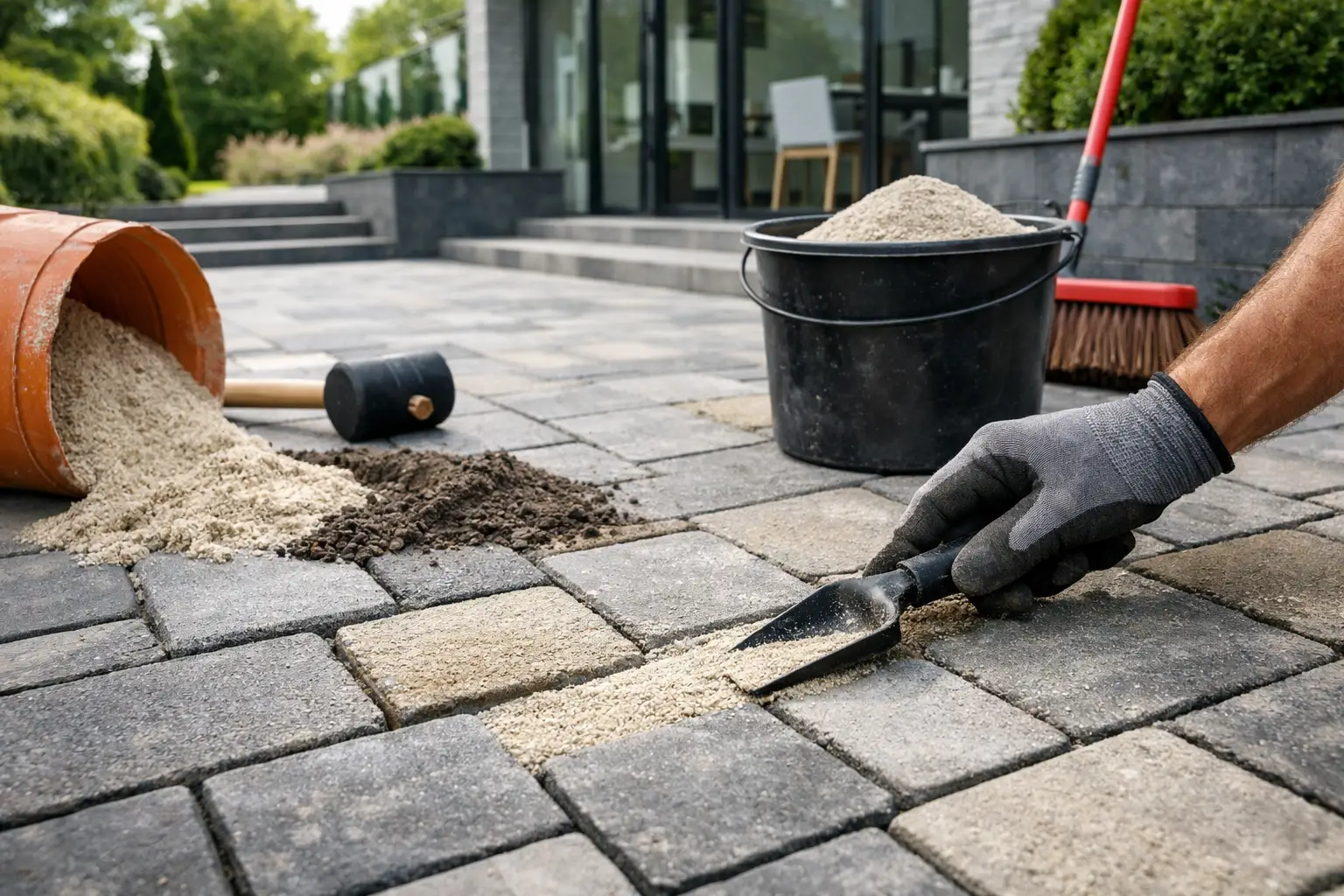
A shifting, green-tinged, or weed-infested interlocking paver surface isn’t always a surface problem. More often than not, the real red flag is the state of the joints. For a polymeric sand replacement in Montreal, the focus should be on the polymer sand between the pavers—its cohesion and ability to stay in place after rain, freeze-thaw cycles, and pressure washing.
In the Greater Montreal area, this issue often arises sooner than expected. Repeated freeze-thaw cycles, de-icing salts, heavy rainfall, and high-traffic driveways, walkways, and patios put joints to the test. When polymer sand degrades, it’s more than an aesthetic concern—it directly impacts the structural stability of the surface and the ease of maintenance.
When polymeric sand replacement becomes necessary
Polymeric sand isn’t a permanent material. When properly applied, it performs well for several years, but it eventually wears down, cracks, erodes, or detaches in sections. At this stage, simply adding fresh sand on top won’t solve the problem.
The first visible sign is often material loss in the joints. Spaces become deeper, uneven, and some sections may empty out almost completely. This frequently happens on surfaces exposed to runoff, improper slopes, or overly aggressive cleaning.
Another classic indicator is vegetation growing in the joints. While polymer sand doesn’t prevent organic growth forever—especially if debris accumulates on the surface—rapid or recurring weed growth usually signals that the joint is no longer performing its role effectively.
Other warning signs include ants, shifting pavers, moss, or sand dust reappearing after rain or snow removal. In multi-unit buildings, commercial properties, or high-traffic areas, these symptoms worsen faster than in low-use zones.
Why Montreal’s climate speeds up wear
Local conditions play a major role in a polymeric sand replacement project in Montreal. Joints here alternate between intense moisture, rapid drying, and deep freezes. This constant movement creates repeated stress that eventually opens joints or weakens their structure.
Snow removal also contributes. Poorly adjusted blades, metal shovels, and certain equipment can strip or erode the top layer of sand. Winter abrasives and salt further accelerate aging. Even a well-installed interlocking paver surface will show signs of wear if maintenance isn’t properly followed.
Pressure washing must also be done carefully. While it’s an excellent way to refresh a surface, miscalibrated pressure or an overly aggressive spray angle can empty existing joints. The surface may look clean immediately, but it’s actually more vulnerable than before.
Replacement vs. top-up: what’s the difference?
It all depends on the actual condition of the surface. If the polymer sand is slightly sunken but still cohesive, a partial intervention may suffice. However, if joints are contaminated, crumbly, improperly cured, or uneven over a large area, it’s better to start fresh.
This is where on-site evaluation makes the difference. A proper replacement isn’t just sweeping new sand over a degraded surface. The depth of the joints, adhesion of the remaining material, condition of the edges, and water behaviour around the pavers must all be checked. If these factors are overlooked, the new sand may not hold properly.
For commercial properties and multi-unit buildings, this distinction is critical. A quick repair may seem cost-effective, but if it needs to be redone soon after, the savings disappear. A targeted, durable intervention is always better than a superficial, short-term fix.
Steps for a well-executed polymeric sand replacement in Montreal
The outcome depends largely on preparation. The first step is to clean the surface in a controlled manner to remove dirt, organic matter, and accumulated debris. Depending on the paver condition, the existing joints must then be stripped to a sufficient depth to prevent old material from compromising the new application.
This phase is often underestimated. If joints remain partially filled with contaminated or poorly compacted sand, the new polymer sand will adhere poorly and cure unevenly. Cleaning must be thorough enough to create a sound base without damaging the paver edges.
Next comes filling. The sand must be evenly distributed, properly seated in the joints, and matched to the paver type and joint width. Not all products perform the same way—some work better for narrow joints, others for wider gaps or surfaces exposed to harsh weather.
Water activation requires precision. Too little water, and the binder won’t cure properly. Too much, and the product may migrate, stain the surface, or weaken once dry. Dry conditions, temperature, and sunlight directly influence this step.
What property managers should watch for
For a property manager, polymer sand isn’t just a cosmetic detail—it’s part of preventive maintenance. Weak joints encourage debris infiltration, vegetation growth, and, over time, paver shifting. On highly visible access points, this quickly degrades the site’s appearance.
Operational risks also matter. A deteriorating surface creates irregularities, traps more water, and becomes harder to maintain. In common areas, near building entrances, or on pedestrian paths, poor maintenance can lead to more extensive repairs than a simple joint replacement.
In these contexts, timing the intervention correctly is often more cost-effective than waiting for severe degradation. Spring and early summer are generally ideal periods, provided the surface is dry and weather conditions are stable.
Common mistakes that shorten lifespan
The most frequent error is applying polymer sand over wet or improperly cleaned joints. The product may seem to set, but its adhesion will be poor. Another common mistake is performing the work when rain is imminent or temperatures won’t allow proper drying.
Post-installation maintenance habits also matter. Overly aggressive cleaning, repeated use of metal tools, or failing to control leaf and soil buildup reduce joint performance. The wear isn’t always obvious, but it accelerates over time.
Finally, avoid treating polymer sand as a miracle solution. If the paver base is unstable, drainage is inadequate, or edging no longer holds the surface properly, replacing the sand won’t fix everything. It improves joint cohesion but doesn’t replace a failing structure.
An intervention that should fit into overall maintenance
On a commercial or multi-residential property, interlocking pavers contribute to the first impression. A quality polymer sand replacement is even more valuable when integrated into a broader outdoor maintenance plan, including surface cleaning, debris control, and regular monitoring of high-risk zones.
This is typically the most effective approach to extend the lifespan of outdoor surfaces and minimize major overhauls. A specialty cleaning company like Nickel & Krome works with this operational mindset, using methods tailored to demanding outdoor surfaces and the realities of Montreal-area buildings.
If your joints are starting to hollow out, crumble, or let pavers shift, the best reflex isn’t to wait for next season. Acting at the right time preserves the surface, simplifies maintenance, and keeps the exterior clean, stable, and consistent with the presentation standards expected of a well-managed site.
Apply this guide to your property
Review the scope, access requirements and service details for Paver services for existing surfaces.