
Paver Sealing Montreal: When and Why
Paver sealing in Montreal protects pavers against wear, stains and freeze-thaw damage when it is planned with the right method.
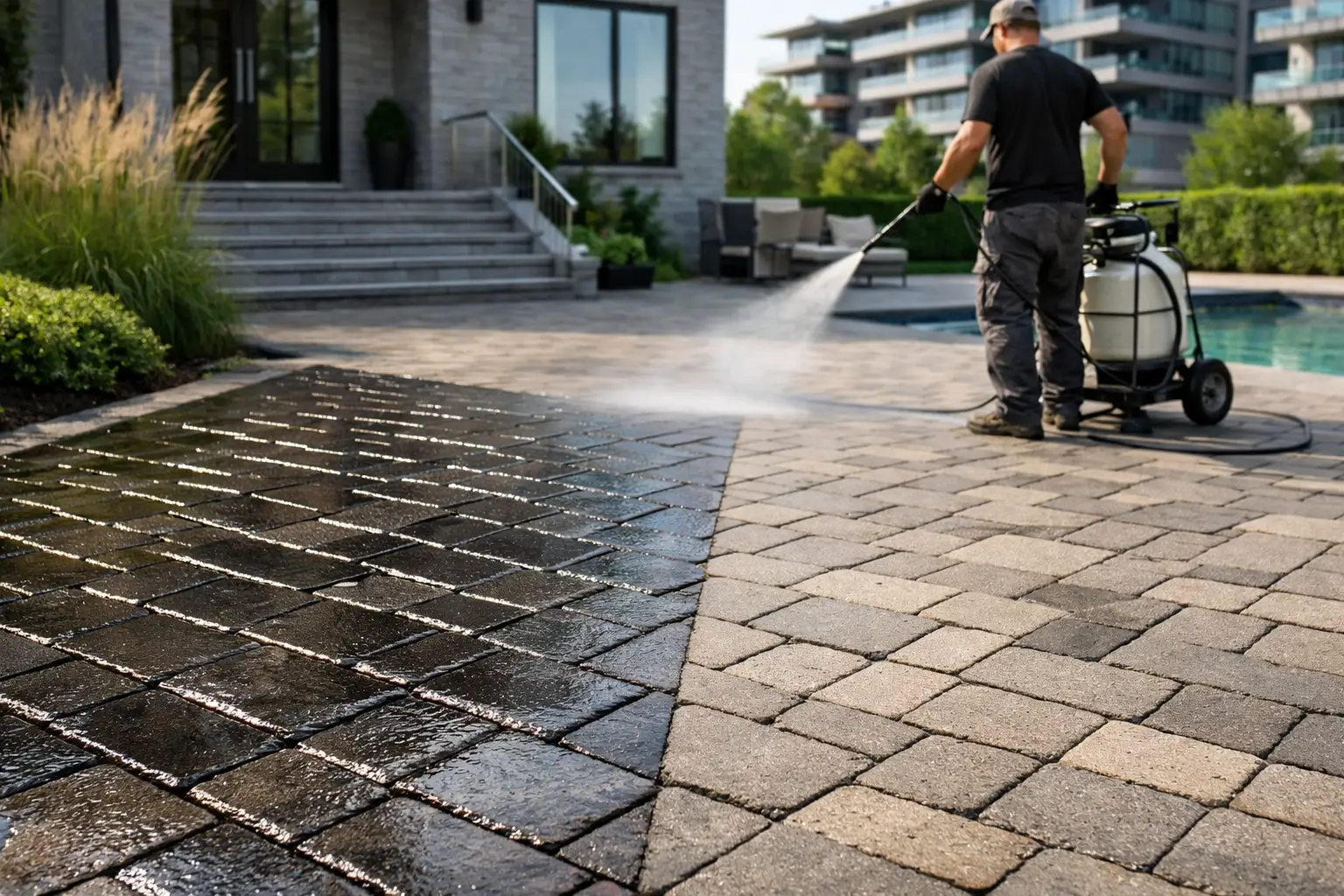
Dull interlocking pavers, weeds growing through joints or oil stains immediately change the perception of a building. For a property manager, condominium syndicate or commercial owner, this is not a small aesthetic detail. It signals relaxed maintenance. Paver sealing in Montreal comes up often for one simple reason: a clean and protected exterior surface supports the building’s image, slows deterioration and reduces heavy restoration work.
In the Montreal region, paved surfaces face much more than pedestrian traffic. Freeze-thaw cycles, abrasives, rain, UV exposure, vehicle movement and organic residue create a fast wear cycle. Sealing is therefore not a cosmetic finish applied at the end of cleaning. It is a protective step that must be planned methodically, at the right time and according to the real condition of the pavers.
Why paver sealing in Montreal requires a real method
In the field, two mistakes come up often. The first is believing that clean pavers are automatically ready to be sealed. The second is applying the same product uniformly to surfaces that do not all react the same way. A paved parking area, a condominium walkway and a commercial terrace do not have the same porosity, contaminants or finish expectations.
Sealer acts as a protective layer against water penetration, dirt and certain stains. It also helps stabilize the surface appearance and make routine maintenance easier. But its effectiveness depends directly on preparation. If the joints are empty, if efflorescence remains or if moisture is trapped in the pavers, the result can disappoint.
This is when whitish areas, an uneven finish or shorter-than-expected durability can appear.
For commercial and multi-unit sites, the issue is even more concrete. Poor execution often means rework, longer restricted-access zones and additional coordination with occupants or users. In other words, the real subject is not simply sealing. It is sealing under conditions that truly protect the investment.
What sealing brings, and what it does not do
Good sealing improves several things at once. It limits stain penetration, reduces the grip of some dirt, helps preserve paver colour and slows surface erosion. In some cases, it also helps hold polymeric sand in the joints, which can slow vegetation growth and paver movement.
However, it does not correct an unstable base, settlement, poor drainage or pavers that are already badly damaged. If the surface moves, water pools or joints are already compromised, sealing does not solve the underlying problem. This is where a serious approach makes the difference: first treat the surface condition, then decide whether sealing is relevant, not the other way around.
That nuance matters for decision-makers managing several properties. A treatment applied at the wrong time can create a temporary visual effect, but it does not replace targeted restoration. In some cases, it is better to deep clean, locally redo joints and postpone sealing to a more stable weather window.
When should interlocking pavers be sealed
The right moment depends on three factors: the age of the pavers, their exposure and their maintenance history. New pavers are not always sealed immediately. Natural salts often need time to rise and the surface needs to stabilize. By contrast, older pavers that have lost colour, absorb water quickly or stain easily can clearly benefit from protection.
In the Quebec context, the intervention calendar matters a lot. Cleaning and sealing must be done on a dry surface, with proper temperature and no immediate risk of rain. This is why the most favourable periods usually run from late spring to early fall. Too early in the season, ground moisture and temperature swings complicate the work. Too late, curing time can be compromised.
There is no universal frequency. A lightly used entrance does not have the same needs as a circulation area exposed to tires, salt and repeated manoeuvres. In practice, the surface is reassessed according to its wear level rather than following a fixed calendar without inspection.
The steps that make the difference in the result
The final result is rarely decided when the sealer is applied. It is decided before. Interlocking pavers meant to be protected must first be cleared of embedded contaminants, moss, organic residue, greasy dirt and, where needed, irregular old layers. Pressure washing can be part of the process, but it must be calibrated to clean without degrading joints or unnecessarily marking the surface.
Next comes the joint assessment. If polymeric sand is missing, displaced or contaminated, it must be corrected before sealing is considered. This step is too often neglected even though it directly influences the stability of the whole surface. Once the surface is cleaned and restored, real drying time must be respected. Not theoretical time, not the minimum delay on paper. The drying time imposed by weather and site configuration.
Product application must also be adapted. Depending on the paver type and desired effect, the same sealer and finish level are not always appropriate. A high-gloss finish may look appealing on some zones, but it can be less suitable for functional access points or areas where a more understated professional appearance is preferred. Again, it all depends on how the area is used.
Paver sealing in Montreal for commercial and multi-unit buildings
On a simple residential site, an intervention can sometimes be planned with more flexibility. In commercial or property-management environments, there is much less room for that. Access, pedestrian safety, delivery schedules, occupant movement and site image during the work must all be managed.
That is why paver sealing in Montreal, in a building context, should be treated as a technical maintenance operation. The goal is not only to have attractive pavers for a few weeks. The goal is to restore a clean surface that matches the building’s maintenance standard, then protect it durably with minimal disruption.
This logic is especially relevant for condominiums, commercial facades, exterior common areas and building entrances where first impressions matter. Poorly maintained exterior pavers suggest the rest of the site follows the same pattern. Clean, uniform and protected pavers immediately reinforce a serious impression.
What to verify before assigning the intervention
Before planning sealing, it is better to ask a few simple questions. Was the surface properly cleaned or only rinsed? Do the joints need correction? Are there deep stains that require targeted treatment? Is drainage satisfactory? Most importantly, does the intervention calendar leave enough time for drying and curing?
These points prevent unrealistic expectations. They also help determine whether the intervention should be done in one phase or several. For some managers, that distinction is useful for budget planning. It can be wiser to prioritize a full reset of the most visible zones, then extend protection to the rest of the site according to the maintenance cycle.
A specialized provider will also tell you when not to seal right away. That is often a good sign of seriousness. In this type of service, reliability is not measured by how quickly someone sells a product, but by the ability to recommend the right intervention sequence.
A maintenance choice, not a simple finish
For a well-managed building, interlocking pavers are part of the perceived envelope of the site. They frame access points, organize circulation and support a visible part of the occupant, visitor and client experience. Sealing therefore has its place, provided it is integrated into a clear maintenance logic, with rigorous cleaning, proper preparation and realistic timing.
This is the field approach where specialized companies such as Nickel & Krome bring real value: treating exterior surfaces as assets to maintain, not as a simple aesthetic item. When pavers are cleaned, restored and protected at the right moment, they remain easier to maintain and more consistent with the professional image of the building.
Before planning your next exterior intervention, look at your pavers the way occupants and visitors see them. If they already show signs of wear or neglected maintenance, acting early often costs less than correcting late.
Apply this guide to your property
Review the scope, access requirements and service details for Scellant pavé uni (French).