Graffiti Cleaning on Facades and Walls
Graffiti cleaning on facades, walls and exterior surfaces: methods, risks and criteria for acting quickly without damaging the building.
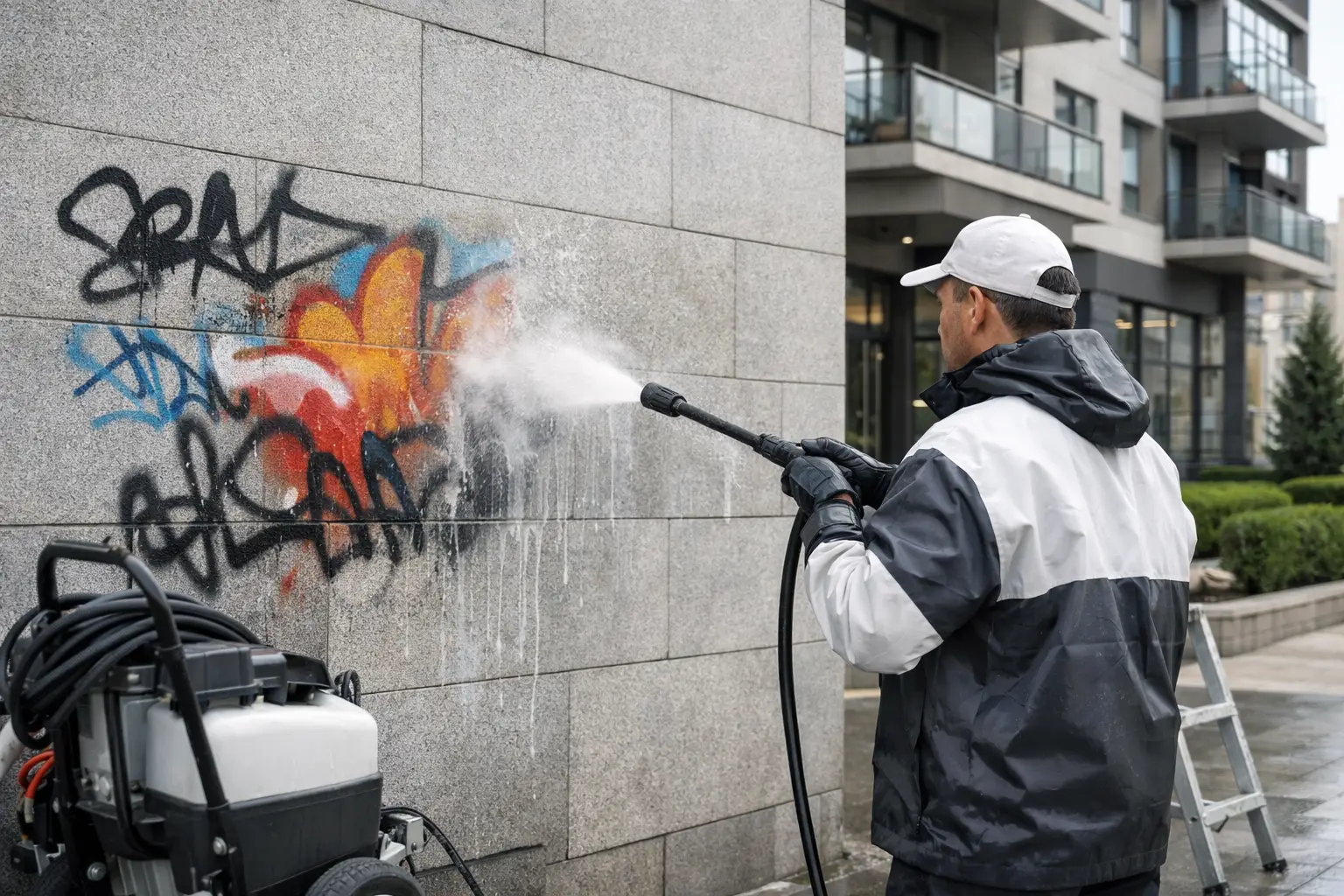
Graffiti that appears overnight on a commercial facade is not only a visual problem. It sends an immediate signal about site maintenance, manager responsiveness and the overall perception of the building. In this context, graffiti cleaning must be treated as a full maintenance intervention, with the right method, at the right time and on the right surface.
For a property manager, condominium syndicate or building owner, the issue is not simply removing a mark. It is restoring the appearance of the premises quickly without causing additional damage to brick, concrete, metal, glass or painted surfaces. That is where the difference between an improvised intervention and a specialized intervention becomes very concrete.
Why graffiti cleaning must be done quickly
The longer graffiti remains visible, the harder it becomes to manage in two ways. First, some products penetrate more deeply over time, especially on porous materials. Second, a marked facade that is not treated can give an impression of neglect, which matters a great deal in a commercial environment, multi-unit property or high-traffic building.
Speed does not mean rushing. Using an overly aggressive solvent, poorly adjusted pressure or an unsuitable technique can set the stain further, discolour the coating or alter the original finish. On masonry, poor cleaning can even open the material’s pores and make future markings harder to remove.
In urban areas such as Montreal and Laval, where buildings combine exposure to pollution, weather and daily wear, every exterior intervention must account for the real condition of the surface. A new wall, an older facade or a painted metal panel are not treated the same way.
Every surface reacts differently
This is often the most underestimated point. People talk about graffiti cleaning as if it were a simple gesture, when in practice everything depends on the substrate.
Brick, stone and concrete
Mineral materials are among the most sensitive because they are often porous. Paint or ink can migrate deeper, especially if the graffiti is not removed quickly. On these surfaces, it is generally necessary to combine an adapted product, controlled dwell time and precise rinsing. Excessive pressure can erode joints, mark concrete or create visible colour differences after the intervention.
Metal, aluminum and painted surfaces
On smoother surfaces, graffiti can sometimes be removed more easily, but the risk shifts. The danger is no longer only product penetration, but damage to the finish layer. A poorly chosen remover can dull a painted panel, leave a halo or cause loss of gloss. On a commercial storefront, this type of damage is immediately visible.
Glass, plastic and composite surfaces
These materials also require restraint. Some solvents can cloud plastics, attack protective films or leave greasy residue that is difficult to eliminate. On glass, abrasive gestures must be avoided because they can create micro-scratches, especially on storefronts exposed to direct light.
The most common graffiti cleaning methods
There is no single solution that works everywhere. An effective intervention depends on a quick diagnosis of the surface, type of marking and depth of penetration.
Chemical treatment is common. It consists of applying a product formulated to dissolve or soften paint, ink or marker. Its advantage is precision, but it requires real control. The right product on the wrong material can do more harm than the graffiti itself.
Pressure washing can also be used, alone or after treatment. It is relevant on certain exterior surfaces, especially when efficient rinsing is needed without leaving residue. But pressure, water temperature and working angle must be adjusted. Too weak, the result remains incomplete. Too strong, the surface deteriorates.
In some cases, more targeted techniques such as steam cleaning or micro-abrasive cleaning may be used. These approaches have their place on specific substrates, but they are not suitable for every building. A heritage wall, decorative facing or architectural finish often requires more caution than a simple technical wall behind a business.
What to avoid before any intervention
When graffiti appears, the temptation is strong to react immediately with products available on site. This is understandable, but rarely a good idea.
Universal cleaners, hardware-store solvents or improvised mixtures often create a false good result. On the surface, the marking appears to fade. In reality, it can spread, penetrate further or leave a permanent shadow. On a light wall, that residual trace is sometimes as visible as the original graffiti.
Locally repainting without complete cleaning can also create problems. The colour difference stands out, the area remains visible and the facade loses its uniformity. For commercial buildings or main entrances, this approximate patch effect harms the image as much as a partial marking.
The immediate environment must also be considered. A poorly controlled exterior intervention can splash glass, dirty a nearby coating, affect plantings or create runoff toward sensitive zones. On an occupied site, safety and perimeter cleanliness are part of the work.
Graffiti cleaning and building image
For managers and owners, the question is often simple: is it worth intervening quickly for a single marking? In most cases, yes.
A well-maintained building inspires confidence. This matters for tenants, visitors, clients and partners. Conversely, a marked facade gives the impression that the site is less monitored. In a commercial park, rental building or condominium, this detail can influence the overall perception of the premises.
The issue is even more sensitive after work or a reset. When a site has just been delivered, renovated or deep cleaned, visible graffiti immediately breaks the impression of cleanliness being sought. That is why exterior surface treatment often belongs to a broader maintenance logic, just like pressure washing, common-area cleaning or post-construction reset work.
When to call a specialized provider
As soon as there is doubt about the material, intervention height, size of the area or risk of deterioration, it is better to assign the mandate to a team used to demanding exterior surfaces.
A specialized provider does not simply erase a mark. They evaluate the substrate, choose the least aggressive method possible and work with a clear objective: recovering a clean, uniform and durable result. This result-based logic is especially important for professional buildings, where the appearance of the premises must remain consistent.
It is also an organizational issue. A manager has no interest in mobilizing several providers for the same perimeter if one partner can handle technical maintenance of interior and exterior surfaces. In this type of approach, graffiti cleaning naturally fits among the specialized interventions that a company like Nickel & Krome performs for commercial and property-management clients.
Prevent rather than repeat
The risk can never be eliminated completely, but the impact of repeat incidents can be reduced. On the most exposed sites, applying an anti-graffiti protective coating may be relevant. This choice depends on the facade type, location and frequency of incidents. Protection adds an initial cost, but it can make future cleanings much easier.
Prevention also involves visual monitoring of sensitive zones, maintaining a good overall level of upkeep and treating markings quickly. A clean, monitored building restored without delay often discourages repetition. This is not an absolute rule, but in practice, the general condition of the site strongly influences the frequency of visible damage.
For managers of real estate portfolios or multiple addresses, the best approach is often a simple procedure: fast reporting, surface assessment, adapted intervention and final visual control. This framework avoids improvised decisions and protects surfaces better over time.
What a professional client looks at before approving the intervention
A B2B decision-maker is not only looking for a price or availability. They want to know whether the intervention will be clean, framed and compatible with site constraints. This includes access, schedules, protection of surrounding areas, team discretion and the ability to work without unnecessarily disrupting occupants or activities.
The right provider must also be able to say when a perfect result is not guaranteed 100%. On some very porous or older materials, a residual shadow may remain despite a serious treatment. This transparency matters. It helps make the right decision between cleaning, partial touch-up or complementary preventive treatment.
Graffiti is never just a detail when it is on an entrance, facade or highly visible wall. Treated quickly and methodically, it stops being a lasting problem. Treated hastily, it can leave a trace more expensive than the marking itself. That is often where the real difference is made between cleaning and truly restoring a building.
Have facade graffiti assessed
To move from general guidance to a scoped commercial intervention, review the graffiti removal service for Montreal, Laval, and downtown. It explains surface risks, test patches, possible methods, access constraints, and the information needed for an assessment.
Apply this guide to your property
Review the scope, access requirements and service details for Commercial graffiti removal in Montreal, Laval and downtown.