
Foundation cleaning: when and how to act
Foundation cleaning prevents stains, deposits, and deterioration. Methods, risks, and best practices for commercial buildings and multi-unit properties.
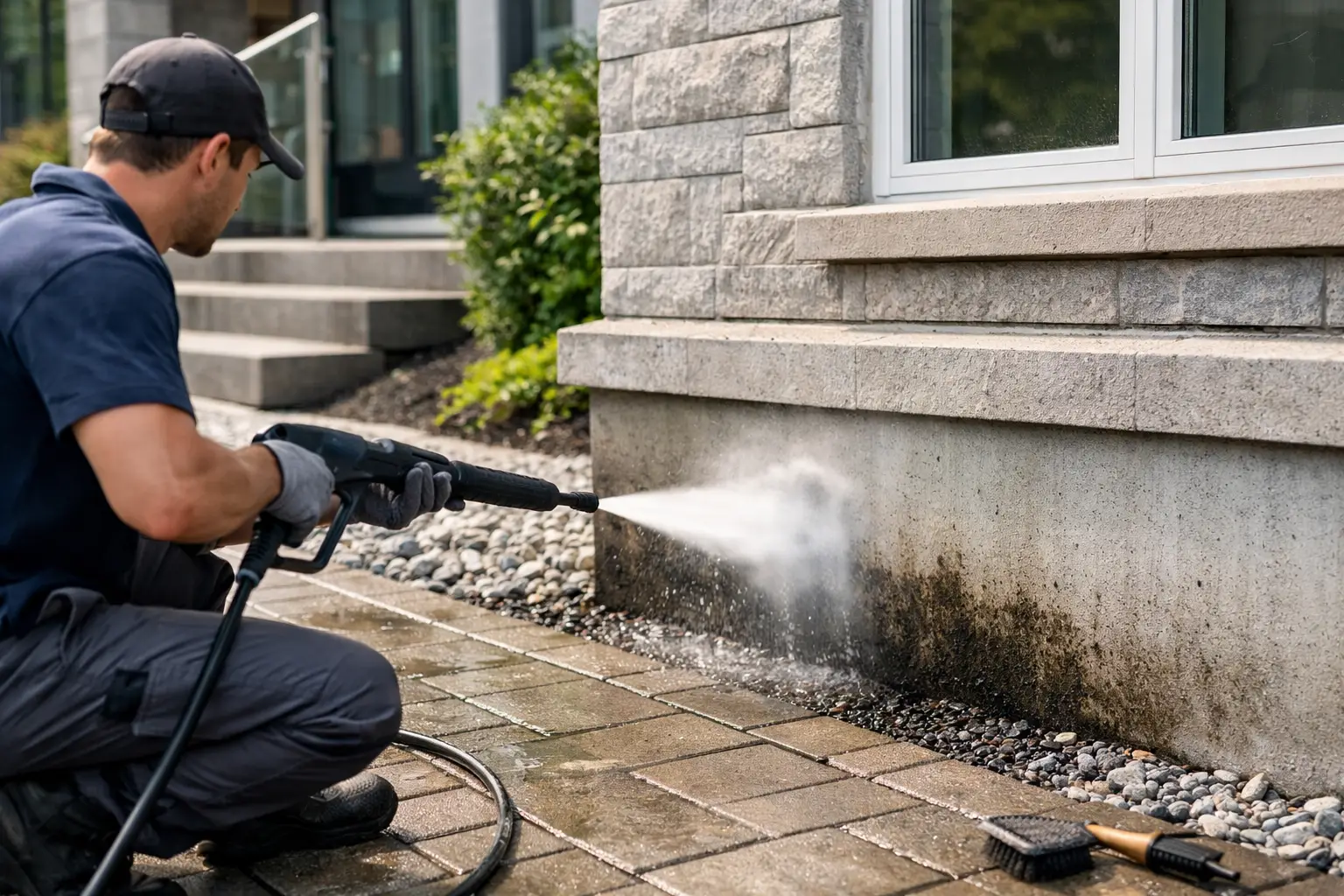
A façade may look fine from a distance, but if the base of the building is marked by streaks, embedded mud, white stains, or green deposits, the overall impression quickly changes. Foundation cleaning is not just an aesthetic detail. For a commercial building, a condo, or a multi-unit property, it’s an intervention that impacts the appearance of the premises, the durability of surfaces, and the perceived quality of maintenance.
In practice, foundations get dirty faster than the rest of the building. They collect splashes, residue from rain, deposits from snow removal, construction dust, and mineral buildup. In some buildings, they’re also the most overlooked areas during regular maintenance. The result is that grime sets in, hardens, and eventually requires a more intensive restoration than planned maintenance would have needed.
Why foundation cleaning really matters
The base of a building concentrates the most wear and tear. Water runs off, soil splashes, freeze-thaw cycles make dirt stickier, and porous materials retain more than you might think. When these deposits are left in place too long, it’s not just about appearance. It’s also about accelerated aging of surfaces.
On concrete, stone, stucco, or certain masonry finishes, the accumulation of dirt can mask more serious signs like micro-cracks, localized crumbling, or abnormal moisture stains. A well-executed cleaning also helps better assess the actual condition of the substrate. For a property manager, this is useful. It allows for earlier identification of what requires maintenance and what needs technical inspection.
There’s also a simple matter of presentation. In buildings used for commercial or rental purposes, the perception of professionalism comes from the details visible upon arrival. A well-kept entrance with clean foundations sends a signal of consistent maintenance. Conversely, a darkened or stained base quickly gives an impression of neglect, even if the rest of the site is well maintained.
What types of dirt affect foundations
Not all stains are treated the same way. This is where a rushed approach can waste time or damage the substrate.
The most common dirt includes splashes of soil, urban dust, organic residue, and moisture-related stains. In some buildings, efflorescence—whitish powder caused by the migration of mineral salts in materials—also appears. The issue here isn’t just visual. If efflorescence returns after cleaning, it may indicate a water movement problem that needs monitoring.
After construction, foundations may also carry traces of cement, grout, mortar, or fine, highly adherent dust. In this case, cleaning becomes more technical. The goal is to remove these without damaging the finish or altering the joints.
Another common case, especially around access points, parking lots, and exterior common areas, is greasy marks, pollution residue, and deposits from de-icing salts. These elements tend to embed themselves in the porosity of the material and often require targeted treatment rather than just rinsing.
Foundation cleaning: effective methods
The right process always depends on the material, the level of grime, and the building’s surroundings. There’s no one-size-fits-all solution.
Pressure washing: effective, but not automatic
Pressure washing can be a good option for removing surface deposits and quickly cleaning large sections. It’s often a suitable solution for solid concrete foundations, provided the pressure, working angle, and projection distance are adjusted correctly.
The risk, when the intervention is poorly calibrated, is opening up the surface, weakening the joints, or forcing water into already sensitive areas. On an old, cracked, or friable substrate, high pressure can do more harm than good. The useful reflex isn’t to wash harder, but to choose the right method.
Mechanical brushing and adapted products
When deposits are embedded or the material is more delicate, cleaning with controlled brushing and a specific product often yields better results. This approach allows for targeted treatment without damaging the entire surface.
This is especially true for mineral buildup, certain construction residue, or stubborn organic stains. Here again, the choice of product matters. An unsuitable cleaner can discolour, leave a film, or react with the material. For a building in use, safety for occupants and nearby surfaces must also be considered.
Controlled rinsing and finishing
The quality of cleaning is also judged by the finishing. If residue is merely moved without being properly removed, or if rinsing leaves dirty streaks lower down, the result appears incomplete. A good intervention includes the removal of dirt, control of splashes, and a visual check at the end of the process.
This is a point often underestimated on buildings with a polished image. A clean base but stained surroundings don’t give a professional result.
When to intervene
The right timing depends on the type of building and its exposure. On a high-traffic commercial site, a condo with visible entrances, or a multi-unit property with exterior common areas, waiting for stains to become obvious isn’t always the best option.
Spring is often a logical time to intervene after winter, especially when foundations have been exposed to splashes, sand, salts, and persistent moisture. Another useful window is after construction work, to remove residue before it sets permanently.
In some cases, a one-time cleaning is enough. In others, it’s more cost-effective to include foundations in a periodic exterior maintenance plan. This is often the right choice for buildings looking to avoid costly restorations and maintain a consistent appearance year-round.
What to avoid
The first trap is believing that all foundations can be cleaned the same way. A recent, dense, and non-porous substrate doesn’t react the same as an old, painted, stuccoed, or already weakened base. Forcing the pressure or using an overly aggressive product can cause visible damage immediately or more subtle but real damage in the medium term.
The second trap is treating only the stain without addressing its cause. If dirt keeps reappearing in the same spot, there may be an issue with drainage, runoff, ground slope, or water flow around the building. Cleaning remains useful, but sometimes the source needs to be corrected to prevent rapid recurrence.
Finally, avoid improvised interventions in occupied spaces. When cleaning affects entrances, walkways, common areas, or frequently used zones, managing access, splashes, and safety is part of the job. This is especially true for condos, commercial buildings, and multi-unit properties where maintenance must be done without unnecessarily disrupting users.
A different approach depending on property type
A small rental building doesn’t have the same constraints as a street-facing business or a multi-unit property. In a condo, foundation cleaning is often part of a broader maintenance plan for exterior common areas. In a commercial building, the goal is also to preserve a neat image for clients, tenants, or visitors.
In post-construction environments, the need changes again. The focus shifts from removing everyday dirt to restoring newly finished or recently modified surfaces, with a higher standard for finishing. In this context, a specialized company like Nickel & Krome intervenes with a precise execution plan tailored to the site’s real constraints.
For managers in Montreal, Laval, and the North Shore, this aspect matters. Buildings there face a unique mix of weather, pollution, freeze-thaw cycles, and seasonal deposits that make lower surfaces more vulnerable than one might expect.
How to assess whether an intervention is necessary
A simple indicator is to observe the regularity of stains. If the base of the building shows dark bands, whitish deposits, green or brown marks, or a clear difference between sheltered and exposed areas, cleaning should be considered.
It’s also important to monitor the progression. A light, recent stain is generally easier and less costly to treat than an old buildup. The longer you wait, the more intensive the restoration will be, requiring more time and sometimes multiple passes. For a maintenance manager, the real question isn’t just “is it dirty?” but “if I wait another season, will the intervention be much more difficult?”
One last criterion helps make the decision: consistency with the rest of the site. When windows, entrances, interlocking pavers, or common areas are well maintained, neglected foundations become even more noticeable. At this stage, cleaning isn’t an extra. It’s the logical finishing touch of professional building maintenance.
Foundations aren’t the most spectacular part of a building, but they’re among the first to reveal the real quality of its upkeep. Keeping them clean preserves appearance, makes surface monitoring easier, and prevents simple grime from turning into a more costly problem to fix. The right time to act is often before it becomes too visible.
Apply this guide to your property
Review the scope, access requirements and service details for Commercial pressure washing in Montreal, Laval, and the North Shore.