Exterior pressure washing in Montreal: best practices and key considerations
Exterior pressure washing in Montreal for buildings, businesses, and condos: methods, surfaces, frequency, and common mistakes to avoid.
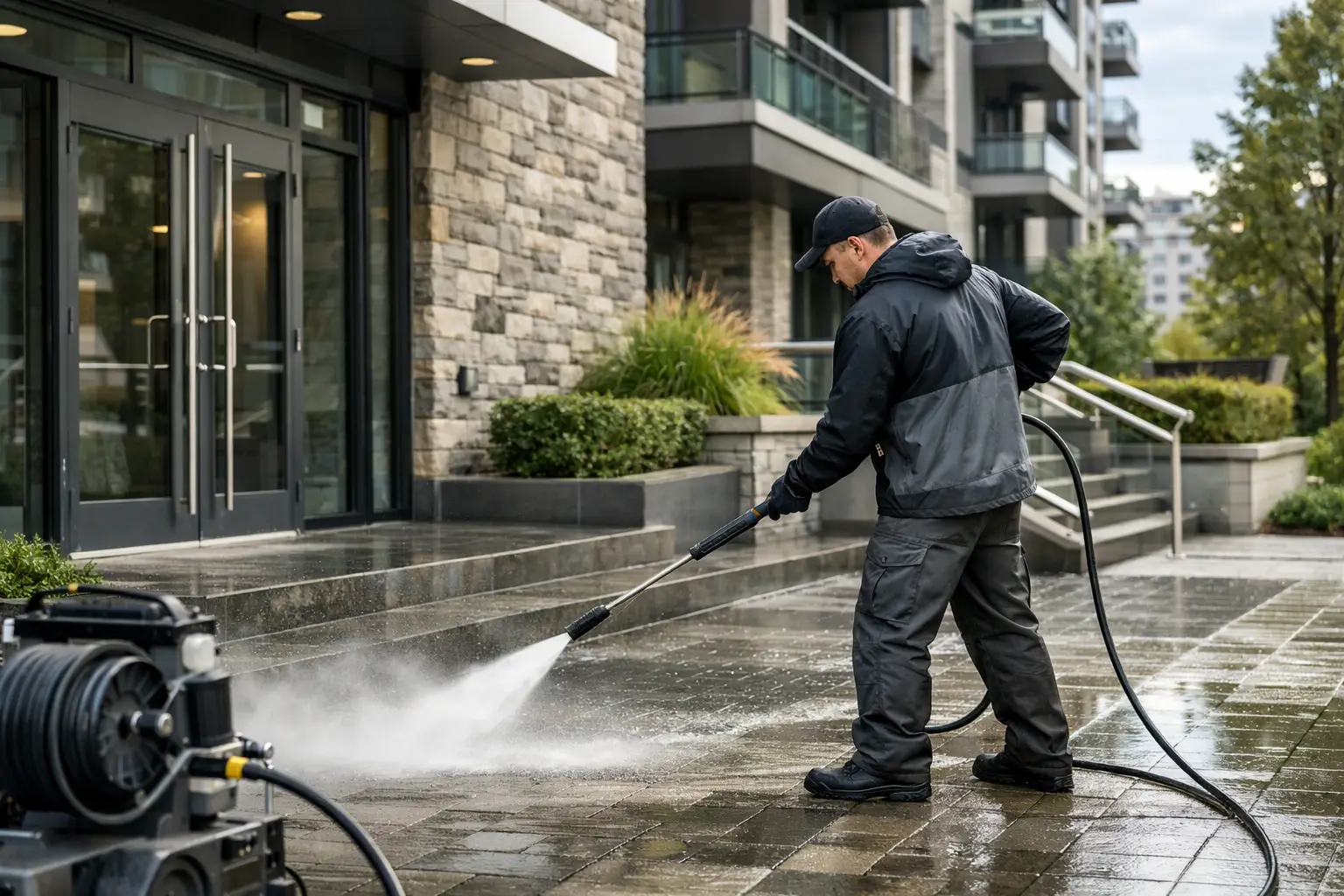
A darkened sidewalk, interlocking pavers overrun with moss, or a façade marred by grime can quickly give the impression that a building is less well-maintained than it actually is. In a market where the appearance of a space matters as much as its actual condition, exterior pressure washing in Montreal addresses a very real need: restoring outdoor surfaces efficiently without improvisation or costly damage.
For property managers, condo boards, commercial owners, or contractors wrapping up a construction project, this isn’t just about "cleaning outside." It’s about selecting the right method based on the surface, level of soiling, site usage, and timing. Overly aggressive cleaning can damage joints, mar coatings, or simply shift dirt around rather than solving the problem. Conversely, a well-calibrated intervention improves appearance, reduces future buildup, and makes routine maintenance easier.
Why exterior pressure washing in Montreal requires a real method
In Montreal and the North Shore, outdoor surfaces take a beating. Salt, traffic dust, organic residue, rust stains, water streaks, and construction debris accumulate quickly. In some properties, winter leaves behind stubborn gray deposits. In others, it’s pedestrian zones, loading docks, and parking areas that degrade visually.
Pressure washing remains one of the most effective ways to treat these surfaces, but pressure is only one parameter. Flow rate, water temperature, nozzle type, working distance, and surface preparation matter just as much. A newly poured concrete slab isn’t treated the same way as older interlocking pavers, and a commercial façade isn’t cleaned the same way as a greasy loading area.
This is where quality gaps appear. Two providers may offer "pressure washing," yet the final result, drying time, and risk to materials can vary widely.
Which outdoor surfaces can be pressure washed
Common needs include entrances, sidewalks, driveways, parking areas, retaining walls, low façades, loading docks, exterior stairs, and interlocking pavers. In commercial or multi-unit properties, outdoor common areas are often the first to dull a building’s image. A clean surface isn’t just about aesthetics—it also conveys a sense of consistent management, which matters to both residents and visitors.
Interlocking pavers require special attention. They can handle certain interventions, but not an improperly dosed cleaning that erodes joints or weakens the surface’s stability. Concrete, for its part, may retain deep stains despite a standard pass if grime has penetrated. In such cases, the treatment must be adjusted rather than blindly increasing pressure.
Post-construction sites present another unique challenge. Fine dust, mortar residue, construction traffic, and stored materials outside create specific deposits. On these jobs, the goal is to deliver a clean exterior without damaging newly finished or recently completed work.
What a proper pressure wash should actually address
A quality service isn’t judged solely by "before and after" photos. It must tackle the right problems. While visible dirt is often the focus, outdoor surfaces accumulate contaminants of many kinds.
These can include a gray film from urban pollution, algae or moss in damp areas, black stains in joints, water streaks on walls, or greasy deposits in service areas. Each case requires a distinct level of action. Sometimes, a simple pressure rinse suffices. Other times, preparation, a specialized cleaning agent, or multiple controlled passes are needed.
The key point for decision-makers is to avoid overly broad promises. Some old stains won’t disappear completely in a single pass. Some highly porous surfaces may retain a slight mark even after thorough cleaning. A reliable provider sets clear expectations upfront and explains what falls under cleaning, leveling, or more advanced restoration.
When to schedule exterior pressure washing in Montreal
The right timing depends on the type of property and its use. For condos or multi-unit buildings, spring often works well to erase winter’s lingering marks and restore access areas. For businesses, an intervention before peak season, terrace openings, or important visits can be strategic. For light industrial sites or high-traffic buildings, a more regular schedule may be justified.
There’s no universal frequency. A building exposed to busy streets, trees, or nearby construction will get dirtier faster. Conversely, some sites only need a well-executed leveling pass followed by light maintenance between visits.
Post-construction contexts often call for a distinct intervention. Waiting too long lets residue settle in. Acting too early—before materials have fully settled—can mean needing to repeat the work. The right timing is determined by the project’s progress and the condition of surfaces already in place.
Common mistakes that end up costing more
The first mistake is assuming that more pressure automatically means better results. On-site, the opposite is often true. Excessive pressure can erode joints, streak certain surfaces, damage weakened areas, or blast dirt onto already clean sections.
The second mistake is treating all surfaces the same way. Exterior stairs, concrete slabs, low siding, and interlocking pavers don’t react identically. Without at least a basic assessment, you risk poor finishing.
The third mistake is overlooking the surrounding environment. Pedestrian access, splash management, water runoff, and protection of adjacent areas are critical—especially in occupied spaces. In commercial or multi-unit buildings, a well-executed intervention should minimize disruptions and leave the site clean by the time the crew departs.
Finally, many underestimate the value of regular maintenance. When you wait too long, grime sets in deeper, and leveling becomes more intensive. The unit cost can rise simply because the surface was left untreated for too long.
What property managers and commercial owners expect
For this clientele, technical quality is essential—but it’s not enough. The real benchmark is operational reliability. An exterior intervention must be easy to plan, clear in scope, and consistent in execution. Maintenance managers don’t need complicated jargon. They want to know what will be cleaned, in what timeframe, and what level of result to expect.
They also expect a realistic assessment of the site. A main entrance doesn’t have the same priorities as a service courtyard. A highly visible area often deserves a more refined finish. A secondary space may only need functional maintenance. This nuance matters because it allows budgets to align with the actual use of spaces.
This is also why a specialized partner adds more value than a generic pressure wash. When a provider understands the constraints of commercial buildings, condos, and post-construction sites, they adapt the intervention to the context rather than applying a one-size-fits-all method. This is the approach Nickel & Krome prioritizes for its specialized projects across Greater Montreal.
How to evaluate a provider without wasting time
The first indicator is their ability to discuss surfaces, risks, and intended results concretely. A good provider doesn’t sell vague formulas. They ask about the material, age, level of soiling, accessibility, and circulation constraints.
The second indicator is the consistency of their service scope. A company experienced with commercial environments, multi-unit buildings, and restoration projects better understands scheduling and image imperatives. This changes the quality of follow-up.
The third point is consistency. Exterior cleaning isn’t just a one-time task. It often fits into a broader maintenance strategy, especially for properties aiming to maintain a professional appearance year-round. It’s best to choose a provider capable of integrating into this continuity.
Useful exterior cleaning, not just visible
Exterior pressure washing delivers an immediate improvement in appearance, but its real value lies elsewhere. It helps maintain cleaner access points, preserves the presentation of a property, and prevents a site from looking neglected even when it’s well managed. For commercial or real estate properties, this difference is noticeable quickly.
When the method is tailored, the outcome isn’t just about equipment power. It’s about the judgment applied on-site, surface by surface, with a clear objective. This is often what separates a simple cleaning from an intervention that’s truly useful for both the building and its operations.
The right decision isn’t to clean harder. It’s to clean smart—at the right time, with an execution level that protects both the property’s image and its surfaces.