
Exterior concrete cleaning without damage
Exterior concrete cleaning requires the right method, adjusted pressure and suitable products to remove stains, moss and grime without damaging the surface.
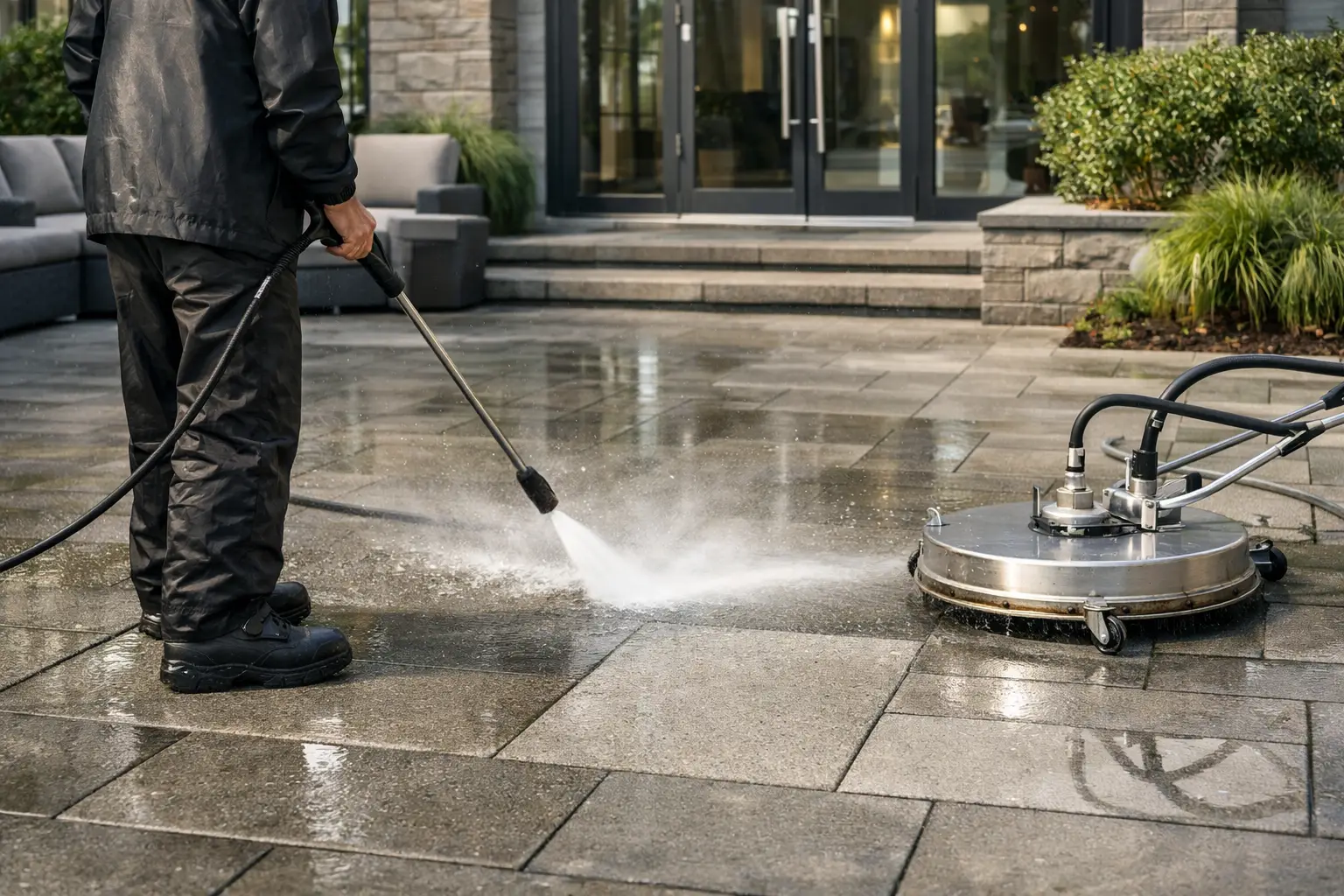
A darkening slab, a ramp marked by tires, a sidewalk stained after construction work—outdoor concrete cleaning is never just a quick rinse. Depending on the surface condition, type of grime and concrete finish, the wrong method can leave marks, open up porosity or accelerate wear. For property managers or commercial owners, the goal is simple: restore a clean, presentable and durable surface without creating a new problem while trying to solve the first.
Why exterior concrete gets dirty so quickly
Concrete is often seen as a tough material, so it’s assumed to be low-maintenance. That’s true structurally, but not when it comes to upkeep. Outdoors, concrete traps dust, absorbs liquids and easily collects greasy particles, especially in high-traffic areas, loading docks, entryways and parking lots.
Add to that freeze-thaw cycles, pollution deposits, rust streaks, organic residue and, in some cases, construction debris. A smooth concrete surface doesn’t react the same way as a porous, brushed or older slab. This is where many cleaning attempts miss the mark: the same approach is applied everywhere, even though the material doesn’t respond the same way.
In a commercial environment or multi-unit building, visual appeal matters as much as actual cleanliness. A stained entrance or a building’s perimeter covered in grime quickly gives an impression of neglect, even if the interior is well maintained.
Outdoor concrete cleaning: what to assess before starting
Before cleaning, you need to read the surface. It’s a very practical step, but often overlooked. New concrete can be more sensitive to certain products. Old, cracked or chalking concrete won’t tolerate overly aggressive pressure. An oil stain isn’t treated the same way as green moss, and cement laitance from construction work isn’t managed like simple embedded dust.
The right diagnosis starts with a few basic questions: what’s the nature of the grime, how long has it been there, what’s the concrete finish and what level of result is expected? In some cases, the goal is a quick visual refresh. In others, the surface needs to be restored without compromising its integrity.
This is also the stage to identify site constraints. Presence of windows, joints, landscaped areas, drains, adjacent flooring or pedestrian traffic—all of this affects the method. On an occupied site, execution quality matters, but so does the organization of the intervention.
Pressure washing: effective, but not automatic
Pressure washing is one of the most common methods for outdoor concrete cleaning, and for good reasons. It quickly removes surface grime, clears built-up deposits and significantly improves the appearance of a slab or sidewalk. But its effectiveness depends largely on pressure settings and technique.
Too much pressure can mark the concrete, slightly erode the surface or create visible shade differences once dry. On some more fragile concretes, you might get a clean result in the short term, but increase surface roughness, which will encourage future buildup. Conversely, too little pressure on an embedded stain will give a partial and often disappointing result.
Hot water can improve performance on greasy stains or certain stubborn residues. Nozzles, working distance and application angle also play a role. These are operational details, but they’re what make the difference between a clean surface and one that’s streaked, uneven or damaged.
Not all stains are treated the same way
On outdoor concrete, the most common grime is rarely uniform. A single area often has multiple issues: atmospheric pollution, gum, rust, moss, oil, construction dust or efflorescence.
Greasy stains usually require a different approach than simple pressure rinsing. If oil has penetrated, a specialized product is often needed, left to act, then followed by controlled cleaning. The result depends on how long the stain has been present and how absorbent the surface is. It’s important to be clear: some old stains can be significantly faded without disappearing completely.
Moss, algae and organic stains pose another challenge. Beyond the visual aspect, they increase the risk of slipping, especially in shaded or poorly drained areas. Here, the goal isn’t just to remove the green surface layer but to address the immediate cause of the growth to slow its return.
Rust stains, very common near railings, metal fixtures or outdoor furniture, also require precision. A poorly chosen product can discolour the concrete or create halos. On visible surfaces, targeted testing and monitoring the material’s reaction are essential.
After construction, concrete often needs specific restoration
At the end of a construction project, outdoor concrete rarely shows uniform dirt. Instead, you’ll often see a buildup of fine dust, cutting residue, traffic marks, sometimes mortar, paint or various splatters. The risk in this context is rushing the job.
Proper post-construction cleaning isn’t about indiscriminately stripping everything. It’s about preserving new surfaces, removing residue without causing scratches or chemical damage, and making access areas presentable for site handover or reopening. It’s a methodical job, especially on commercial buildings, new condos or multi-unit complexes.
For general contractors and property managers during the handover phase, this is often a sensitive point. An exterior slab that’s dirty or stained can give the impression of an unfinished project, even if the rest is up to standard.
How often should exterior concrete be cleaned?
There’s no universal frequency. It all depends on traffic, environment and usage. A busy commercial entrance exposed to street pollution won’t have the same maintenance schedule as a rarely used technical yard. In some cases, seasonal cleaning is enough. In others, two to four interventions per year are more realistic to maintain a consistent level of presentation.
The climate plays a clear role. In the Montreal, Laval and North Shore regions, winter often leaves behind a mix of sand, salt, black deposits and traffic marks that stain surfaces in the spring. Waiting too long can make cleaning heavier and more costly simply because grime has had time to set in.
For commercial and real estate sites, the best practice is to think in terms of maintenance rather than reaction. A regularly maintained surface recovers faster, with less aggression and a more uniform result.
What a specialized provider really changes
On paper, cleaning concrete seems simple. In the field, it’s experience, pressure adjustments and surface reading that ensure a successful outcome. A specialized provider knows how to adjust pressure, choose the right approach based on the grime, protect sensitive areas and intervene without unnecessarily disrupting site operations.
This is especially useful for occupied buildings, condos, outdoor common areas and post-construction contexts. The benefit isn’t just aesthetic. It also affects the durability of surfaces, user safety and the building’s overall image.
For managers looking for a reliable partner rather than an improvised intervention, this difference is real. Nickel & Krome specializes in this type of need, with an approach focused on execution, restoration and specialty cleaning.
Cleaning without overtreating
The best cleaning isn’t necessarily the most aggressive. On outdoor concrete, trying to make everything disappear in one pass can come at a cost to the surface. A well-chosen method seeks a balance between visual results, material respect and operational efficiency.
When concrete is part of a site’s image, it deserves better than a standard treatment. An adapted intervention helps extend its lifespan, reduce future buildup and keep the surroundings consistent with the building’s level of standards. It’s often this subtle care that changes the perception of a place from the first glance.
Apply this guide to your property
Review the scope, access requirements and service details for Commercial pressure washing in Montreal, Laval, and the North Shore.