Effective commercial building cleaning services
Commercial building cleaning goes beyond appearances—it preserves property value, reduces wear, and ensures a functional environment. Here’s how to structure a reliable and consistent cleaning service.
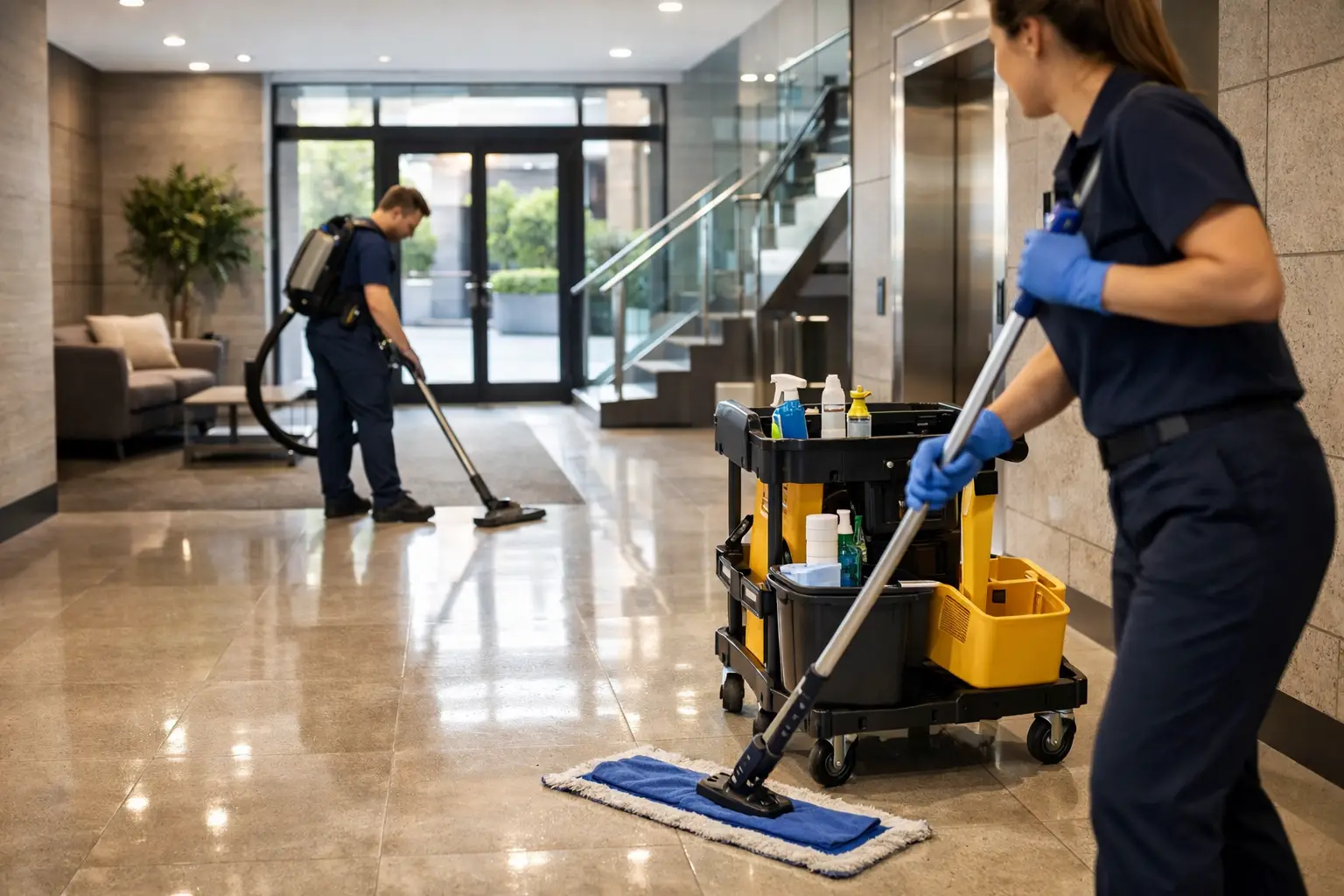
A stained lobby, a dusty stairwell, or trash piling up near exterior entrances says a lot about a building’s management. In commercial or multi-residential settings, commercial cleaning isn’t just about keeping spaces tidy. It protects the property’s image, reduces premature wear, and maintains a functional environment for occupants, visitors, and on-site teams.
For property managers, the real challenge isn’t scheduling a cleaning crew now and then. It’s about ensuring consistent quality in high-traffic areas, where needs shift with the seasons, building type, and surface conditions. This is where the difference between standard cleaning and a structured approach becomes clear.
What commercial building cleaning really includes
In practice, building cleaning relies on a series of coordinated interventions. Common areas come first—lobbies, corridors, elevators, stairwells, waste rooms, vestibules, and washrooms when applicable. But it’s also important to address often-overlooked surfaces like baseboards, interior glass at high-contact points, doors, handrails, frames, and corners where dirt accumulates quickly.
A quality service goes beyond mopping. It includes dust removal, targeted floor washing based on finish type, disinfection of high-contact points, waste management, and visual upkeep of traffic zones. In some buildings, more technical interventions are needed, such as after renovations, major moves, or when heavily soiled surfaces require restoration.
It’s also about observation. An experienced team notices early signs of buildup, recurring stains at certain entrances, areas needing more frequent attention, or surfaces reacting poorly to unsuitable products. This vigilance prevents unnecessary rework.
Why frequency makes all the difference
The quality of commercial building cleaning often depends less on marketing promises and more on the right execution rhythm. A high-traffic office building has different needs than a mid-sized multi-unit property. A condo with elevators, indoor parking, and multiple access points will also have different requirements than a small building with a single main entrance.
Cleaning too infrequently leads to visible neglect. Cleaning too often in certain areas can, in turn, drive up costs without real benefit. The right approach is to adjust frequency based on actual usage. Exterior access points in winter, vestibules during rainy seasons, and elevators in high-occupancy buildings typically need more attention than secondary, low-traffic zones.
This is where a well-designed maintenance plan becomes useful. It helps distinguish what needs to be done daily, weekly, or at longer intervals. This framework prevents oversights while giving both the supplier and the manager a clear view of expectations.
Building image hinges on the details
In real estate, first impressions are never just a detail. A clean, odor-free, clutter-free common area immediately reassures visitors. Conversely, a poorly maintained building gives the impression of poor management, even if the structure itself is in good condition.
For commercial buildings, the impact is direct. Clients, tenants, and partners perceive the environment’s quality before evaluating anything else. For condos and multi-unit properties, the cleanliness of shared spaces influences occupant satisfaction and the building’s perceived value.
This dimension is often underestimated. Yet consistent cleaning helps maintain the property’s reputation, reduces complaints, and simplifies day-to-day management. When spaces stay clean consistently, the manager spends less time correcting visible issues.
Zones requiring a more technical approach
Not all buildings need only routine cleaning. Some contexts require specialized interventions. This is the case after renovation work, following a major move-in, or after a period of intensive occupancy that leaves behind embedded residue, fine dust, or material stains.
Post-construction cleaning, for example, isn’t something to improvise. Gypsum dust, adhesive residue, window streaks, forgotten protective films, and finishing debris require a rigorous method. Using the wrong products or tools can damage newly installed surfaces that haven’t yet been properly protected.
The same logic applies outdoors. Interlocking pavers at entrances, sidewalks, loading zones, or concrete surfaces accumulate stubborn stains and grime. In these cases, cleaning may involve pressure washing or deeper restoration. The goal isn’t to clean aggressively, but to clean appropriately based on the surface and its level of soiling.
How to choose a provider without wasting time
For a property manager, the main criterion isn’t just price. What matters is the ability to execute correctly, maintain consistency, and intervene under real-world conditions. A provider may offer a competitive quote but fail to adapt to a building that demands consistency, flexibility, or occasional technical interventions.
First, verify if the company understands the environments it serves. Cleaning a commercial building, a condo, or a post-construction site follows different requirements than simple residential cleaning. Methods, equipment, and work organization must align with the building’s needs.
Clarity in services is also a good indicator. A vague mandate leads to unclear expectations. Conversely, a well-defined service specifies covered zones, frequency, planned tasks, and intervention limits. This reduces misunderstandings and makes follow-up easier.
Finally, reliability is the deciding factor. A consistent, present team that can flag issues often outweighs a broad but hard-to-maintain promise. In Greater Montreal, where buildings face highly variable conditions by season and occupancy, this regularity makes a real difference.
What an effective maintenance plan should include
An effective plan is rooted in the building’s reality. It considers traffic patterns, peak periods, flooring types, waste management, seasonal factors, and occupancy levels. It also allows for adjustments, because a building is never static.
In many cases, it’s wise to combine recurring cleaning with periodic deep-cleaning interventions. Daily or weekly maintenance keeps standards high. Occasional intensive cleanings address what routine maintenance can’t always handle, such as dull floors, buildup in hard-to-reach corners, or exterior surfaces marked by weathering.
This approach is especially useful for managers looking to avoid the classic cycle of neglect followed by emergency repairs. Regular maintenance often costs less than correcting a building left too long without precise upkeep.
It’s about method, not just promises
Commercial building cleaning is a highly practical service. It’s visible in the floors, entrances, stairwells, and the overall condition of common areas. But its success depends on method—adapted frequency, stable execution, appropriate products, and the ability to intervene when the building falls outside normal parameters.
This is precisely what commercial property owners, condo boards, general contractors, and maintenance managers look for in a partner: simplicity in management. A specialized company like Nickel & Krome brings this operational logic, with an approach tailored for recurring mandates, restorations, and environments where standards are higher than average.
When cleaning is well structured, it stops being a topic of conversation. Occupants notice without mentioning it, visitors perceive a well-maintained space, and the manager can focus on other priorities. That’s often the best sign that a building is being cared for properly.