
Planning Residential Common-Area Cleaning in Downtown Montreal
A practical guide to planning lobby, corridor, elevator, stairwell, and waste-room cleaning for residential buildings in Downtown Montreal.
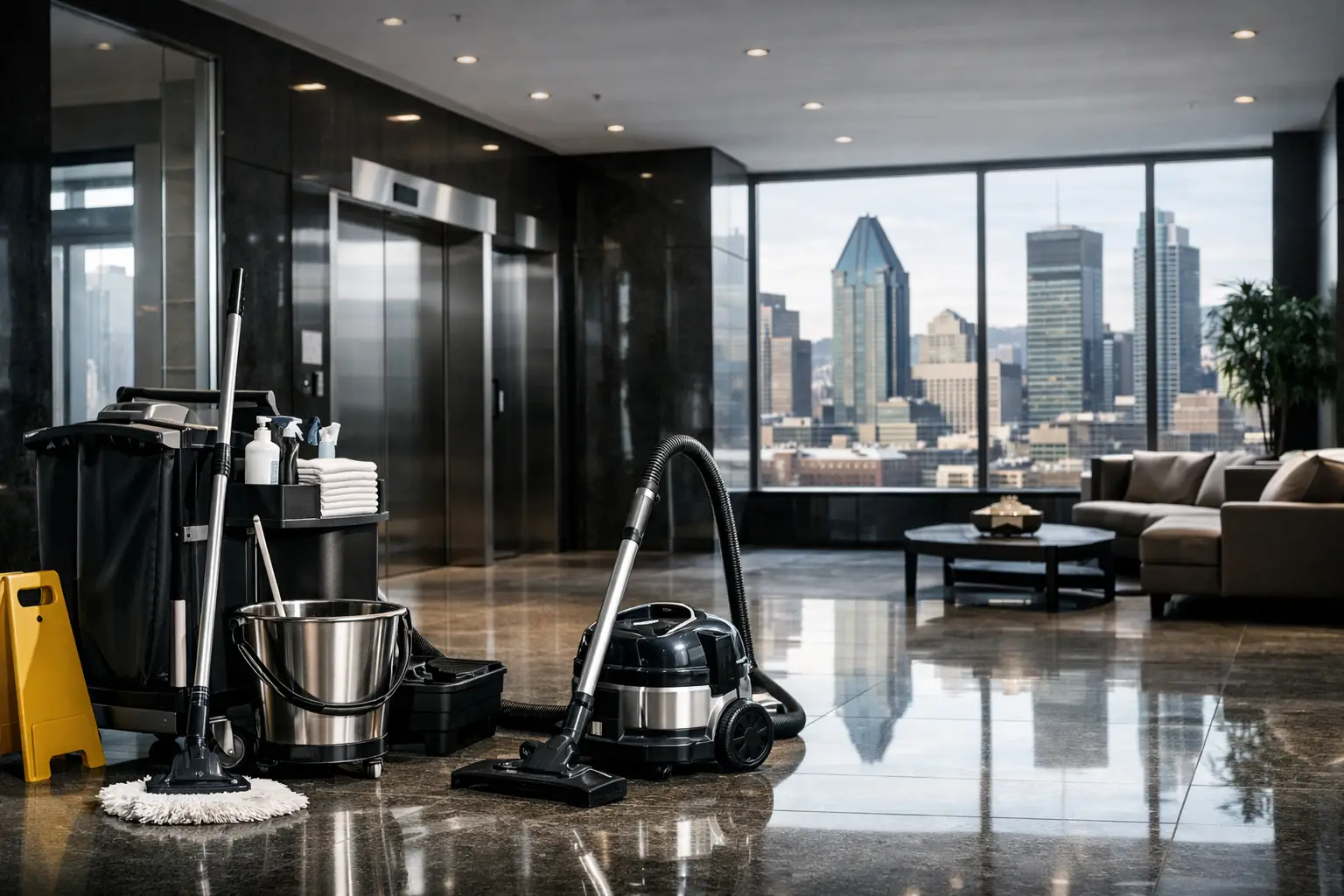
A marked corridor after a busy weekend, fingerprints in an elevator, or residue around waste bins show that shared zones do not become soiled at the same rate. In Downtown Montreal, planning should reflect occupancy, traffic, and the actual use of each common area.
Entrances, elevators, deliveries, and moving periods place heavy demands on shared spaces in Downtown Montreal. For a property manager or condo board, a common-area cleaning program should identify the zones, frequencies, access conditions, and situations requiring a separate intervention.
Planning common-area maintenance Downtown
The term residential cleaning can sound like housekeeping inside private units. In a property-management context, it mainly refers to the spaces that shape the daily resident experience: entrance lobbies, corridors, elevators, stairwells, waste rooms, recycling rooms, and underground garages.
These areas do not have the same constraints. A lobby must remain presentable despite frequent entries and exits. Corridors require attention to marks, dust, and less-visible corners. Waste rooms need a more targeted approach to manage residue, floor liquids, and the areas around bins. In an underground garage, abrasives, water, salt, and tire marks require a different method from the one used on residential floors.
Downtown common-area maintenance should therefore be based on the building's actual conditions: unit count, traffic, pets, moves, current work, equipment access, and peak periods. For an occupied tower with intensive access and delivery constraints, the dedicated Downtown condo-tower service provides a more complete framework than isolated cleaning of selected shared zones.
Who maintains a condominium's common areas?
A condominium's common areas are usually maintained by a provider retained by the condo board, board of directors, or property manager. Its cleaning role is to complete the agreed tasks in shared spaces according to the frequencies and priorities established for the building.
The assignment may cover the visible condition of surfaces, localized marks, waste when its handling is included, and buttons and handrails. Observations such as a leak, an overflowing bin, or construction-related dust should be defined separately so the team knows what to report and which authorized contact should receive it.
Consistency is the practical issue for managers. A building can look clean on Monday and neglected by Thursday when the frequency does not match traffic levels. The useful question is not only how many visits are scheduled each week, but which zones become soiled at what time and what presentation standard the building intends to maintain.
What common-area maintenance may include
Common-area maintenance may include floor washing, lobbies, corridors and stairs, elevator cleaning, wiping frequently touched surfaces, and maintaining waste and recycling rooms. Indoor garages, technical zones, and exterior surfaces require separate confirmation according to the assignment and the methods involved.
The exact service content depends on the building. A condo property with a premium lobby and two elevators does not have the same needs as a multi-unit building with several entrances, a laundry room, and a heavily used waste room. The quote should therefore establish covered zones, recurring tasks, frequency, possible time windows, and the handling of non-routine requests.
When an assignment also includes observations, access coordination, or notes to the manager, those responsibilities belong to a clearly defined building concierge scope. A move or construction work can then be reported without automatically treating a specialized reset as routine maintenance.
Adapting frequency to zones and occupancy
There is no universal frequency. A few targeted visits per week may be enough for a small, quiet building. In a Downtown residential tower, the lobby, elevators, and waste rooms may require more frequent attention, sometimes daily. Buildings with many deliveries, visitors, or moves should also adjust their maintenance plan to those conditions.
The same issues may recur in waste rooms, elevators, entrances, corridors, or stairs. Increasing frequency everywhere is not always the best response. It may be more useful to reinforce high-traffic zones, change the timing, or schedule more complete periodic cleaning when the scope supports it.
A manager can review observations over several weeks. When they repeatedly concern the same zone, the method, equipment, frequency, or layout may need to be reviewed. A waste room, for example, may require residue treatment, cleaning around bins, and planning aligned with collection days.
Zones requiring specialized attention
Downtown buildings often combine varied materials with access constraints. Stone floors, glass surfaces, metal doors, entrance mats, and elevator panels are not all cleaned in the same way. An unsuitable product or equipment choice can leave marks, dull a finish, or create an uneven appearance despite a recent visit.
Underground garages are a separate case. During winter, moisture, de-icing residue, sand, and tire marks accumulate quickly. Recurring maintenance aims to contain visible buildup, but a periodic reset may be needed when contamination exceeds the routine scope. Pressure washing may form part of the solution when it is appropriate for the site and its installations.
Needs change again after construction work. Fine dust, gypsum residue, paint marks, and debris should not be assigned to a normal concierge routine. Post-construction cleaning requires a planned intervention, particularly before unit handover, reopening a zone, or occupying a floor.
Choosing a Downtown maintenance provider
Price matters, but an imprecise scope leaves ambiguous zones and complicates follow-up for the manager. Before retaining a provider, review its understanding of common areas, ability to work within building-access constraints, and method for communicating conditions observed on site.
Also ask who will be responsible for follow-up, how priorities are established, and what happens when an unusual condition arises. A serious assignment does not promise that a building will never become soiled. It describes a realistic routine, planned equipment, the limits of recurring cleaning, and how to address a condition outside the agreed scope.
Nickel & Krome S.E.N.C., NEQ 3381837957, provides common-area cleaning assignments and distinct concierge, commercial-cleaning, and reset services in Montreal. An estimate is prepared from the zones, occupancy, access conditions, proposed frequency, and building-specific limitations.
The quality of a program is not limited to the shine of a lobby. It depends on an understandable scope, frequencies suited to the site, and a clear channel for reporting matters outside the planned cleaning work.
Apply this guide to your property
Review the scope, access requirements and service details for Condo tower cleaning in Downtown Montreal and Ville-Marie.