
Operations guide
Downtown Montreal office cleaning: access, alarms, evenings and weekends
Quick answer
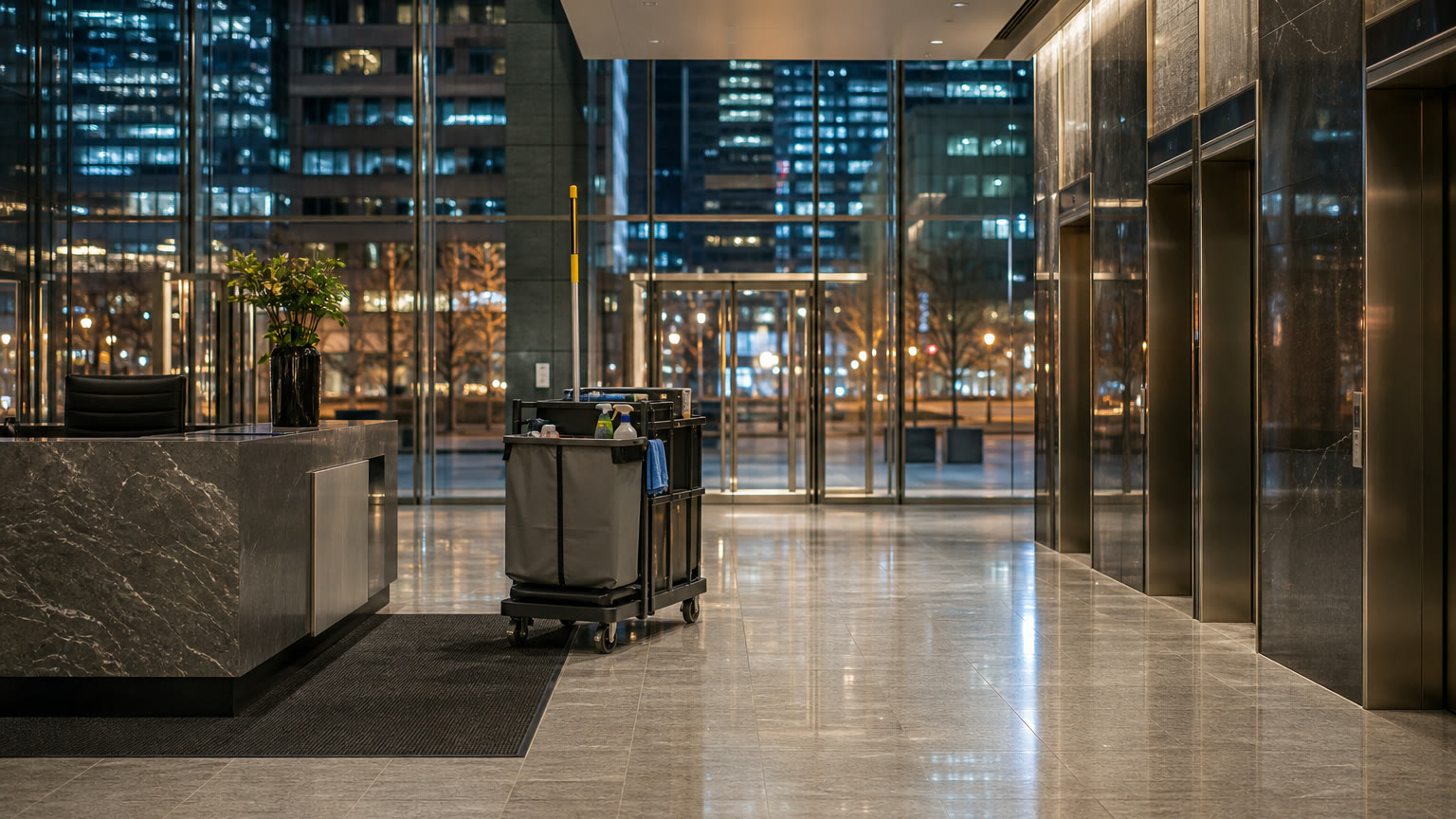
Reliable downtown office cleaning is built around the building’s real access conditions: security desk, cards, alarms, elevators, loading areas, permitted hours and escalation contacts. The scope should also separate quiet recurring tasks from louder periodic work and define a complete lockup procedure.
In downtown Montreal, a cleaning team does not simply enter an empty office. It enters a managed building where security, elevators, controlled doors, alarms, loading areas and property rules determine the sequence of work. An after-6 p.m. schedule may look simple until a card stops opening a floor, an employee stays late or the service elevator changes operating mode.
This guide supports the Downtown Montreal office-cleaning page. For mixed-use buildings, retail, clinics, or a multi-zone scope, also review Downtown commercial cleaning. The goal is operational: turn building constraints into instructions that a team can execute and a manager can verify.
Map access before the first service
The startup walk-through should follow the team’s actual route: approved entrance, security desk, service elevator, floor, janitorial room, water source, restricted rooms and exit. An address and door code are not enough. The plan should identify who records attendance, which cards open which areas, when elevators become restricted and where keys must be returned.
The property manager should name a primary contact and a backup. The provider then records exceptions such as restricted archives, executive offices available only on specific days, a closed loading area, corridor construction or an event that moves the service window. This map separates productive cleaning time from waiting and avoidable travel.
- Approved entrance, security desk and attendance process
- Cards, keys, elevators and accessible floors
- Janitorial room, water, wastewater and storage
- Emergency contacts and after-hours escalation
Alarms, keys and lockup procedure
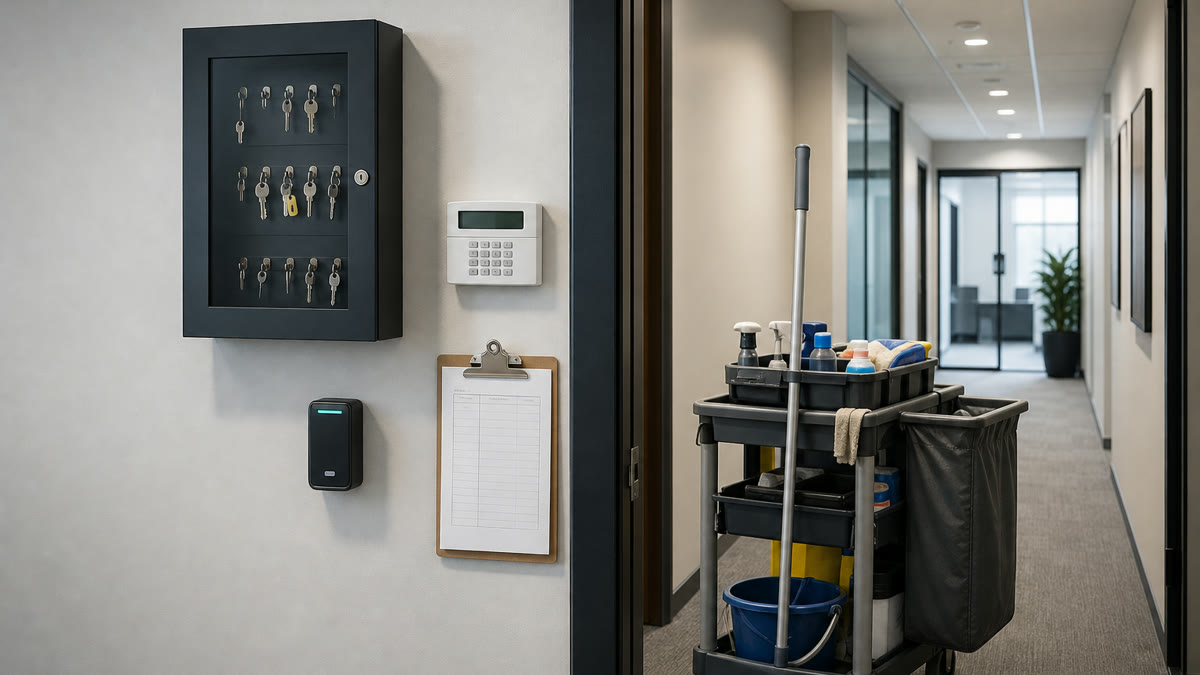
Alarm handling should never rely on a one-time verbal instruction. The procedure states which zones are armed, the door-closing order, how to report an anomaly and whom to call before trying a code again. Personal codes remain under the site’s access policy; the cleaning team only needs permissions that match its assigned scope.
Lockup also includes a simple closing check: accessible windows handled as instructed, lights restored to the requested state, taps checked, waste taken to the agreed point, equipment stored and the final door confirmed. A short completion record helps the manager distinguish an access failure from a missed cleaning task.
Choose between evenings and weekends
Evenings suit recurring tasks that follow daily occupancy: washrooms, kitchens, waste, touchpoints, localized vacuuming and floor care. Weekends provide a longer window to move chairs, reach difficult areas, complete wetter floor work or reset spaces that cannot be interrupted during the week. A strong program often combines both windows instead of forcing every task into one visit.
The decision should account for security hours, remaining occupants, events, ventilation, drying time and equipment movement. A later start is not automatically more efficient when a team waits for an elevator, cannot reach the loading area or stops a machine whenever someone crosses the zone.
| Window | Best use | Confirm first |
|---|---|---|
| Weekday evening | Recurring service after occupancy | Alarm time and late workers |
| Weekend | Detailed work and temporarily closed zones | Building and elevator access |
| Mixed window | Weekday routine plus periodic correction | Shared calendar and service notice |
Noise, deliveries and public space in Ville-Marie
Most interior cleaning tasks are quiet, but some work can create noise or require loading: auto-scrubbing, extraction, equipment movement, product delivery or special waste handling. The applicable rule depends on the activity and borough. The City of Montreal maintains a Ville-Marie regulation hub covering noise, traffic, cleanliness and the public domain.
Before an unusual intervention, the building representative should confirm the rules that apply to the address and planned activity. A cleaning assignment does not authorize a team to block a sidewalk, service lane or loading zone. Noisy work and heavy deliveries deserve a separate check rather than being treated as ordinary routine maintenance.
Make quality follow-up useful
A task list is necessary, but it does not prove that the result meets the need. Follow-up should name observable outcomes: entrances free of loose debris, washrooms supplied according to the agreed responsibility, accessible glass corrected, floors left safe and service rooms relocked. Photos are appropriate only when the building allows them and confidential information is excluded.
Managers benefit from a short communication loop: urgent anomalies reported immediately, non-urgent issues entered in the service record, out-of-scope work approved before completion and the scope reviewed periodically. This prevents a one-time request from becoming an unfunded recurring expectation and prevents access problems from being misread as omissions.
Downtown office startup checklist
Before requesting a price, collect the details that directly affect labour, travel and method. Comparable bids start with the same access scenario and the same defined result.
- Address, floor, square footage and space types
- Service days, permitted start and required exit time
- Security desk, card, key and alarm procedure
- Service elevator, loading and parking availability
- Counts for washrooms, kitchens, meeting rooms and workstations
- Floor finishes and expected periodic work
- Responsibilities for waste, recycling and consumables
- Primary and backup contacts, reporting and emergencies
Operational perspective: test the scenario before locking it in
In practice, the best way to validate an after-hours program is to simulate the first service with management. Time the entrance, sign-in, elevator trip, opening of zones and equipment return. This rehearsal exposes conditions a floor plan cannot show: a card that misses a secondary door, storage that is too far away, a reserved elevator or a contact who is no longer available after a set hour.
The first month should stabilize instructions rather than add tasks. Useful observations are factual: access delay, an occupied zone, an unapproved product, saturated matting, insufficient storage or a drying window that is too short. The manager and provider can then change the sequence without arbitrarily changing the expected result.
Once the routine is stable, exceptions belong in a shared calendar. Moves, construction, late meetings, holidays, events and loading-area closures need enough notice to reposition tasks. This discipline matters downtown, where several vendors and occupants may rely on the same elevators and service spaces during a narrow evening window.
Manager questions
- Can cleaning continue while a few employees are still working?
- Yes, when zones, noise and priorities are agreed. The team can begin in released areas and return to occupied workstations without moving personal items.
- Who should issue cards and alarm permissions?
- The property manager or authorized site representative controls access. The provider receives only the permissions needed for the documented assignment.
- Do weekends always cost more?
- Not automatically. Price depends on scope, duration, access constraints and frequency. A longer uninterrupted window can sometimes reduce inefficiency.
- Is the loading area needed for every visit?
- Not for light service when equipment is stored onsite. Deliveries, machines and periodic projects may require a reservation and service route.
- How should an out-of-scope request be handled?
- Describe, price and approve it before work begins, except for an immediate action needed to secure an area under the agreed protocol.
Official sources and references
- City of Montreal — Frequently consulted Ville-Marie regulations
- City of Montreal — Construction-noise information
Official sources verified July 10, 2026.
This information is provided for general purposes. Requirements may vary by borough, building type and the nature of the operations. Verify the official rules applicable to the address concerned. Applicable permits and hours also depend on the activity and building instructions.