
Operations guide
Condo tower cleaning in Montreal and Laval: frequency, areas and follow-up
Quick answer
Condo tower cleaning should be planned by use, not with one frequency for every area. Lobbies, elevators and entrances often need frequent control, while corridors, stairs, waste rooms and garages follow different cycles. A strong program connects these tasks to inspections, access rules and anomaly reporting.
A high-rise condominium concentrates a large amount of activity in a few circulation points. Residents share the same doors, elevators and lobbies, while deliveries, pets, strollers, in-suite work and winter conditions quickly change the surfaces. Floor count matters, but density, peak hours and the layout of common spaces matter just as much.
The primary service for a recurring whole-building program is residential building upkeep. A need limited to selected shared spaces belongs under common-area cleaning. When the requirement is an onsite presence with inspections and coordination, building concierge support remains a separate operational scope.
Assign a frequency to each area
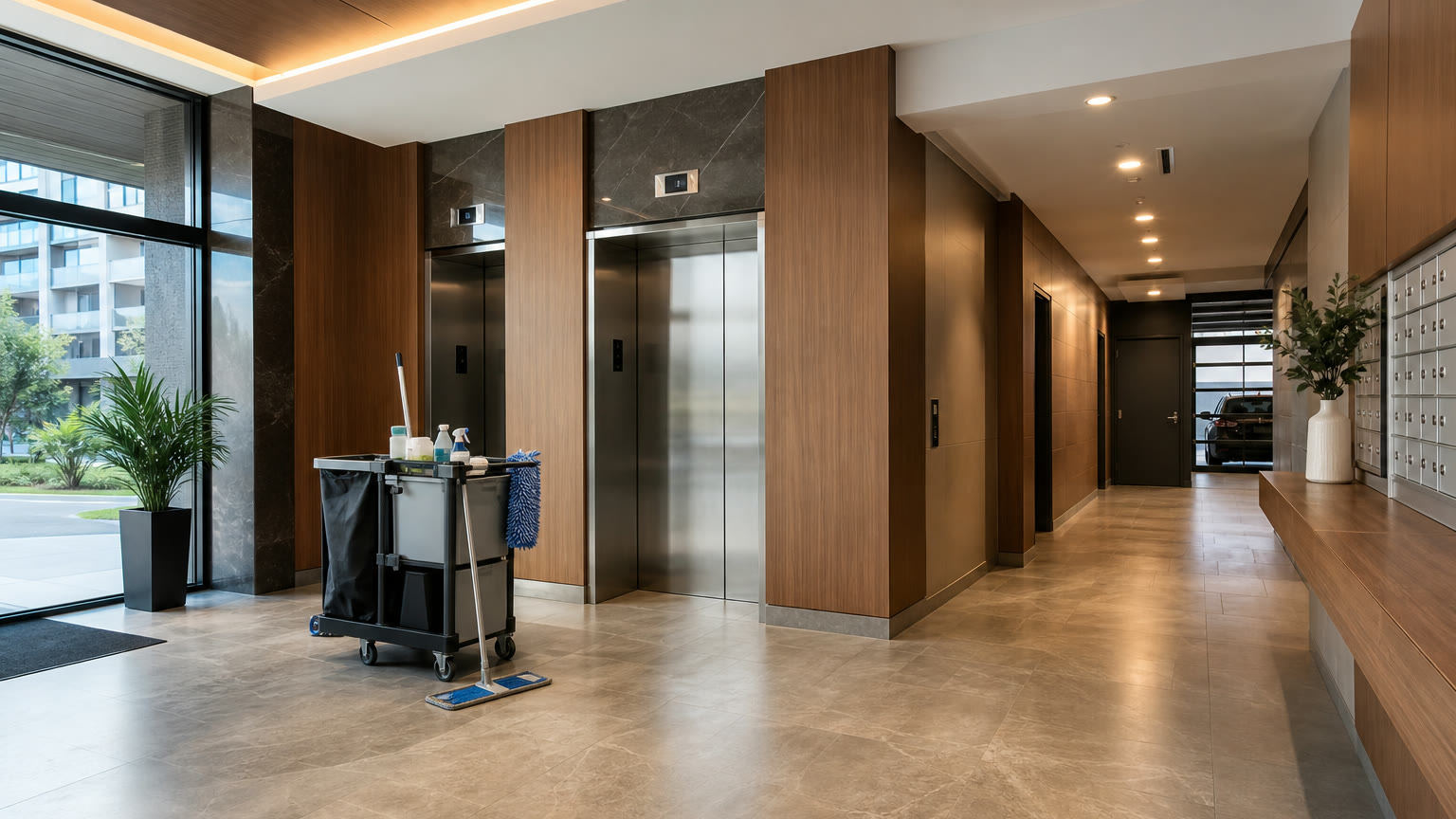
The lobby, vestibules and elevator cabs form the daily public face of the tower. They quickly collect water, salt, wheel marks and fingerprints. Residential corridors may need a less frequent full service, but elevator landings, waste-chute doors and fire doors still require attention. Stairs can be quiet for days and then become critical during a move or elevator outage.
A useful frequency is described by area and outcome: daily visual control, complete service several times per week, scheduled washing or condition-triggered work. It also accounts for peak periods. An entrance mat that performs well in summer can become saturated within hours during a wet-snow event.
| Area | Main risk | Frequency logic |
|---|---|---|
| Lobby and vestibule | Water, salt, traffic and appearance | Frequent control adjusted to weather |
| Elevators | Touchpoints, mirrors, tracks and debris | Repeated short passes |
| Corridors and stairs | Dust, local marks and safety | Floor-by-floor cycle with targeted return |
| Waste and recycling | Spills, odours and sorting | Aligned with collection schedule |
| Indoor garage | Sand, calcium, dust and drains | Specialized seasonal maintenance |
Plan vertical movement and access
Travel can consume a significant share of a tower shift. The team needs to know which elevator to use, when moves have priority, where equipment can be filled and how to avoid moving waste through a clean lobby. A well-placed janitorial room or storage point can change the cadence more than simply adding labour hours.
The access protocol identifies cards, keys, doors, excluded technical rooms and permitted task windows. It also clarifies coordination with security, management and other vendors. Cleaning equipment should not obstruct an exit, hold an elevator unnecessarily or remain unattended in a corridor.
Integrate waste and recycling rooms
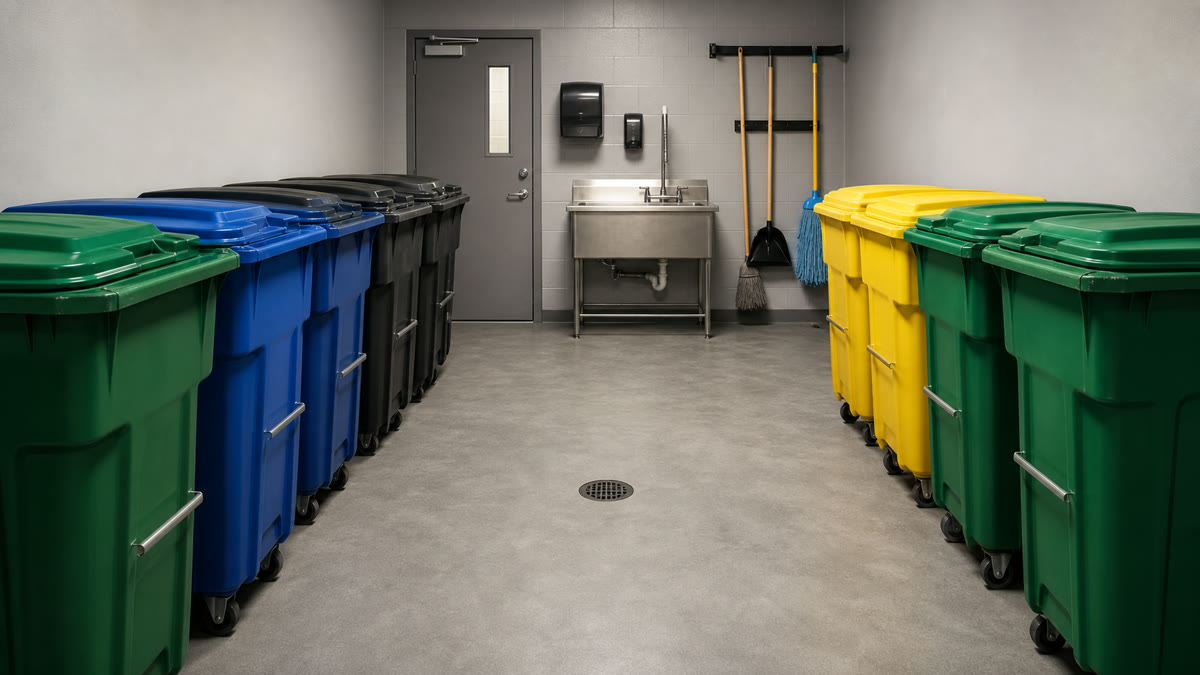
Waste rooms need a defined scope: spill pickup, touchpoint cleaning, floor washing suited to the installation, source-focused odour control and reporting damaged containers. A cleaning provider does not design the collection system, but observations can help management identify recurring overflow and adjust the building’s internal routine.
In Laval, by-law L-12424 governs residual-material management and includes multi-unit buildings. The condo board or manager remains responsible for verifying obligations, accepted containers and the collection service that applies. The cleaning scope should align with those rules without pretending to replace them.
Connect the indoor garage to winter planning
The garage carries sand, calcium and water toward elevators and lobbies. A tower that treats the garage and interior as unrelated can keep cleaning the symptom while missing the source. Mats, vestibules, thresholds and pedestrian routes belong in the seasonal plan even when underground parking cleaning is assigned as specialized work.
Mechanical sweeping or a deep garage wash is not a daily concierge task. It requires vehicle, level, drain, water and drying coordination. The residential program should still include localized pickup at access points and a process to report buildup that increases transfer into the building.
Build inspections that trigger action
A useful inspection does more than mark an area clean. It observes stable checkpoints: saturated matting, loaded elevator tracks, repeated marks near a door, unusual odour, leakage, failed lighting or a waste-room spill. Some observations belong to cleaning; others must be escalated to management or a qualified trade.
Reporting frequency depends on tower size and the required onsite presence. A periodic summary may suit a stable program, while an urgent anomaly needs immediate notice. Separating execution, inspection and escalation preserves the intent of operational concierge support without turning every cleaning task into a property-management mandate.
Information for a condo tower estimate
A precise description makes it possible to compare real scopes rather than isolated labour totals. Document the areas, vertical movement and events that change workload.
- Floors, units, entrances and elevator cabs
- Area and finish of lobbies, corridors and stairs
- Peak hours, moves and elevator rules
- Waste rooms, recycling, chutes and collection calendar
- Garage, vestibules, mats and winter conditions
- Janitorial rooms, water, storage and access
- Desired frequency by area and periodic work
- Inspection, reporting, request and emergency process
Operational perspective: manage the tower with triggers
A stable tower performs better with a small set of observable triggers than with an endless list of fixed frequencies. A storm triggers an added vestibule check; a move triggers an elevator and route reset; recurring overflow triggers a discussion about collection capacity or timing. The provider performs and reports, while management decides on system changes.
Planning should also protect sensitive periods. Morning departure, evening return and move windows concentrate traffic. Wet work and bulky equipment fit better outside those peaks. In contrast, a short entrance check can be more useful immediately after peak movement than at a fixed time that is disconnected from use.
The program should be reviewed after one complete seasonal cycle. Montreal and Laval buildings face different winter, delivery and circulation conditions. Information from the first winter can improve matting, service passes, storage and garage coordination without turning a temporary condition into permanent cost.
Managers can make that review concrete by comparing a small set of records: resident requests by area, repeated spill or odour locations, weather-related added visits, move calendars and inspection notes. The purpose is not to count every mark. It is to find patterns that show whether the original allocation of labour still matches the tower. A recurring elevator issue may call for a short additional pass, while a yearly garage condition may remain a separate planned project.
Condo board and manager questions
- Does a tower need daily cleaning?
- Some areas may need daily control, but the full frequency depends on traffic, season, unit count and the expected standard.
- Are common-area cleaning and whole-building upkeep the same?
- No. Common areas can be a targeted scope. Whole-building residential upkeep coordinates multiple areas and cycles across the property.
- Who handles non-cleaning anomalies?
- The team reports them under the agreed protocol; the manager, board or qualified trade decides the response.
- Must the garage be in the same contract?
- It can be coordinated in the program, but specialized garage washing should keep its own method, schedule and constraints.
- How should winter frequency change?
- Use observable triggers such as saturated mats, calcium transfer and water in vestibules, then add targeted passes during critical weather.
Official sources and references
- City of Laval — Residual-material collections and requirements
- City of Laval — By-law L-12424 on residual-material management
Official sources verified July 10, 2026.
This information is provided for general purposes. Requirements may vary by borough, building type and the nature of the operations. Verify the official rules applicable to the address concerned. The condo board or manager must also validate collection schedules, safety rules and building-specific obligations.