Common-Area Maintenance in Montreal: What to Plan
Common-area maintenance in Montreal: frequency, critical zones, execution quality and how to choose a reliable provider.
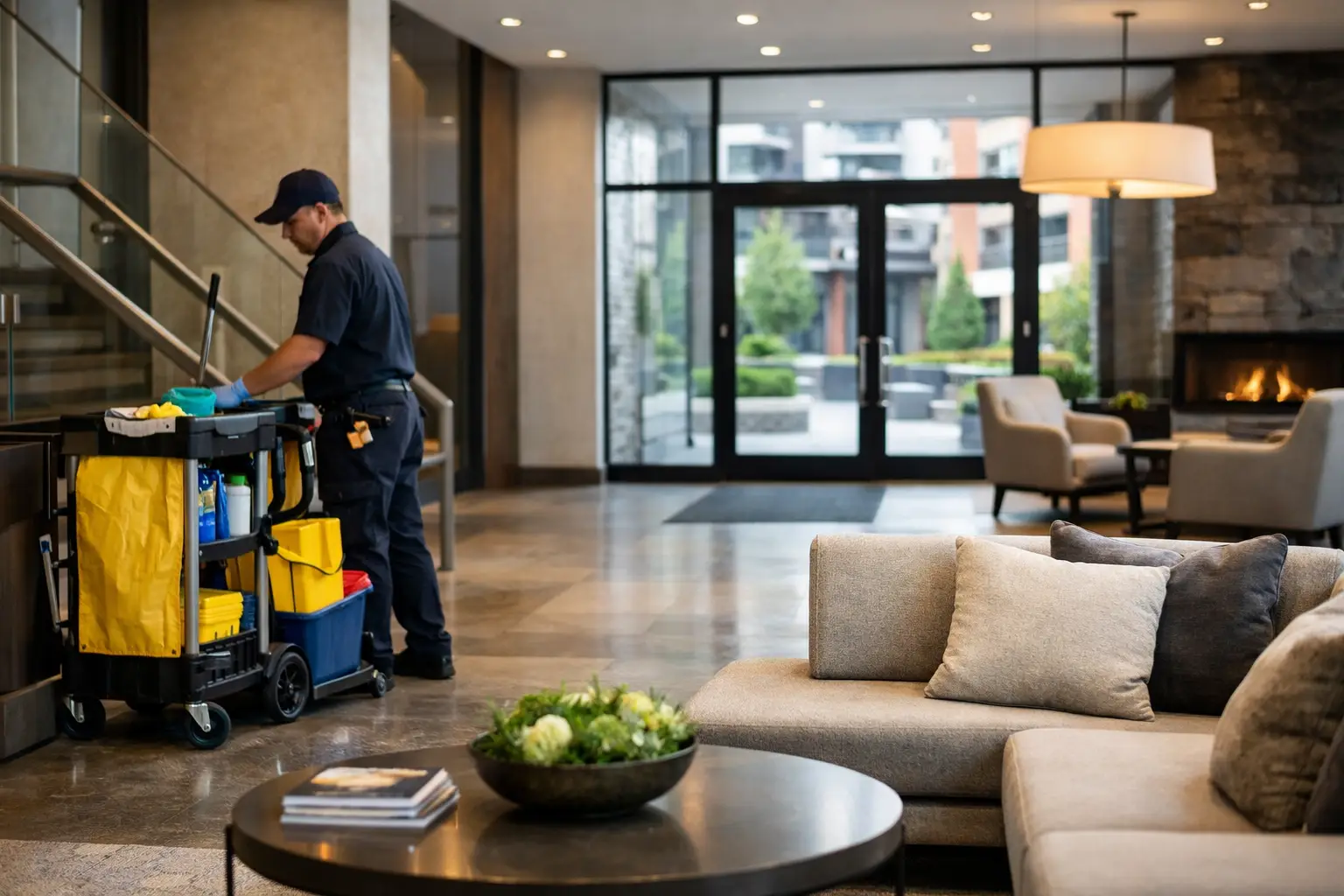
Common-area maintenance in Montreal requires the right frequency, attention to critical zones and reliable execution standards to keep a building presentable.
In a building, common areas set the tone within seconds. A stained lobby, marked elevator or corridor that holds odors immediately creates an impression of neglect. By contrast, well-structured common-area maintenance in Montreal supports the building’s image, reduces complaints and protects surfaces that are costly to replace.
For a property manager, condominium or commercial owner, the issue is not simply sending in a maintenance team. It is about maintaining spaces used every day by occupants, visitors, suppliers and sometimes construction teams. The difficulty is clear: common areas wear quickly, get dirty quickly and rarely forgive average execution.
Why common-area maintenance is not managed like simple cleaning
Common areas concentrate traffic. Entrance hall, vestibule, stairs, elevators, landings, laundry rooms, gym, corridors, interior glass, handles, baseboards, mailboxes, garages and pedestrian access points do not have the same constraints or the same pace of soiling. A uniform program applied everywhere often produces a poor result: some zones are overtreated, others are neglected.
In Montreal, familiar conditions must also be managed: melting snow, abrasives, humidity, construction dust, salt, spring mud, leaves and residue carried from parking areas and exterior entrances. This means good maintenance depends less on theoretical frequency than on a field reading of the building.
This is often what separates standard service from truly useful service. The right provider does not simply execute a round. They adjust methods according to finishes, seasons, traffic levels and the actual condition of the premises.
Common-area maintenance in Montreal: the zones that need the most attention
The entrance almost always requires the highest level of vigilance. It is the first zone seen by occupants and the first to receive water, salt, dirt and debris. A poorly maintained or saturated mat stops doing its job and quickly transfers dirt into corridors and the elevator.
Elevators are also sensitive points. Finger marks, panel marks, floor residue and buildup in tracks quickly create an impression of neglect. Because the space is closed and highly visible, every detail stands out.
Corridors and stairwells require rigorous consistency. Even when they appear clean at first glance, dust on baseboards, corners, wall edges and vertical surfaces eventually degrades the overall perception. This is especially true in high-traffic multi-unit and commercial buildings.
Shared spaces such as community rooms, laundry rooms, gyms or washrooms require another level of intervention. Visual cleanliness is not enough here. Contact points must be treated, odors managed, humidity residue controlled and premature surface wear prevented.
The right frequency depends on the building, not a fixed formula
Many managers look for a simple answer: daily, three times a week, weekly. In practice, it depends. An office building with concentrated weekday traffic is not managed like a residential condominium, and a multi-unit building in active leasing mode is not managed like a stabilized property.
Daily maintenance may be necessary for entrances, lobbies, elevators and some very busy corridors. By contrast, secondary zones can be maintained less frequently if real quality control is in place. The risk, when frequency is reduced too much, is having to compensate later with more expensive reset work.
Season also changes the equation. In winter and early spring, floors and access points often require more attention because of salt and water. After work, even minor work, fine dust circulates everywhere and contaminates common areas longer than expected. In these contexts, a flexible plan is better than a fixed checklist.
What a good service must really cover
Effective maintenance is not only vacuuming and washing floors. It must cover horizontal and vertical surfaces, visible details, contact points, accessible glass, wall marks, corners, baseboards and metal components. The overall result creates the impression of control.
The method matters as much as the task list. Some finishes do not tolerate overly aggressive products. Some stone, ceramic, vinyl or polished concrete lobbies require different procedures to avoid haze, residue or accelerated wear. A specialized provider knows where to disinfect, where to simply clean and where the priority is preserving the finish.
The immediate exterior also matters. The condition of thresholds, entrances, access sidewalks and paved surfaces directly affects interior cleanliness. If the exterior environment is neglected, interior maintenance is always catching up. For many buildings, treating the interior and exterior with the same maintenance logic clearly improves the overall result.
How to evaluate execution quality
The problem with common areas is that a service can look acceptable on paper and disappoint in the field. Tasks are checked off, but results do not hold. To avoid this, performance must be judged by concrete signs.
Look at consistency, not only the first visit. A serious provider maintains the level over time. Floors do not become dull after a few weeks, corners do not fill with dust, glass surfaces stay clean and occupant complaints decrease instead of moving from one zone to another.
Responsiveness also matters. In a building, a spill, weather event, messy delivery or work activity can change the situation in a few hours. A good partner can absorb these surprises without disorganizing the entire service.
Finally, execution quality appears in the details occupants notice without always naming: no stagnant odor, controlled entrances, presentable elevators, clean floor edges and surfaces without greasy films or repeated marks.
Common-area maintenance in Montreal: choosing a provider adapted to the building
The right choice depends on the building’s real standard. If the property receives commercial tenants, frequent visitors or residential clients attentive to the quality of shared spaces, the provider must deliver more than presence. Stable execution, clear supervision and an understanding of operational constraints are required.
Ask a few simple questions. Does the provider understand high-traffic buildings? Can they handle recurring maintenance as well as occasional reset work? Can they manage post-work contexts, seasonal needs and exterior surfaces if necessary? The more spread out the needs are, the more valuable a specialized partner becomes.
In Greater Montreal, this issue is very concrete. Between multi-unit buildings, condominiums, commercial buildings and constantly changing properties, multiplying providers for connected needs is rarely efficient. A coordinated approach simplifies follow-up and reduces blind spots.
This is exactly where a specialized company like Nickel & Krome brings value: a field reading of needs, execution focused on results and the ability to work in routine maintenance as well as technical cleaning or reset work.
The real cost is not always the one people think
Many decisions are made based on monthly price. That is understandable, but often misleading. A cheaper service can lead to more complaints, a degraded image, faster wear of floor finishes and more frequent corrective interventions. In the end, the total cost is not lower.
By contrast, a properly calibrated service maintains the premises with less variation, fewer emergencies and less rework. For a manager, that means less time lost monitoring, following up or explaining why the entrance is not at standard after a busy day.
The best scenario is not the heaviest service. It is the right level of maintenance, applied consistently and adjusted when conditions change. This logic protects the building, the occupant experience and the daily management workload.
A well-maintained building is not noticed only because it is clean. It is noticed because nothing distracts, nothing drags and nothing gives the impression that follow-up is escaping management. This level of control often makes the difference between maintenance that is endured and maintenance that is truly useful.
Apply this guide to your property
Review the scope, access requirements and service details for Recurring common-area cleaning for condos and managed buildings.