
7 Commercial Underground Parking Garage Cleaning Mistakes
Discover 7 commercial underground parking garage cleaning mistakes that cause dirt, complaints and premature surface wear.
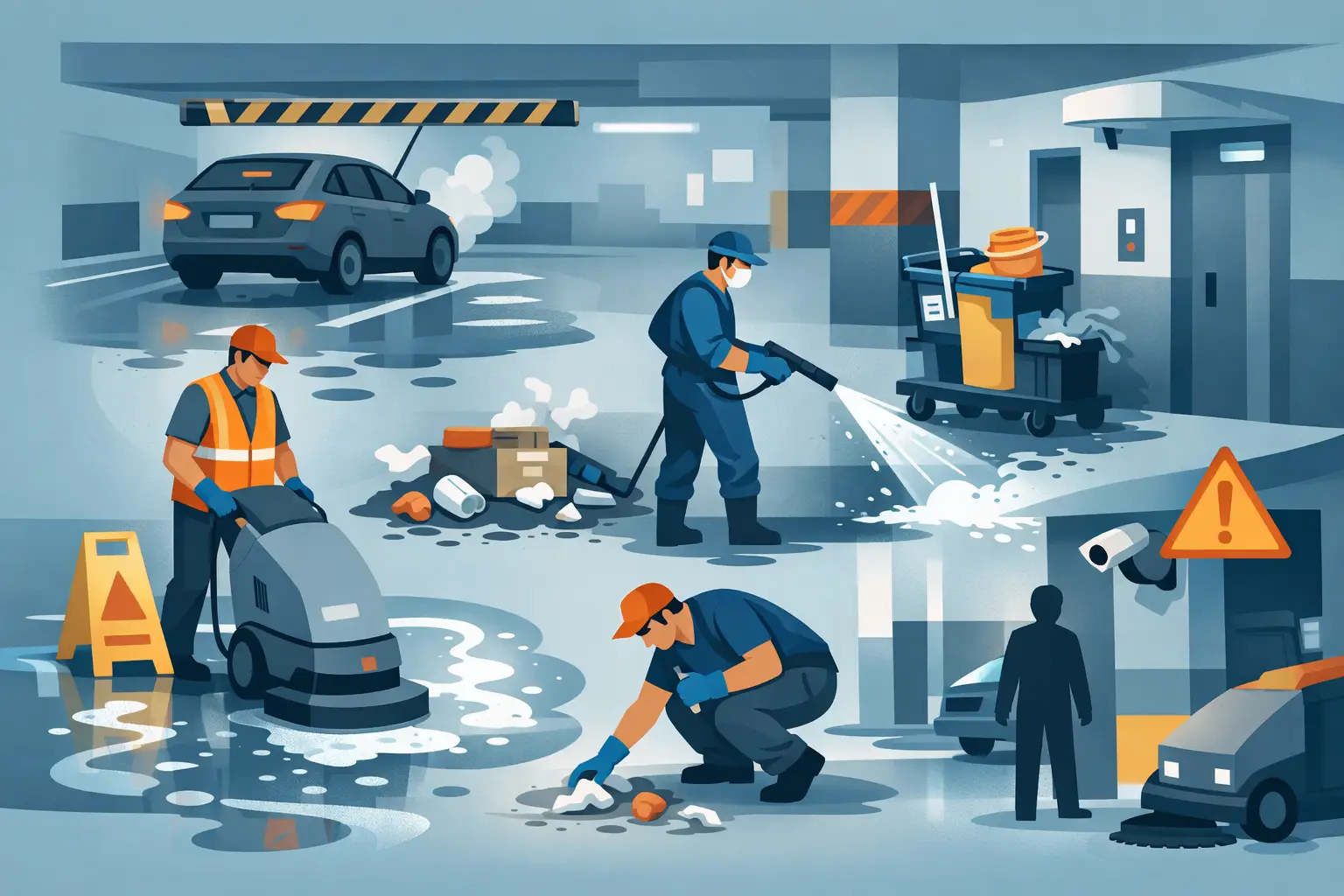
A poorly maintained commercial underground garage shows quickly - embedded tire marks, greyish puddles, fine dust drifting up into the lobbies, stubborn odours near the entrances and a general impression of neglect. When we talk about commercial underground parking garage cleaning mistakes, we are rarely talking about a purely visual problem. We are mostly talking about accelerated wear, occupant complaints, safety and the building’s image.
In a building, the underground parking garage is a high-impact technical zone. It receives water, road salt, sand, oils, debris and everything that comes in on tires or boots. Treating it like a simple floor to wash is often the first mistake. Effective maintenance requires field logic, proper sequencing and the right equipment for an underground garage.
The most costly commercial underground parking garage cleaning mistakes
Most problems do not come from a single bad wash, but from a series of approximate decisions. In the short term, the garage looks “done”. In the medium term, deposits settle in, drains work poorly and dirt comes back too fast.
1. Cleaning too late, once buildup has already set in
Waiting until the parking garage is visibly dirty before acting almost always costs more. The mix of road salt, sand, mud and traffic residue becomes compact. Once bonded to the concrete, removal requires more water, more passes and more time.
In practice, the right rhythm depends on the type of building, the number of vehicles, the season and the ventilation. In winter and spring, the cadence often needs to be revised. A condo building with daily traffic is not managed like a small, lightly used parking area. It is one of the points a serious building janitorial service must know how to adjust.
2. Using the wrong method for the type of dirt
Not all dirt in an underground garage is treated the same way. Fine dust, road salt deposits, oil stains, tire marks and accumulated mud require neither the same products nor the same tools. Sweeping quickly and then rinsing with large amounts of water can give an impression of cleanliness, but it leaves behind a dirty film and residue in joints and corners.
Commercial cleaning of this type of zone requires a simple but rigorous diagnosis. What must be vacuumed before washing? What must be loosened mechanically? Where should water be limited? Where should the effort be concentrated so dirt does not resurface the next day? When this reading is not done, the result rarely holds.
3. Sending too much water without controlling drainage
This is a frequent mistake in indoor garages. The surface is rinsed abundantly, but without checking drain capacity, the actual floor slopes or partial obstructions. As a result, dirty water moves around instead of being extracted. It flows around columns, stagnates in certain aisles and leaves a film that turns black again as it dries.
Good operational maintenance plans for the water’s path, the condition of the catch basins and recovery. In some buildings, work must be done zone by zone rather than all at once. In others, an auto-scrubber, vacuum extraction and controlled rinsing must be combined. The right choice depends on the garage, not just on the machine available.
4. Neglecting edges, corners, columns and pedestrian zones
A parking garage often looks acceptable from the centre of the aisle. Yet it is the contours that reveal the real quality of the work. Blackened edges, dusty column bases, corners loaded with salt and stained pedestrian entrances immediately give the impression of partial work.
These zones are also where dirt accumulates the longest. They hold moisture, heavy debris and the residue that vehicle traffic does not displace. In a well-managed building, underground garage cleaning is never limited to the surfaces that are easiest to cover.
5. Underestimating the impact on the other common areas
The garage is not isolated from the rest of the building. Dirt settles there, then travels toward the elevators, stairwells, vestibules and sometimes the corridors. When the parking garage stays loaded with dust and residue, the team maintaining the common areas works in reaction rather than in prevention.
This is where you see the difference between a simple cleaning visit and true building janitorial services. What do building janitorial services include? They include precisely the coordination of zones, an adapted frequency, cleanliness upkeep and follow-up on sensitive points. Who cleans the common areas of a condominium? Generally, a team specialized in building maintenance or commercial cleaning, able to treat the building as a whole and not as a series of separate rooms.
6. Choosing a provider without real building experience
Who maintains a building? Not just a team able to wash surfaces, but a field partner who understands circulation, schedules, safety constraints and management expectations. For a commercial underground garage, this nuance matters a lot.
A provider unaccustomed to buildings often mishandles access, temporary signage, coexistence with users and sequencing with the other zones. They may do good work on a small empty surface, then be less effective in an occupied parking garage with continuous circulation and limited intervention windows. The real test is not the pitch. It is consistency on site.
7. Thinking one deep clean replaces a maintenance plan
Intensive washing has its place, especially after winter, after construction work or during a restoration. But if everything rests on a single heavy intervention, the garage degrades again quickly. The deposits come back, so do the complaints, and the budget always seems spent in a rush.
What works better is an approach based on regular maintenance and targeted interventions. Sometimes a building needs a seasonal deep clean with occasional follow-ups. Sometimes the frequency must be higher in turning zones, near doors or at the elevator entrances. There is no single formula, but there is a simple rule: the underground garage must be managed as a living zone of the building.
How to avoid these mistakes in a commercial underground garage
The first step is to look at the garage as an operational space, not as a simple basement. You have to account for traffic, peak periods, humidity, winter residue and the impact on the building’s overall image. That changes the work plan, the frequency and the methods.
Next, clarify what is actually included in the service. Are the drains checked visually? Are the edges treated? Do the pedestrian entrances receive the same attention as the aisles? Does the provider plan for water recovery or only rinsing? Many disappointments come from a vague mandate.
Finally, field communication remains essential. A good provider flags the more problematic zones, notes unusual accumulations, reports restoration needs and adjusts the intervention to the building’s cycle. This is particularly useful for property managers, condo boards and maintenance leads who want fewer callbacks and more stability.
What a manager should check before hiring a team
Before entrusting the maintenance of an underground parking garage, ask how the team works, not just what it costs. On this type of surface, the equipment, the method and the order of execution make a real difference. A serious team must be able to explain how it limits stagnation, how it treats heavy residue and how it protects circulation during the intervention.
In Montreal, Laval and on the North Shore, garages go through very pronounced cycles of snow, road salt, sand and thaw. A plan that works in summer can become insufficient in February or April. That is why well-designed building maintenance relies on actual observation of the building and not on a frequency copied from another site.
The Nickel & Krome S.E.N.C. team, NEQ 3381837957, works precisely with this field logic for building maintenance, building janitorial services and commercial cleaning. For a manager who wants to stabilize the cleanliness of an underground garage without having to watch everything, the right question is not only “who can clean?” but “who can hold the quality over time?”. If the answer is clear from the start, the building breathes better, complaints decrease and the parking garage finally stops being a weak point.
Apply this guide to your property
Review the scope, access requirements and service details for Sweeping, washing and restoring underground parking lots.
View the documented occupied-garage project in Montreal (French)