
Cleaning stairwells and parking garages: methods, frequency and key points
Cleaning stairwells and parking garages requires a structured approach to maintain safe, durable access. Learn the best methods, frequency, and key control points for these high-traffic areas.
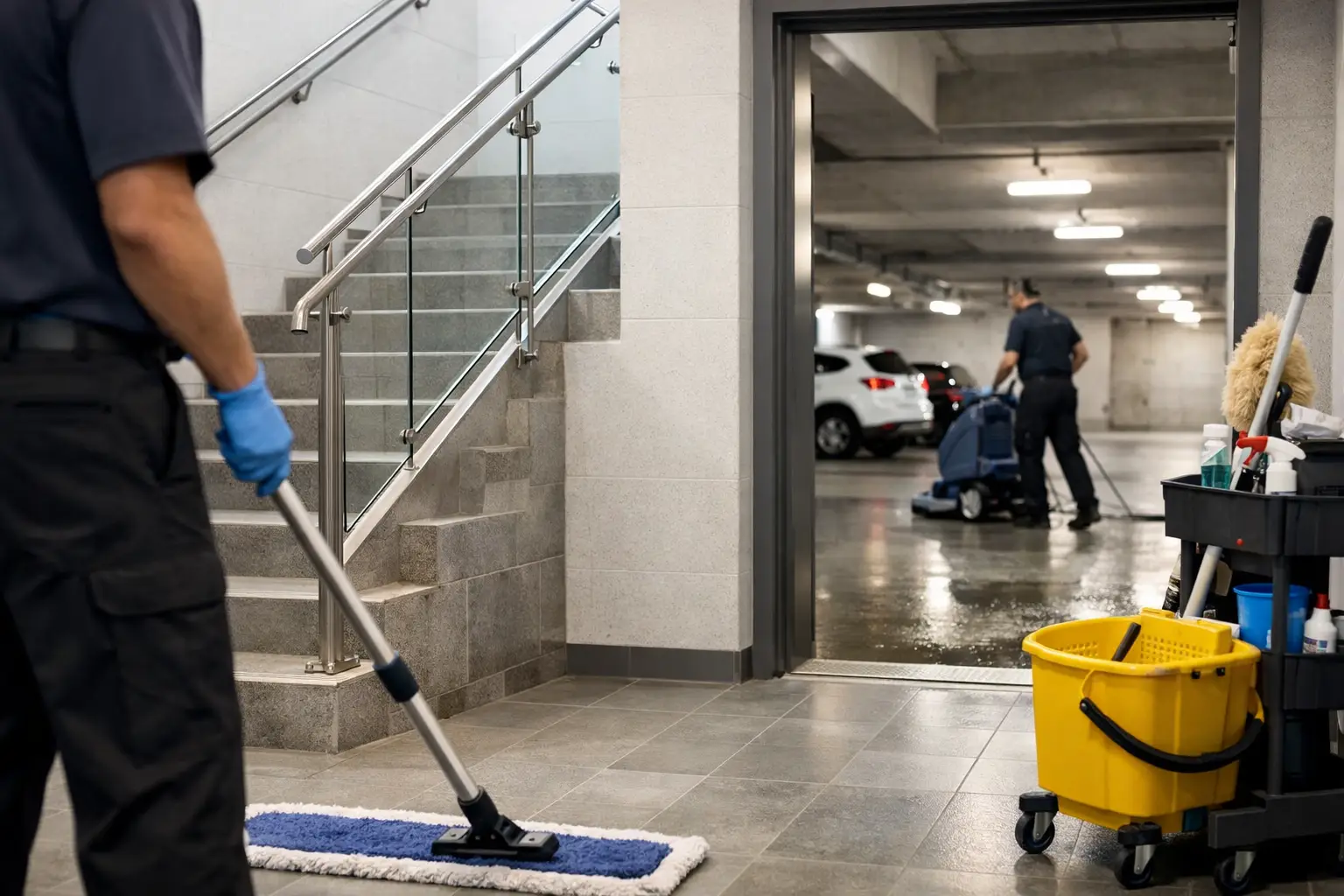
In any building, stairwells and parking areas are often the first spaces to show dirt and the fastest to accumulate grime. Cleaning stairwells and parking garages isn’t just about routine maintenance—it’s about preserving access, ensuring user safety, and protecting surfaces, especially in multi-unit residential, commercial, or mixed-use buildings.
When these areas are neglected, the issues go beyond appearances. Fine dust settles on steps, de-icing salts corrode coatings, oil stains linger on garage floors, and moisture fosters unpleasant odours. Conversely, a well-structured cleaning routine keeps circulation areas clean, reduces premature wear, and simplifies daily building management.
Why stairwell and parking garage cleaning requires a real method
On the ground, these two zones face different types of dirt and constraints. A stairwell collects dust tracked in on shoes, scuff marks on risers, smudges on handrails, cobwebs in corners, and sometimes construction or moving residue. Parking areas, meanwhile, accumulate abrasive grit, tire scuffs, oil drips, litter, and—depending on the season—a heavy load of salt and mud.
The common factor is high usage. The more foot and vehicle traffic, the more precise the cleaning must be. In a condo, rental building, or commercial property, these spaces are used daily, often around the clock. A purely visual clean isn’t enough. Surfaces must be treated according to their material, level of soiling, and exposure to moisture.
Frequency also makes a difference. A cleaning schedule that’s too infrequent turns routine maintenance into major restoration work. In the short term, this costs more. In the medium term, it accelerates wear on flooring, joints, baseboards, and metal finishes.
What effective cleaning should cover
In a stairwell, cleaning isn’t limited to the steps. Contact zones and vertical surfaces matter just as much as the floor. A thorough service typically includes vacuuming or sweeping steps and landings, washing surfaces with the right method for the material, wiping handrails, treating visible wall marks, cleaning corners, baseboards, handrails, doors, and frames. If the building has an elevator nearby, the transition between the two zones should also be addressed to prevent visible buildup.
In parking areas, the approach depends on the space type. An indoor garage requires careful management of fine dust, abrasive residue, localized stains, and drips. An outdoor lot demands more mechanical or manual sweeping, spot washing, and cleaning of adjacent pedestrian zones. Access points are critical: garage doors, thresholds, curbs, stair exits, dumpster areas, and pathways between parking and the lobby.
The best cleaning isn’t necessarily the most intensive at every visit. It’s about smart sequencing: first remove abrasive particles, then treat stubborn grime, and finally focus on contact zones and visual details. This prevents spreading dirt from one area to another and ensures longer-lasting results between cleanings.
Stairwells and parking garages: different risks, shared requirements
The stairwell directly impacts occupant safety. Dusty steps, damp corners, or greasy handrails can quickly become hazards. In buildings with high tenant or visitor turnover, these flaws are immediately noticeable. The goal should be consistent cleanliness—not just occasional catch-up.
Parking areas present other challenges. Mud and salt residue tracked in by vehicles accelerate wear and complicate pedestrian movement. Oil stains or standing water create an impression of neglect and can permanently damage certain surfaces. In underground garages, ventilation, humidity, and drying time must also be considered to avoid disrupting site operations.
In both cases, consistency is the best tool. A well-maintained building isn’t necessarily the one cleaned most intensively, but the one where sensitive areas are treated before problems take hold.
How often should you schedule cleaning?
There’s no one-size-fits-all frequency. It depends on the number of users, season, flooring type, desired finish level, and site history. A small condo won’t have the same needs as a high-density multi-unit building or a commercial property with daily traffic.
For stairwells, weekly cleaning may suffice in quiet buildings, while multiple visits per week are better in high-traffic environments. In winter, frequency often needs to increase due to salt, water, and outdoor debris tracked inside.
For parking areas, it’s important to distinguish between routine maintenance and deep restoration. Routine work keeps buildup in check and maintains clean access. Deep restoration, done occasionally, tackles heavily soiled zones, stubborn stains, curbs, and exits. In the Montreal, Laval, and North Shore regions, winter and thaw cycles almost always require adjusting frequency—especially in buildings where garage entrances open directly into common areas.
Common mistakes on these types of contracts
The first mistake is applying the same protocol everywhere. A stairwell with resilient flooring, painted concrete, or ceramic tile doesn’t clean the same way as an indoor garage with fine dust, persistent moisture, and mechanical stains. An outdoor lot shouldn’t be treated like an open parking area.
The second common error is underestimating transition zones. These are often the first areas to give a negative impression: garage exits, fire doors, intermediate landings, stair bases, thresholds, and corners. If these spots remain dirty, the rest of the cleaning can feel incomplete—even if large surfaces were done properly.
The third mistake: waiting until conditions deteriorate to intervene more aggressively. This reactive approach ends up costing more, disrupting spaces longer, and creating more dissatisfaction among occupants or users.
How to evaluate a provider for stairwell and parking garage cleaning
For property managers or maintenance supervisors, the real criterion isn’t just the cost per visit. It’s whether the provider understands the site’s constraints and can adapt their execution. A stairwell in an occupied building requires discretion, precision, and good drying control. A parking area demands organized work that can handle technical zones without unnecessary disruption.
It’s useful to ask how the following are managed: actual cleaning frequency, localized stain treatment, seasonal adjustments, quality control, and expected finish level. A good partner doesn’t sell generic cleaning—they offer a clear, reality-based method tailored to the building.
Most managers are looking for reliability: a service that can maintain a consistent pace over time without constant adjustments or rework. For technical maintenance and common area upkeep, consistency matters far more than the visual impact of a single pass.
When to schedule routine cleaning vs. restoration
Routine cleaning maintains conditions. Restoration corrects accumulated neglect, post-season wear, post-construction grime, or visible degradation. Both approaches are complementary but serve different needs.
If a stairwell has ingrained marks, dusty corners, dull surfaces, or persistent residue, a routine clean won’t be enough. Similarly, if a parking area has accumulated sand, salt, tire scuffs, construction dust, or embedded litter, a deep clean is needed before establishing a regular schedule.
At Nickel & Krome, this operational logic is central: address the site’s real condition properly, then maintain results with an adapted method. It’s often the best way to prevent common areas from becoming a recurring source of complaints, rework, or accelerated wear.
A well-maintained building is often recognized in the least spectacular places. A clean stairwell, a tidy parking area, and seamless transitions send a simple but decisive signal: the property is managed with care—and it shows from the first step.
Apply this guide to your property
Review the scope, access requirements and service details for Sweeping, washing and restoring underground parking lots.
View the documented occupied-garage project in Montreal (French)