Cleaning Corridors, Elevators and Stairs
How to maintain corridors, elevators and stairs with the right frequency, methods and checkpoints for cleaner common areas.
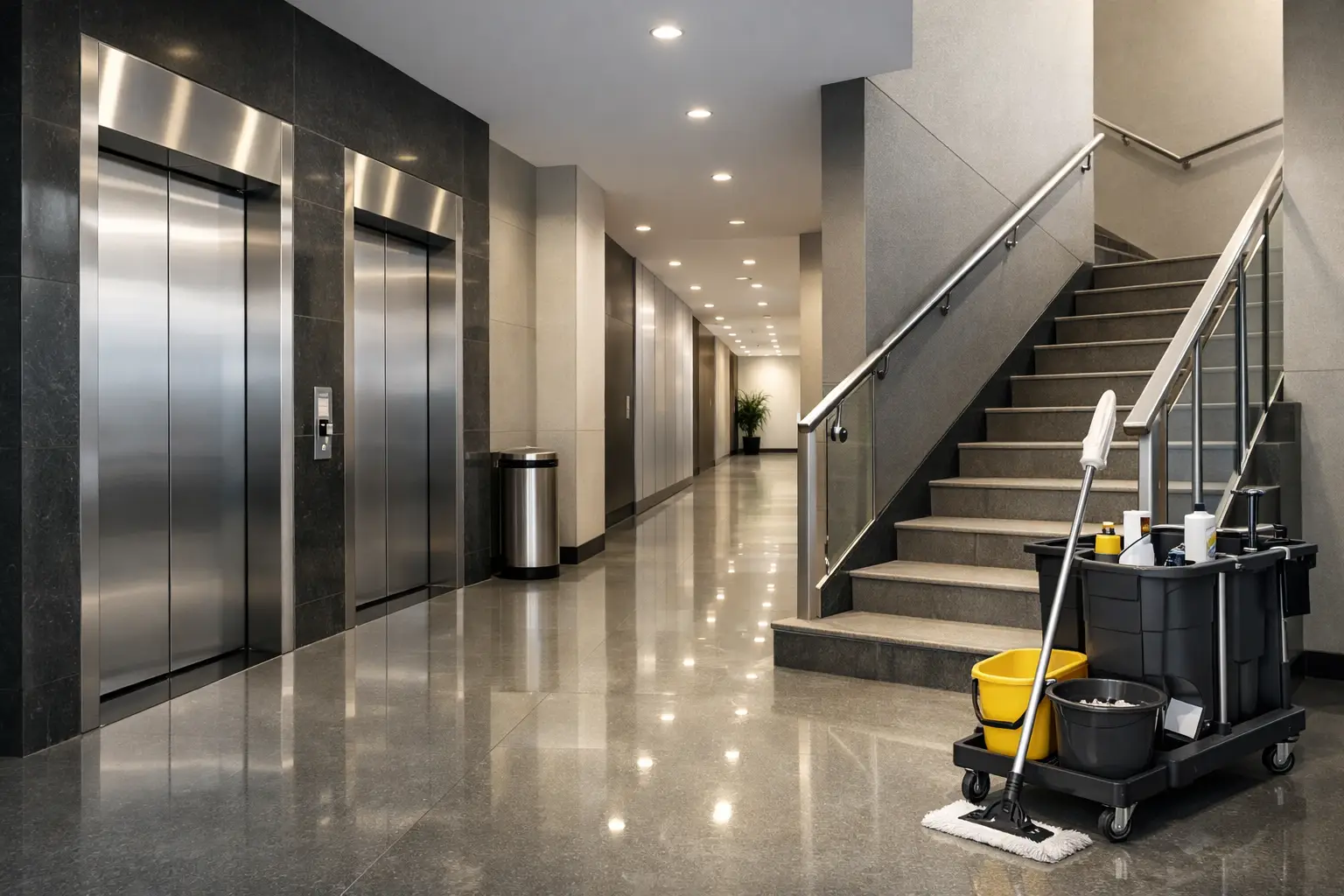
A corridor marked by 8 a.m., an elevator covered in fingerprints before noon, or a stairwell that holds dust and odours for days is often where complaints begin. Cleaning corridors, elevators and stairs is not only an aesthetic detail. For a property manager, it is an operational function that affects the building's image, occupant comfort and the perception of quality from the first entry.
In a residential building, multi-unit property, condominium or commercial site, these areas absorb most daily traffic. They collect street dirt, humidity, winter abrasives, delivery residue, occasional spills and repeated marks on surfaces. When maintenance is poorly planned, the whole building can feel neglected even if the units, offices or commercial spaces are well kept.
Why these common areas need a real method
Common areas are not cleaned like an apartment or a small closed office. They are continuous circulation zones with varied materials, sensitive schedules and high expectations. A lobby or corridor can look acceptable early in the morning and deteriorate quickly after resident traffic, deliveries, strollers, carts and repeated entries.
Elevators bring their own constraints. The space is tight, wall panels mark quickly, rails collect dust and debris, and even a small odour feels amplified. Stairwells are often less visible during daily visits, so they can degrade quietly until the condition becomes obvious.
This is why serious building janitorial services go beyond a quick mop pass. The work needs planned frequencies, products adapted to each surface, attention to touch points and field follow-up. The right service level depends on the building type, traffic volume and expectations from residents or users.
What corridor, elevator and stair cleaning includes
When people ask who cleans the common areas of a condominium, the answer is usually a building janitorial team or a specialized building maintenance provider. The role is to keep shared spaces clean and presentable on a recurring basis, with a prevention mindset rather than a constant catch-up approach.
In corridors, the work often includes vacuuming or dust removal depending on the flooring, washing floors, spot treating stains, wiping baseboards, doors, handles, frames and vertical surfaces exposed to contact. Corners, thresholds, low mouldings and marks near walls often reveal the real quality of the work.
In elevators, maintenance is about hygiene and presentation at the same time. Buttons, panels, mirrors, handrails, thresholds, grooves and floors all need attention. Wheel marks, moving residue, renovation dust and persistent odours must also be monitored because they immediately affect the user experience.
For stairs, cleaning includes steps, risers, nosings, handrails, landings, wall corners, fire doors and glass where present. In many buildings, dust moves down and settles again continuously. Without consistency, the dirty look returns quickly.
Choosing the right maintenance frequency
The right frequency depends on real traffic. A busy rental building with many entries and exits needs more frequent attention than a quiet small condominium. A building near a road, worksite or delivery zone will collect more dust and debris. In winter, abrasives, calcium, water and mud accelerate floor degradation and increase cleaning needs.
Some zones should be checked several times a week, and sometimes daily in high-traffic buildings. Other areas can be maintained less often if their condition stays stable. The key indicator is not only the frequency written in the contract. It is whether the building remains presentable between visits.
Why specialization matters
A building may be maintained by an internal caretaker, a maintenance team or an outside provider. But once several common zones, fixed schedules, corrective work and a high level of consistency are involved, specialization becomes a clear advantage.
A team used to buildings understands the typical irritants: buildup in corners, glass doors that are always marked, odours returning on certain landings, elevators dulled after moves and stairwells overlooked because they are less visible. It also knows how to work without disrupting occupants and how to adapt to the building's rhythm.
Mistakes that increase complaints
The first mistake is treating every area the same way. A quiet upper-floor corridor does not wear like a ground-floor entrance or a main elevator landing. Applying the same routine everywhere often produces an average result everywhere.
The second mistake is rushing visible surfaces and neglecting details: dirty corners, blackened wall bases, door marks, dull elevator buttons and greasy handrails. These details shape the perception of neglect.
The third mistake is poor communication. If a manager has to repeat the same requests, flag the same misses or request corrections for the same zones, the relationship becomes costly in time. In common-area maintenance, reliability matters as much as the immediate result.
After work, moves and critical periods
Corridor, elevator and stair cleaning changes after renovation work, a major delivery or a heavy occupancy period. Fine dust, gypsum residue, wall marks, adhesive traces and dirt tracked through shared spaces require more than routine maintenance.
A building-focused provider treats this as a reset of shared zones, not just a basic cleaning visit. That is useful for occupied condominiums, commercial buildings and new properties after construction.
What a manager should verify
Good maintenance shows over time. Complaints decrease, odours are better controlled, elevators stay presentable longer, stairs stop feeling forgotten and corridors keep a consistent appearance between visits.
Look at regularity, finishing details, responsiveness and the provider's understanding of the building's constraints. If the team knows the high-traffic areas, sensitive hours and recurring friction points, the service will be more stable. If everything must be explained at every visit, the building eventually pays the price.
The Nickel & Krome team, NEQ 3381837957, works with this building-maintenance logic for common areas. For a property manager, condo board or maintenance lead, the real gain is not only a cleaner corridor today. It is a building that holds its standard week after week, with less follow-up and fewer complaints to manage. For a concrete need, call +1 514-974-3311.
Apply this guide to your property
Review the scope, access requirements and service details for Recurring common-area cleaning for condos and managed buildings.