Building janitorial services in Montreal for commercial properties
Building janitorial services in Montreal for commercial properties, businesses, and construction sites: regular maintenance, post-construction cleaning, and well-managed exterior surfaces.
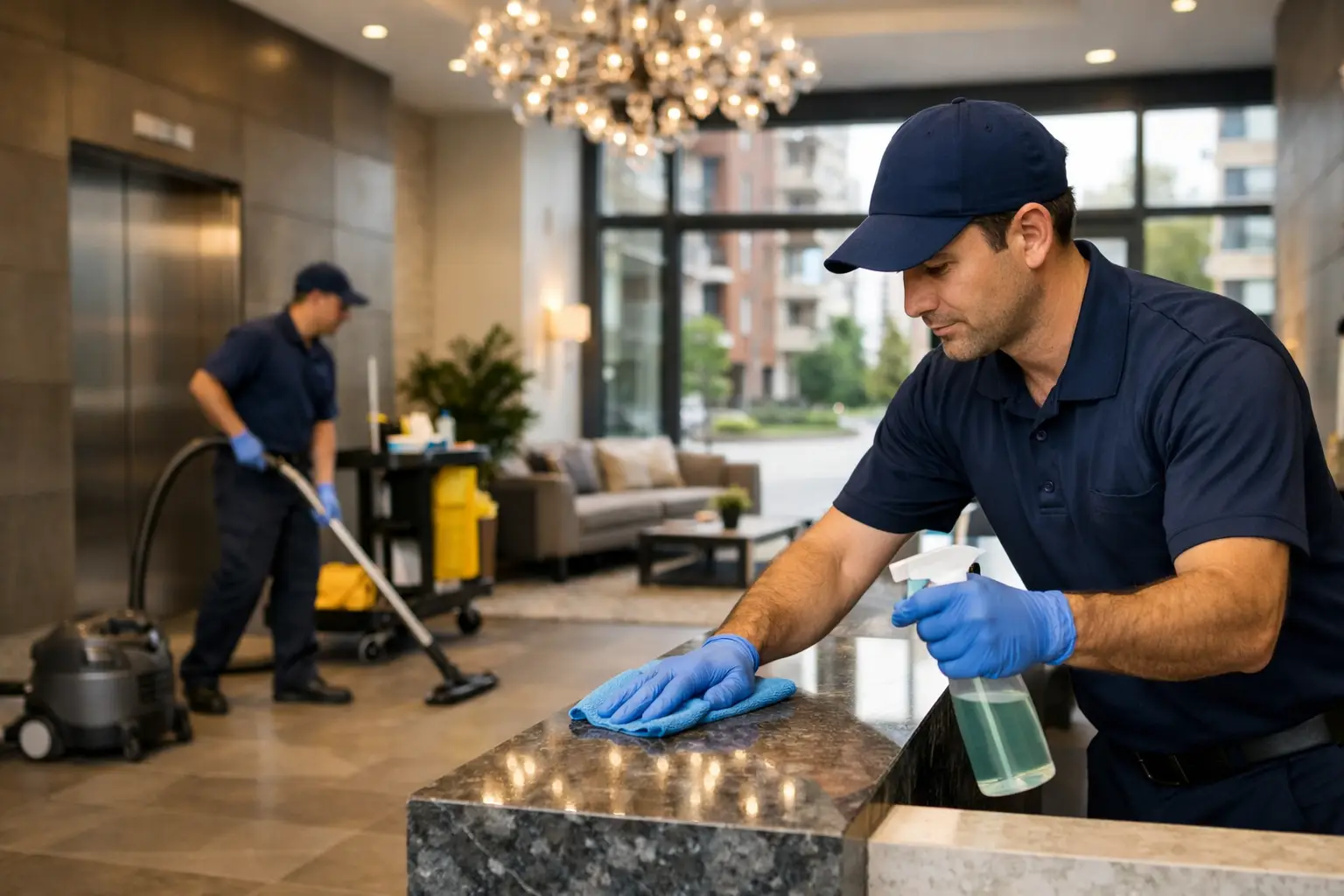
A spotless lobby at 8 a.m. doesn’t tell the whole story. What really matters is the state of the space at 4 p.m., after occupants, visitors, delivery drivers, and tradespeople have passed through. When you’re looking for building janitorial services in Montreal, you’re not just hiring a cleaning crew. You need a provider that can maintain a building over time, handle post-construction cleanup, and preserve a professional image without adding to your management workload.
For property managers, condo boards, commercial owners, or maintenance supervisors, the question isn’t simply “who cleans?” The real question is: “Who can handle sensitive areas, meet deadlines, and follow a methodical approach tailored to the building’s type?” That’s where the difference lies between standard cleaning and a service truly adapted to the site.
What you really expect from building janitorial services in Montreal
In a commercial or multi-unit environment, cleanliness isn’t just a detail—it shapes how occupants feel, how visitors experience the space, and even how safe it is to move around. Stains in an elevator, a soiled entrance after bad weather, or a neglected stairwell can quickly give the impression of a poorly maintained building, even if the rest is in order.
Effective building janitorial services must go beyond visible tasks. They require a structured cleaning logic: knowing which areas degrade fastest, which materials need specific products, how often to intervene, and how to adjust service levels based on occupancy.
In an office building, the main challenge is often image and consistency. In a condo, the focus shifts to daily traffic, lobbies, door windows, elevators, and waste management. On a recently completed construction site, the priorities are different: fine dust, material residue, adhesive stains, and meticulous cleanup before handover. These contexts have neither the same constraints nor the same methods.
Maintaining cleanliness: consistency is key
Commercial cleaning and common-area maintenance form the foundation of most contracts. But this type of service is deceptively simple. A reliable provider isn’t judged by the number of visits listed in a quote—it’s judged by the consistency of execution.
Many buildings appear well-maintained in the first few weeks, only for quality to drop over time. Corners get overlooked, baseboards accumulate dust, and smudges on glass doors linger longer. These signs worry managers because they often signal a lack of method.
The right approach always depends on actual usage. A high-traffic main entrance isn’t treated the same as a secondary corridor. A community room, a waste room, or a winter vestibule requires precise adjustments. It’s often better to have a realistic plan built around critical zones than a broad program on paper that’s poorly executed on-site.
Post-construction cleaning: a specialized task
Post-construction cleaning is often underestimated by clients who don’t deal with it regularly. Yet it’s one of the most technical interventions. Construction dust doesn’t behave like everyday grime—it settles everywhere, reappears after the first pass, and demands a strict order of operations.
A well-executed post-construction cleanup isn’t about “making it look clean” quickly before handover. It involves removing cutting residue, treating surfaces without damaging them, cleaning windows, frames, thresholds, light fixtures, baseboards, joint marks, and adhesive traces, then inspecting everything with an eye for restoration.
Timing is also critical. Arriving too early—while other trades are still active—can waste time and budget. Arriving too late can delay handover or occupancy. The right partner knows how to read the context and time their intervention perfectly, delivering the expected level of finish.
Exterior surfaces shape first impressions
Interior cleanliness gets most of the attention, but exterior surfaces immediately influence a building’s image. Blackened interlocking pavers, stained entrances, debris on sidewalks, or façade streaks create an impression of neglect before anyone even steps inside.
Exterior cleaning—especially pressure washing and interlocking paver maintenance—addresses this reality. It’s not just about aesthetics. Some surfaces become slippery, while others degrade faster if not properly maintained. Water pressure, flow rate, and surface treatment must be carefully calibrated. Too weak, and the results won’t last. Too aggressive, and you risk damaging joints, finishes, or fragile areas.
For commercial buildings, multi-unit complexes, or outdoor walkways, this visual refresh can make a real difference—especially at the start of the season or after construction work.
How to choose the right provider without mistakes
Price matters, of course. But in this industry, a low quote can hide an incomplete service, an ill-fitted frequency, or execution that’s hard to sustain. For decision-makers, the smart move is to assess operational capacity before comparing budgets alone.
First, check if the provider works in environments similar to yours. A small office, a multi-unit building, a high-traffic retail space, and a construction site nearing completion have very different needs. A highly generalized supplier may work for simple needs, but when surfaces are sensitive or deadlines are tight, specialization becomes a concrete advantage.
Next, evaluate the clarity of the offer. A good partner explains what’s included, what requires a one-time refresh, what depends on frequency, and what needs specialized intervention. This transparency prevents misunderstandings and simplifies contract management.
Finally, look at day-to-day reliability. Can the team follow a stable maintenance plan? Can they handle both interior and exterior tasks? Can they adapt to an occupied building or a site in the final stages of delivery? These are often the factors that build lasting relationships.
Why a single partner simplifies management
In practice, juggling multiple providers complicates operations quickly. One for common areas, another for post-construction, another for pressure washing—this means more coordination, more follow-ups, and more grey zones between services.
When one partner can cover routine maintenance, post-construction cleanup, and certain exterior services, oversight becomes simpler. The site is better understood, priorities are integrated faster, and transitions between regular cleaning and intensive work flow more smoothly.
This is especially useful for property managers, condo boards, or commercial building owners who need practical solutions without constantly chasing multiple contractors. In Greater Montreal, where buildings and needs vary widely by sector, this focused versatility is often more cost-effective than spreading services across multiple providers.
Local context shapes cleaning strategies
In Montreal and its surrounding areas, building maintenance is also a matter of season and occupancy patterns. Winter brings slush, salt, water, and abrasives into lobbies and corridors. Spring reveals the condition of exterior entrances, pedestrian walkways, and paver surfaces. Summer often concentrates construction and remediation work. Fall shifts focus back to access points and high-traffic zones.
A well-designed service accounts for this reality. It doesn’t propose the same intensity of intervention year-round or the same priorities for every type of site. This on-the-ground understanding saves clients time and prevents problems from escalating into emergencies.
Specialized companies like Nickel & Krome meet this need precisely: taking on technical, recurring, or post-construction cleaning needs with an approach tailored to commercial buildings, multi-unit properties, and sites that demand more than a simple cleaning pass.
What a well-maintained building changes daily
A clean building isn’t just about “looking good.” It reduces complaints, supports occupant satisfaction, makes visits smoother, protects surfaces, and makes operations more predictable. For managers, it means fewer last-minute fixes. For contractors, it means a neater handover. For owners, it means an image that aligns with the property’s value.
Choosing the right provider isn’t a cosmetic expense—it’s an operational decision. And when needs span routine maintenance, post-construction cleanup, and exterior surfaces, it’s best to rely on a service that understands the building’s reality, not just the task at hand.
If your spaces need to stay presentable, functional, and ready for use without constant supervision, the right partner is often the one that can intervene with rigour before problems even become visible.
Apply this guide to your property
Review the scope, access requirements and service details for Recurring common-area cleaning for condos and managed buildings.