Commercial pressure washing guide: methods, surfaces, risks and best practices
Commercial pressure washing guide: methods, surfaces, risks and best practices for cleaning façades, interlocking pavers and outdoor areas. Learn how to choose the right approach for your building.
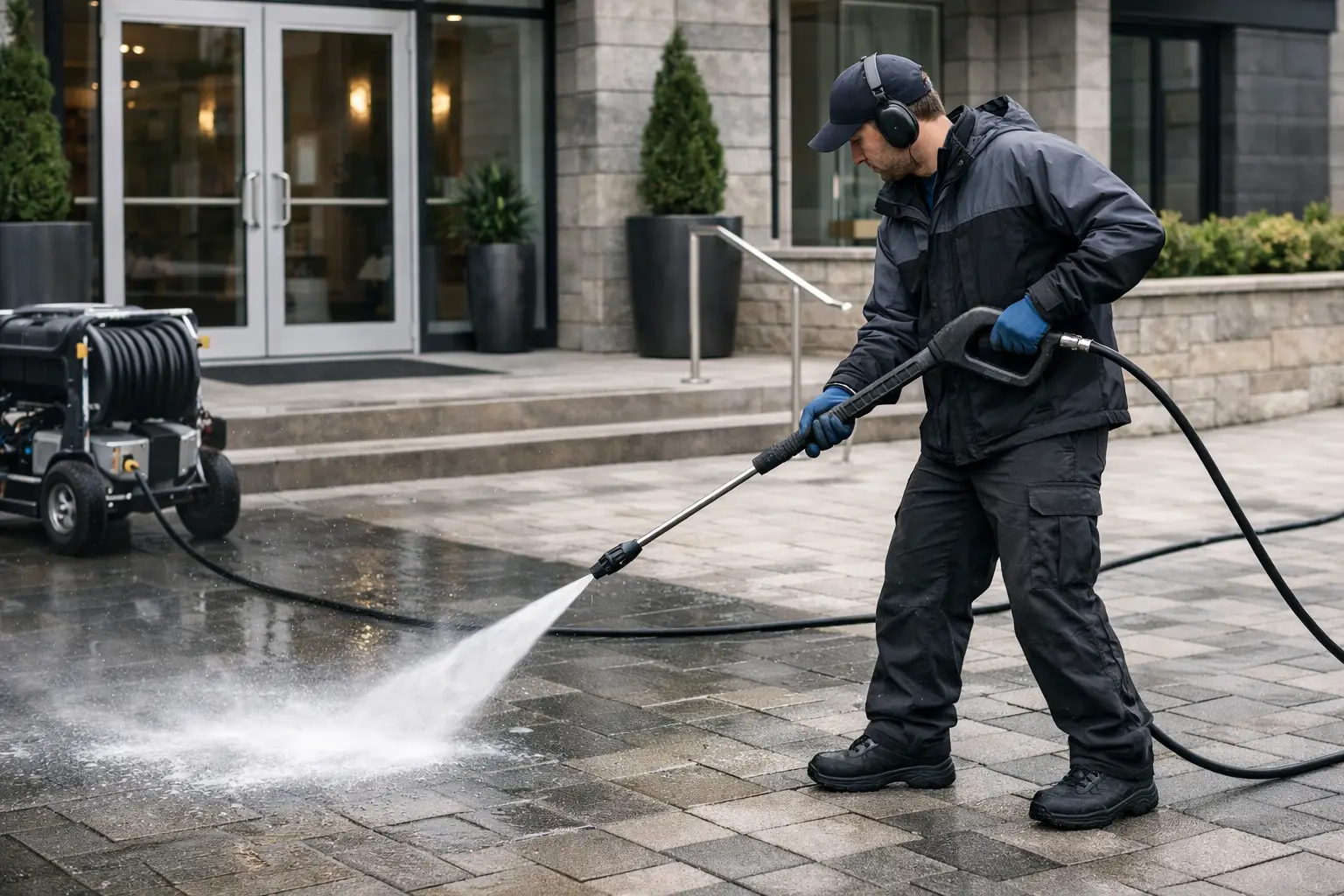
A darkened sidewalk, an oil-stained interlocking paver, or a façade holding onto pollution quickly gives the impression of a neglected building. For property managers or commercial owners, this isn’t just an aesthetic issue. This commercial pressure washing guide helps you make informed decisions about frequency, surfaces to treat, risks to avoid, and the level of intervention actually needed for your building.
In a commercial setting, pressure washing primarily restores outdoor surfaces to a clean, safe, and presentable state. It targets areas that quickly accumulate stubborn dirt: entrances, walkways, loading docks, retaining walls, parking lots, building perimeters, and pavers. When done correctly, it enhances the appearance of the space, reduces long-term buildup, and extends the lifespan of materials. Done incorrectly, it can leave marks, weaken joints, or displace sealants—especially on porous or aging surfaces.
Why a commercial pressure washing guide is useful
Pressure washing may seem straightforward from a distance. In practice, it relies on a balance between pressure, flow rate, temperature, nozzle type, cleaning product, and surface material. This combination drastically changes the outcome.
For commercial or multi-unit buildings, the stakes are also operational. Interventions must avoid disrupting traffic, prevent debris from hitting windows, prevent drain clogs from residue, and eliminate risks for occupants. This is why a standard consumer-grade pressure washer often falls short for high-traffic sites.
The right reflex isn’t to demand the highest possible pressure. The right reflex is to seek the method best suited to the surface and level of dirt buildup.
Which surfaces are suitable for commercial pressure washing
Exterior mineral surfaces are typically the most suitable. Concrete, certain masonry finishes, curbs, access ramps, and interlocking pavers clean well when pressure is properly adjusted. These areas trap dust, tire marks, organic deposits, and sometimes construction residue.
Interlocking pavers require special attention. They regain their appearance after thorough cleaning, but their joints are sensitive to erosion if the process is too aggressive. After washing, a polymer sand refill may be necessary depending on the initial condition and cleaning intensity.
Not all façades are treated the same way. Sound brickwork doesn’t clean like stucco, composite panels, or painted surfaces. Some dirt comes off with moderate pressure and a good detergent. Others require a gentle chemical treatment followed by controlled rinsing. Again, the right method depends on the material, its age, and its condition.
Dirt that justifies an intervention
In a commercial environment, we’re not just talking about dust. Gum stains, black streaks under thresholds, grease spots near service areas, pollution deposits, moss, and algae on damp surfaces are among the most common issues.
Some dirt is purely an image problem. Others become maintenance or even safety concerns. Organic buildup on a ramp or shaded walkway can make the surface slippery. Grease accumulations near technical zones attract more dirt and complicate regular cleaning. As for post-construction residue, it should be addressed quickly to prevent permanent adhesion.
What to assess before intervening
Before any washing, assess the actual condition of the surface. A cracked, crumbling, or poorly sealed surface won’t react the same way as a new finish. Also consider the immediate surroundings: windows, landscaping, furniture, signage, doors, air intakes, and pedestrian traffic.
Weather plays a bigger role than you might think. Washing in extreme heat can cause some products to dry too quickly. In cold weather, the risk of slippery surfaces increases. In active zones, timing is just as important. Early morning or off-peak hours reduce constraints and allow for more methodical work.
For managers, the real gain lies here: scheduling the right work at the right time, rather than correcting damaged surfaces afterward.
Commercial pressure washing guide: methods and precautions
The first step is identifying the type of dirt. Accumulated dust, moss, oil stains, or cement residue don’t respond to the same approach. Next comes equipment selection: pressure, flow rate, and accessories must be adapted to the surface—not the other way around.
Pretreatment often makes the difference between a superficial wash and a truly clean result. On heavily soiled areas, a well-chosen product loosens dirt, reduces working time, and prevents the need for excessive pressure. This is especially true for organic deposits and grease.
Rinsing must be uniform and controlled. An incorrect working distance or an unsuitable nozzle can leave visible marks, particularly on light-coloured concrete or tiles. On interlocking pavers, joints should be preserved as much as possible. On some façades, direct washing can force water into weak points of the building.
Finally, residue management shouldn’t be overlooked. Dirty water, sludge, and debris displaced during cleaning must be contained or directed properly—especially in a commercial context where site appearance matters as much as cleaning performance.
Most common mistakes
The first mistake is believing that a stronger jet always yields better results. In reality, excessive pressure can chip paint, erode joints, mark tiles, or lift surface particles from already worn concrete.
The second mistake is using the same method everywhere. A main entrance, a side façade, a container area, and a paver sidewalk don’t have the same exposure levels or constraints. A uniform approach reduces efficiency and increases the risk of rework.
The third mistake is delaying intervention too long. The longer a stain sets, the more aggressive the treatment required. Conversely, planned maintenance keeps surfaces presentable and often avoids heavy-duty cleaning.
Should you plan for one-time or recurring maintenance?
It depends on the type of building and its use. A street-facing business, a multi-unit building with exterior common areas, or a condo with visible interlocking pavers won’t have the same rate of dirt buildup. High-traffic zones generally require more attention than secondary surfaces.
In many cases, a seasonal refresh is enough to maintain a good overall appearance. But on sites exposed to pollution, construction, traffic, or moisture, targeted interventions may be needed throughout the year. The best model is often a mix: a planned deep clean, followed by targeted maintenance on sensitive spots.
This is especially relevant in Greater Montreal, where winter, sand, de-icing salts, and thaws leave outdoor surfaces in highly variable condition come spring.
How to choose a provider for a commercial site
Price matters, but it’s not everything. For a commercial mandate, you should prioritize a provider’s ability to handle different surface types, work without disrupting site operations, and use a clear method.
A good provider asks precise questions about materials, access points, site condition, and scheduling constraints. They also clarify what will come off completely, what will only fade, and what will require additional work. This transparency prevents unrealistic expectations.
Another key point is execution consistency. For a building or property portfolio, you want a partner capable of delivering the same quality of results from one intervention to the next. This is what sets apart a quick clean from truly mastered exterior maintenance. It’s in this spirit that specialized companies like Nickel & Krome handle technical and recurring needs, rather than relying on ad-hoc service logic.
When pressure washing isn’t enough
Sometimes, you have to accept that washing alone won’t remove everything. Deep stains, efflorescence, metal marks, or old blemishes may require specialized treatment—or even more extensive restoration. On weakened surfaces, the realistic goal isn’t always to return to a like-new state, but to achieve a clean, uniform, and durable result without damaging the material.
This is where quality advice makes all the difference. A reputable provider doesn’t promise miracles. They recommend the level of intervention that makes sense for your building, budget, and expected outcome.
A clean exterior doesn’t replace good property management, but it sends a clear signal. For occupants, visitors, tenants, and clients, it’s simple proof that the site is maintained with care.
Apply this guide to your property
Review the scope, access requirements and service details for Commercial pressure washing in Montreal, Laval, and the North Shore.