
Post-construction cleaning for commercial spaces
Post-construction cleaning ensures your commercial space is ready for handover with thorough, fast and site-specific restoration. Essential for managers, owners and general contractors.
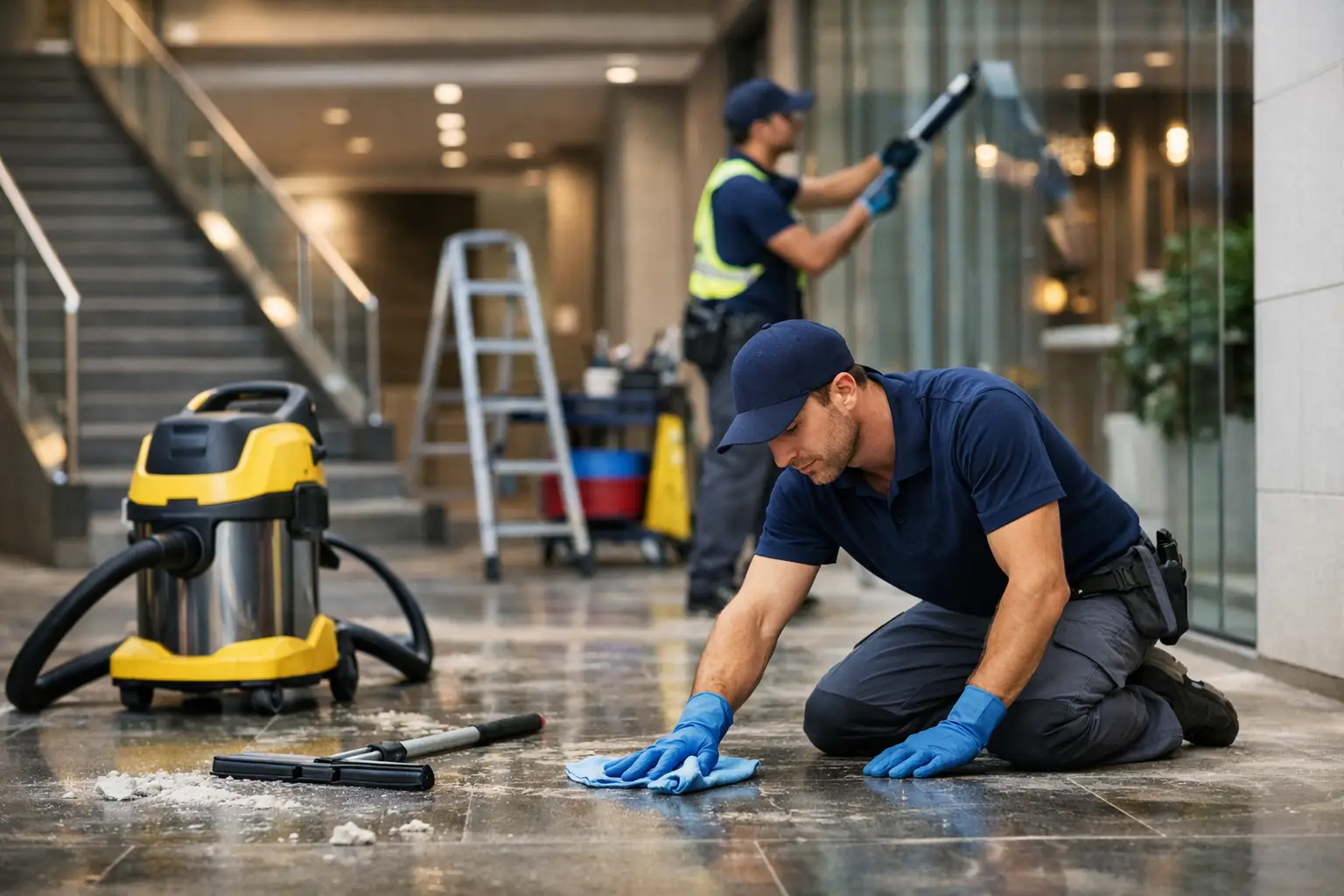
A commercial space can appear complete after construction yet remain unusable at handover. Fine dust on surfaces, joint residue, paint splatters, dull windows, marked floors, and forgotten debris in technical areas—this is where post-construction cleaning comes in. For managers, owners, or general contractors, this step is far from trivial. It directly impacts the perceived quality of the project, site safety, and the speed of occupancy.
Why post-construction cleaning can’t be improvised
On a commercial site, dirt isn’t uniform or superficial. It builds up in layers, depending on the trades that have passed through. Gypsum dust isn’t treated the same as paint splashes. Residue from adhesives on new flooring requires a different approach than what’s used on tile, aluminum frames, or glass storefronts.
This is what sets a true restoration apart from a routine cleaning pass. The goal isn’t just visual cleanliness—it’s eliminating construction contaminants, protecting freshly installed materials, and delivering a presentable site without causing damage during the process.
In retail, office buildings, clinics, or rental spaces, expectations are high and deadlines tight. Cleaning must follow a rigorous execution plan, with a clear understanding of the site and priorities.
What a complete service should actually include
Post-construction cleaning varies based on the site’s condition, total area, and stage of completion. Some jobs involve a final handover, while others occur between phases to allow access for future tenants, fit-up crews, or inspectors.
Debris, dust, and visible residue
The first step is usually removing leftover construction waste, vacuuming heavy and fine dust, and clearing pathways. It may seem basic, but this is often where the rest of the job’s efficiency is determined. If this step is poorly executed, particles will resettle on windows, counters, baseboards, and equipment.
Horizontal and vertical surfaces
A thorough post-construction cleaning targets ledges, moldings, frames, doors, partitions, switches, accessible fixtures, fixed shelves, and other areas where dust settles after construction. In commercial environments, façade surfaces and eye-level areas are especially important, as they immediately shape the impression of finish.
New floors and coverings
Floors require special attention. Whether it’s ceramic, vinyl, sealed concrete, commercial carpet, or wood, the method changes. An overly aggressive approach can leave marks, dull a finish, or compromise original protection. Conversely, a light touch leaves a visible film of construction residue that stands out as soon as the space opens.
Windows and frames
Windows, mirrors, glass partitions, and metal frames are almost always marked at the end of construction. Stuck-on dust, fingerprints, adhesive residue, or fine splatters detract from the overall perception of the site. In retail or office buildings, this step has a direct impact on the space’s image.
When to schedule the cleaning
One of the most common issues on construction sites isn’t the cleaning quality but its timing. If the team arrives too early, part of the work will need to be redone after the last trades have passed through. If they arrive too late, handover is delayed.
In practice, it all depends on the site’s actual completion level. Dust-generating work must be finished or, at minimum, clearly isolated. Access must be secured, lighting must be functional, and areas to be cleaned must be as clear as possible.
In some cases, a two-phase approach works best. An initial pass can rough-clean before inspections or furniture installation. A second pass finalizes the space just before opening, key handover, or tenant move-in. This method prevents a single intervention from compensating for an active construction site.
Key considerations for commercial sites
Not all buildings have the same constraints. A retail space doesn’t share the same priorities as a multi-unit residential common area, an administrative space, or a clinic. Cleaning must account for the space’s future use.
In commercial environments, reception areas, storefronts, washrooms, break rooms, and main circulation paths often need to be flawless from the first glance. In rental buildings or mixed-use properties, the focus also includes restoring common areas, lobbies, stairwells, and elevators that have been impacted by construction traffic.
Sensitive surfaces also require attention. Matte finishes, stainless steel, certain laminates, partially removed protective films, or freshly installed coverings don’t tolerate poorly chosen products or overly abrasive repeated motions. Experience on-site makes a real difference here.
What managers and contractors really look for
When a decision-maker hires a provider for post-construction cleaning, they’re not just looking for an available team. They want a contractor who understands site constraints and can keep pace without requiring multiple return visits.
Reliability matters as much as technique. The provider should be able to confirm an intervention quickly, adapt to last-minute changes, coordinate building access, and deliver results that align with the end client’s expectations. For a general contractor, the cleaning step also reflects on their own reputation at project handover.
That’s why the most sensitive jobs rarely come down to price alone. A suspiciously low quote may hide insufficient cleaning time, an understaffed team, or a failure to account for finishing details. Conversely, a well-structured service reduces rework, delays, and headaches at the most critical phase of the project.
Post-construction cleaning for commercial spaces in Montreal, Laval, and the North Shore
In the Greater Montreal area, tight deadlines make this type of intervention even more strategic. Between project density, access constraints, parking, delivery schedules, and the narrow window between construction completion and occupancy, cleaning must be meticulously organized.
For property managers, condo boards, and commercial owners in Montreal, Laval, or the North Shore, it’s often more practical to work with a company experienced in technical environments and post-construction restoration. Local expertise simplifies coordination and minimizes wasted time.
This is where a specialized company like Nickel & Krome adds value. The goal isn’t just to clean—it’s to ensure the space is truly ready for what comes next, whether that’s opening day, possession handover, or reoccupation.
How to evaluate a provider before handing over your site
Before confirming a job, a few key details should be clarified. The provider must understand the exact nature of the work completed, the materials present, the area to be cleaned, and the expected level of finish. A basic construction site and a high-end handover require different precision and time investment.
It’s also useful to verify their ability to work in a real commercial context. This includes managing access, working outside business hours if needed, coordinating with other trades, and handling both interior and immediate exterior areas if restoration requires it.
A good partner typically asks the right questions upfront. They won’t promise uniform results without first assessing the site. They’ll define the scope, identify potential limitations, and tailor their intervention instead of offering a one-size-fits-all formula.
The step that protects your project’s value
Final cleaning is often seen as the last stretch. In reality, it’s an integral part of quality handover. A poorly restored space gives the impression of an unfinished project, even if the construction work itself was well executed. Conversely, a clean, tidy, and cohesive site showcases materials, reassures the end client, and smooths the transition to occupancy.
On commercial or real estate assets, this difference is immediately apparent. It’s visible during the first visit, at project handover, in the impression left on occupants, and in the ease of commissioning. When post-construction cleaning is taken seriously, the end of the project finally feels like a true handover.
Apply this guide to your property
Review the scope, access requirements and service details for Post-construction cleaning for general contractors, developers and phased handovers.