
Planning underground parking garage pressure washing
Pressure washing underground parking garages reduces dirt, salt, and safety risks. Best practices for method, frequency, and key areas to target in buildings and condos.
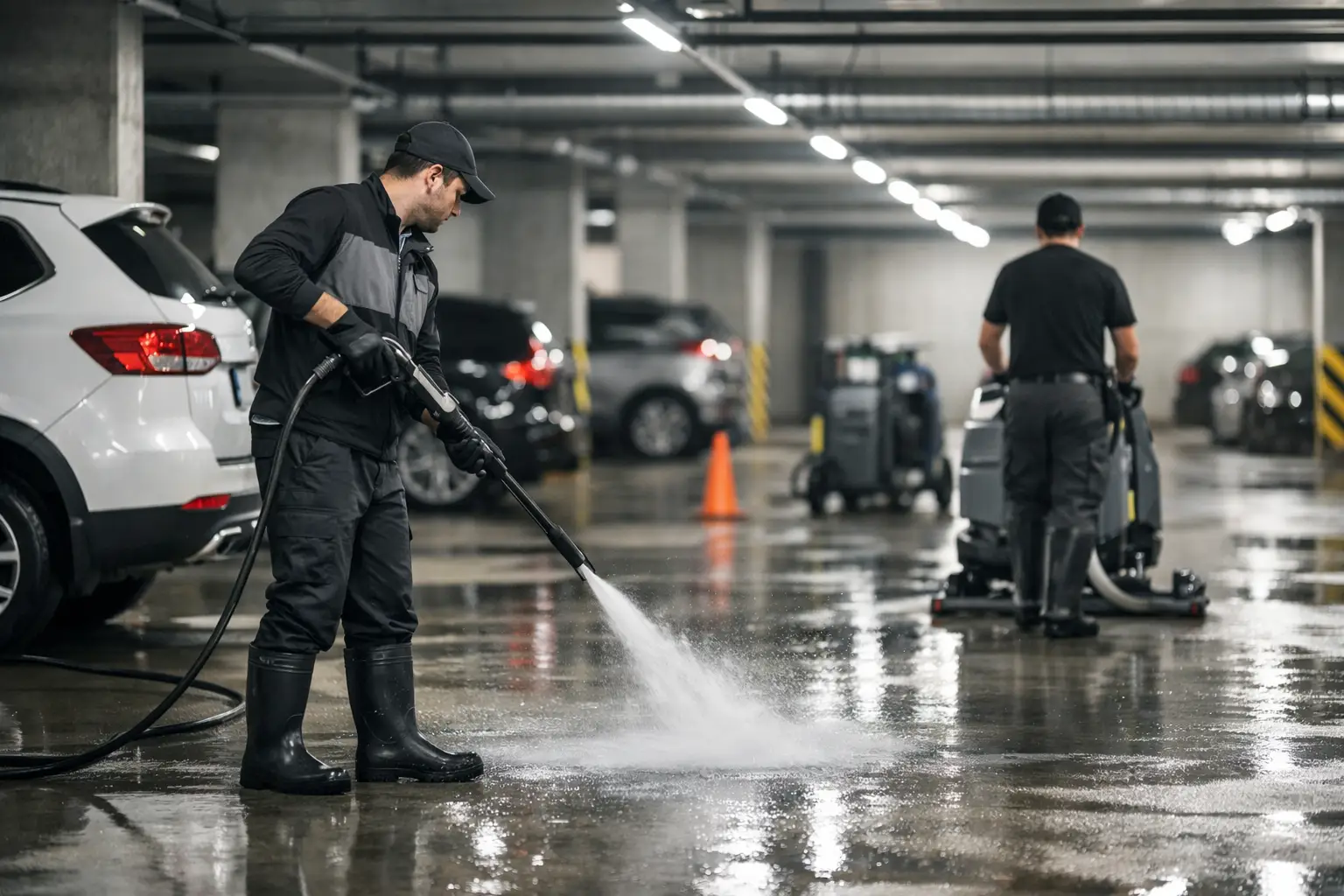
A dirty underground parking garage is noticeable before you even think about the building itself. Greyish puddles, fine dust kicked up by vehicles, salt stains, stagnant water odours, and faded markings send a clear message to occupants, visitors, and property managers: maintenance isn’t up to standard. Pressure washing an underground parking garage isn’t just about a quick clean—it’s a maintenance operation that protects surfaces, improves safety, and supports the building’s image.
In commercial, multi-residential, or condo contexts, the issue rarely stops at visible dirt. The real challenge is progressive buildup. In winter and spring, de-icing salt, abrasives, mud, and hydrocarbons accumulate everywhere. If cleaning is delayed too long, these residues seep into concrete pores, clog drains, increase slip hazards, and accelerate general deterioration.
Why pressure washing underground parking garages is a maintenance operation
Underground parking garages face constant pressure. Traffic is repetitive, humidity is often present, ventilation isn’t always ideal, and contaminants don’t stay on the surface long before redistributing. A simple mechanical mop or quick sweep isn’t enough when the slab, corners, ramps, and areas around columns have already accumulated months of deposits.
Technical washing extracts what’s truly adhered to surfaces—salt, compacted dust, tire marks, oils, and fine particles that eventually form abrasive sludge. This layer wears down finishes, blurs floor markings, and contributes to an impression of neglect, even in otherwise well-maintained buildings.
There’s also a preventive aspect. Properly executed cleaning helps keep drains functional, limits buildup that traps water, and reduces areas where deposits become harder to remove over time. It’s not a guarantee against all concrete deterioration, but it’s a concrete lever to prevent problems from taking hold too quickly.
What a good underground parking garage wash must really address
When a property manager plans maintenance, they often focus on the driving surface—understandably, since it’s the most visible area. Yet an effective wash must go further. Curbs, thresholds, wall edges, dead corners, and equipment surrounds are often where residues concentrate the most.
Ramps require special attention. They accumulate water, calcium, sludge, and tire marks at a higher level than the rest of the garage. Since the slope increases slip risks, their cleaning shouldn’t be treated like an extension of the main slab.
Drains are another critical point. A wash that stirs up dirt without properly recovering it can shift the problem rather than solve it. In an underground environment, drainage, dirty water recovery when needed, and residue management during the intervention must all be considered.
Finally, low vertical surfaces matter too. Peripheral walls, column bases, concrete baseboards, and some service doors end up with a very visible dirt line. If left unaddressed, the result feels incomplete, even after a thorough floor cleaning.
Frequency depends on usage, not a fixed rule
There’s no universal frequency for pressure washing underground parking garages. It all depends on traffic volume, season, building type, and the level of cleanliness expected by occupants or users. A stable condo garage doesn’t get dirty at the same rate as a commercial or mixed-use garage with daily traffic.
In the Montreal, Laval, and North Shore regions, seasonality plays a big role. Winter brings salt, abrasives, and moisture. Spring reveals the full extent of buildup—often the time when a deep wash is necessary. In high-traffic buildings, a seasonal intervention plus targeted mid-year maintenance yields better results than a single annual deep clean.
The smart approach is to watch three simple indicators: ramp condition, residue around drains, and the general appearance of parking spaces and traffic lanes. When these areas show persistent buildup, waiting longer usually costs more in time, effort, and restoration.
Method, equipment, and execution: where quality is decided
A successful wash starts with preparation. Secure access points, mark work zones, coordinate vehicle movement when needed, and adapt the intervention to the building’s constraints. In some cases, work is done in sections to minimize disruption for occupants and maintain minimal circulation.
Next comes method selection. Depending on the garage’s condition, a combination of pre-wash, mechanical brushing, controlled pressure washing, and recovery may be used. The goal isn’t to blast water everywhere—it’s to loosen contaminants without damaging surfaces or pushing residue into sensitive areas.
This is where specialized expertise makes a difference. Too much pressure in the wrong spot can damage surfaces or force dirt into joints and cracks. Conversely, a method that’s too light leaves a residual film that quickly makes the cleaning feel ineffective. Execution quality hinges on balancing power, control, and finishing.
In demanding environments, the intervention must also account for building realities: clearance height, ventilation, water access, acceptable noise levels, schedules, and resident or user circulation. A provider experienced in these types of mandates works with these constraints rather than against them.
Common mistakes that waste time and budget
The first trap is delaying cleaning until the situation is too visible to ignore. By then, the intervention is heavier, longer, and sometimes more disruptive. Preventive maintenance often costs less than an urgent overhaul.
The second mistake is choosing a service based solely on price. On paper, two interventions may seem comparable. In reality, everything depends on what’s included: zone preparation, ramp treatment, drain attention, residue recovery, and peripheral finishing. A low price may hide a partial clean that will need repeating sooner than expected.
Another often underestimated point: communication with occupants. Without clear instructions, vehicles may remain parked, access may be blocked, and cleaning efficiency drops. Good advance planning avoids much friction on intervention day.
Finally, don’t confuse a one-time wash with a maintenance strategy. A high-traffic underground garage won’t stay clean long-term with a single isolated operation if no follow-up is planned.
How to evaluate a provider for this type of intervention
For property managers or maintenance supervisors, the real question isn’t just whether the provider washes garages—it’s whether they understand the site’s concrete constraints. Can they work in an occupied building? Can they phase the work? Do they know how to handle critical zones without unnecessarily disrupting building operations?
It’s also useful to ask how the intervention will be structured. A serious provider explains the method, potential limitations, preparation conditions, and expected results. They won’t promise a miracle uniform clean on old, deeply stained, or already deteriorated surfaces. They’ll clarify what’s achievable through cleaning versus what requires separate repair or restoration.
This is precisely where a specialized company like Nickel & Krome adds value: an execution-focused approach tailored to buildings and technical contexts where rigour matters as much as visual results.
What the building actually gains after the intervention
The most obvious benefit is appearance. A clean garage reassures, enhances the building’s image, and improves occupant experience. But the most useful gains are often less visible. Traffic flows better, problem areas stand out more clearly, markings are more readable, and routine maintenance becomes simpler afterward.
The wash also provides a clean slate for inspecting the actual condition of surfaces. Under layers of dust and salt, certain cracks, localized wear, or drainage weaknesses can go unnoticed. Once the garage is clean, site management becomes more precise and proactive.
An underground parking garage doesn’t need to be spotless for a single day each year. It needs consistent maintenance that matches the building’s image and requirements. When washing is planned methodically, it stops being an unavoidable expense and becomes a simple, useful, and cost-effective long-term decision.
Apply this guide to your property
Review the scope, access requirements and service details for Sweeping, washing and restoring underground parking lots.
View the documented occupied-garage project in Montreal (French)