
Parking lot cleaning in Montreal: what to expect
Parking lot cleaning in Montreal: frequency, methods, seasonality, and key checkpoints to keep a parking area clean and safe. Learn how proper maintenance impacts building image, user safety, and surface durability.
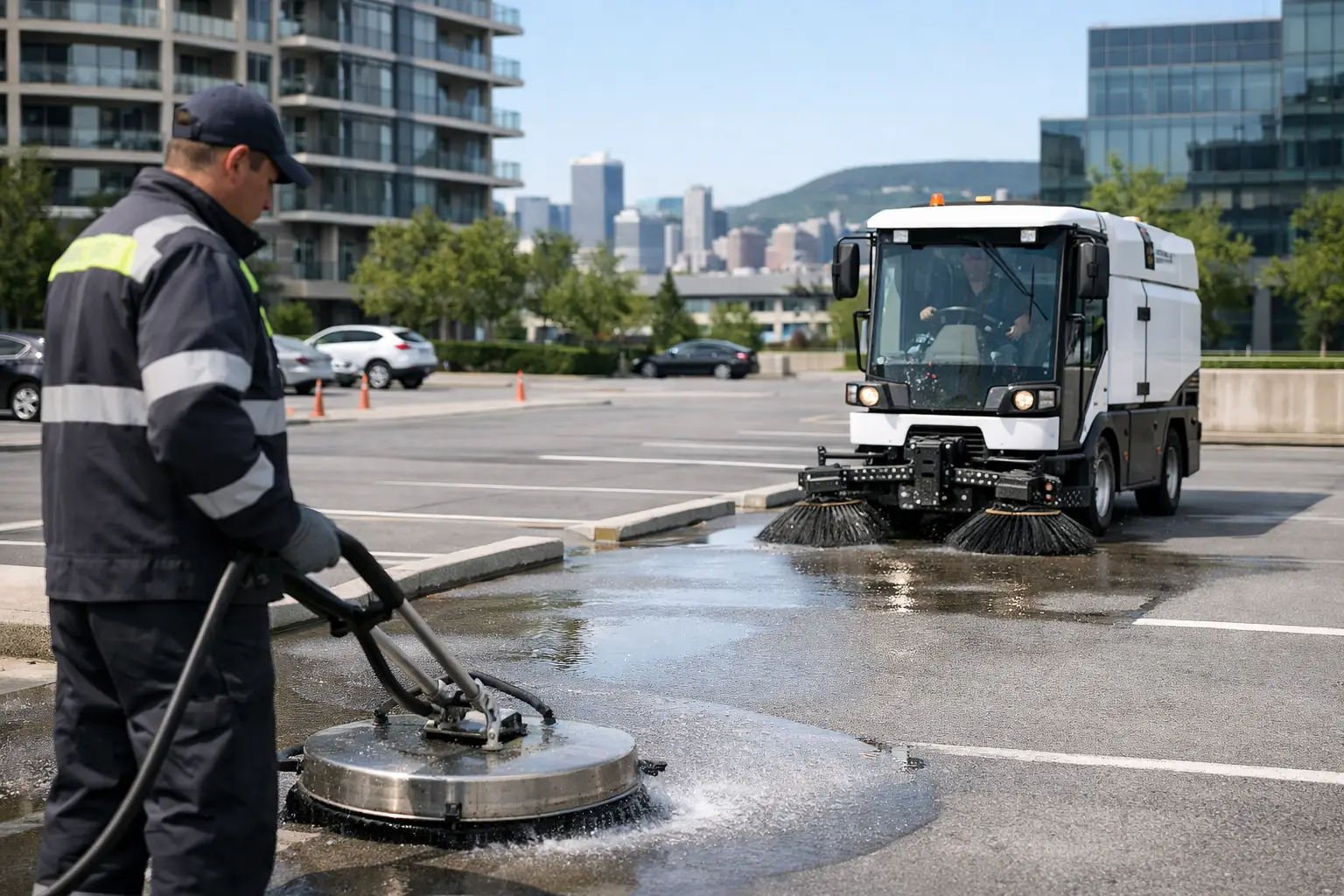
A dirty parking lot is noticeable even before a visitor steps inside. Oil stains, construction dust, debris pushed against curbs, and abrasive sand after winter—when it comes to parking lot cleaning in Montreal, these details directly impact a building’s image, user safety, and surface durability.
For property managers, condo boards, or commercial owners, parking lot cleaning isn’t just a cosmetic task. It’s a maintenance intervention that protects assets, reduces complaints, and keeps the area presentable between seasons, after work, or during a more comprehensive upgrade.
Why parking lot cleaning isn’t just a quick sweep
On-site, parking lots accumulate multiple types of dirt simultaneously. There are visible light debris, fine dust, traffic marks, organic residue, greasy deposits, and in Quebec, a significant amount of sand, salt, and mud tracked in by tires and pedestrians.
The issue is that these accumulations don’t stay neutral on the surface. They migrate toward entrances, clog common areas, stain thresholds, obstruct drainage zones, and quickly give the impression of poor maintenance. In a commercial or multi-unit building, this impression matters. It influences the perception of tenants, visitors, clients, and even on-site staff.
You also need to consider the type of parking lot. A small outdoor parking area for a rental building doesn’t have the same needs as a high-traffic commercial circulation area or a lot that has just undergone construction. The right approach depends on the surface, usage frequency, immediate environment, and actual level of grime.
Parking lot cleaning in Montreal: real seasonal needs
In Montreal and surrounding areas, seasonality completely changes the nature of interventions. This is often where the difference lies between reactive maintenance and more rigorous management.
In spring, the main challenge is the massive accumulation of sand, dust, and winter residue. Even a parking lot that seems fine from a distance can release a lot of particles as vehicles pass over it. Without thorough cleaning, this dust continuously resurfaces, settles on façades, and is tracked back into the building.
In summer, needs shift toward stains, debris, greasy grime, and overall appearance. This is also the time when commercial lots must remain visually clean, especially when they’re directly tied to customer reception or the building’s image.
In fall, fallen leaves, organic matter, and moisture create another type of problem. Edge zones, ramps, and certain drains fill up quickly. If left unaddressed, the grime compacts and becomes harder to remove.
Finally, during post-construction periods, maintenance falls outside the usual framework. Cutting dust, material residue, machinery traffic marks, and heavy deposits require a more technical intervention. This is especially true for commercial sites, new buildings, or post-construction restorations.
When regular maintenance is enough—and when a full restoration is needed
Not all parking lots require the same level of service. In some cases, well-executed periodic cleaning is enough to keep the site clean. This is often the case when the surface is already in relatively good condition, traffic is stable, and no particular event has worsened the situation.
In other cases, a full restoration is necessary. This applies to lots that have been neglected for a long time, heavily stained surfaces, peripheral zones where debris and sediment have accumulated, or sites that have undergone construction. Here, the goal isn’t just maintenance—it’s correcting a backlog of neglect.
This distinction is important for decision-makers. Requesting standard maintenance for a site that needs a deep intervention often leads to disappointing results. Conversely, prescribing a heavy operation for a well-maintained lot isn’t always necessary. A realistic site assessment allows for adjusting the means, intervention time, and frequency.
Methods that deliver real results
Effective parking lot cleaning relies first on the method, not just the equipment. Sweeping, debris collection, curb clearing, treatment of encrusted zones, and pressure washing of certain surfaces must be planned based on the actual condition of the site.
Mechanical or manual sweeping removes dry deposits and loose particles. It’s often essential after winter and useful for routine maintenance. However, it quickly reaches its limits on ingrained stains, compacted dust, or exterior surfaces that trap dirt in their texture.
Pressure washing can then become the right solution, provided it’s used judiciously. On certain surfaces, it significantly improves visual appeal and allows for a more complete restoration. On others, improper pressure can simply move grime around without truly cleaning it, or even worsen wear if the intervention is poorly calibrated.
This is why a specialized provider always considers the nature of the surface. Asphalt, concrete, interlocking pavers, or mixed zones require different settings and precautions. The right result isn’t just about execution power—it’s about treating the surface without damaging it.
What property managers should watch for
A parking lot may seem acceptable at first glance but still pose daily issues. Certain signs justify a faster intervention than one might think.
Piles along curbs are a good indicator. They often show that routine cleaning isn’t thorough enough. Recurring marks near pedestrian access points, grime around dumpsters, residue that returns after every rain, or dust entering the lobby are also clear signals.
You should also monitor the consistency between the exterior and interior. A building may have well-maintained common areas, but this effect is lost as soon as visitors arrive if the parking lot gives an impression of neglect. For condos, multi-unit buildings, or commercial sites, this visual continuity matters greatly.
In areas with high traffic in Montreal, Laval, or the North Shore, the challenge is often consistency. The more traffic there is, the faster dirt returns. A frequency that’s too spaced out ends up costing more, because it turns routine maintenance into repeated restoration work.
How to plan a parking lot cleaning service in Montreal
The right frequency depends on the site, but it’s better decided based on clear objectives rather than vague habits. A main parking lot serving daily customers doesn’t have the same expected standards as a secondary area used occasionally. Similarly, a new or recently renovated building often requires closer monitoring at the start.
To plan effectively, ask a few simple questions. How much traffic does the site receive each week? Is the parking lot visible upon arrival? Do occupants complain about outdoor grime? Are there ongoing construction, frequent deliveries, or technical zones that generate more debris?
From there, you can establish a realistic schedule. A seasonal deep clean in spring is often necessary, followed by maintenance interventions based on site usage. In some cases, a post-construction or post-heavy-dirt-period restoration is added. The key point is to avoid an improvised approach where you wait until the parking lot’s condition becomes too visible.
For properties that combine indoor cleaning, common area maintenance, and exterior work, working with a partner who understands the entire building simplifies management. This is especially relevant when needs go beyond routine cleaning and require a more comprehensive maintenance approach, as Nickel & Krome does in demanding commercial and real estate environments.
A clean parking lot protects more than just appearances
A well-maintained parking lot first serves the site’s image, but that’s not its only benefit. It helps limit the transfer of dirt indoors, keeps access points cleaner, and reduces the sense of neglect that quickly sets in when the exterior isn’t maintained.
You should also consider the lifespan of the surfaces. Cleaning doesn’t repair damaged pavement, of course. However, it helps prevent abrasive accumulations, organic matter, or persistent deposits from worsening visual and functional wear. Again, context matters, but consistent maintenance is more cost-effective than a series of emergency interventions.
A clean parking lot sends one simple and useful message: the building is managed with care. For a tenant, visitor, contractor, or client, this signal is immediate. And in a market where presentation, safety, and execution consistency matter, these very concrete details often make the difference day to day.
Apply this guide to your property
Review the scope, access requirements and service details for Sweeping, washing and restoring underground parking lots.
View the documented occupied-garage project in Montreal (French)