Commercial building cleaning services
Commercial building cleaning services: how to choose a reliable provider for maintenance, post-construction cleaning, and your building’s image.
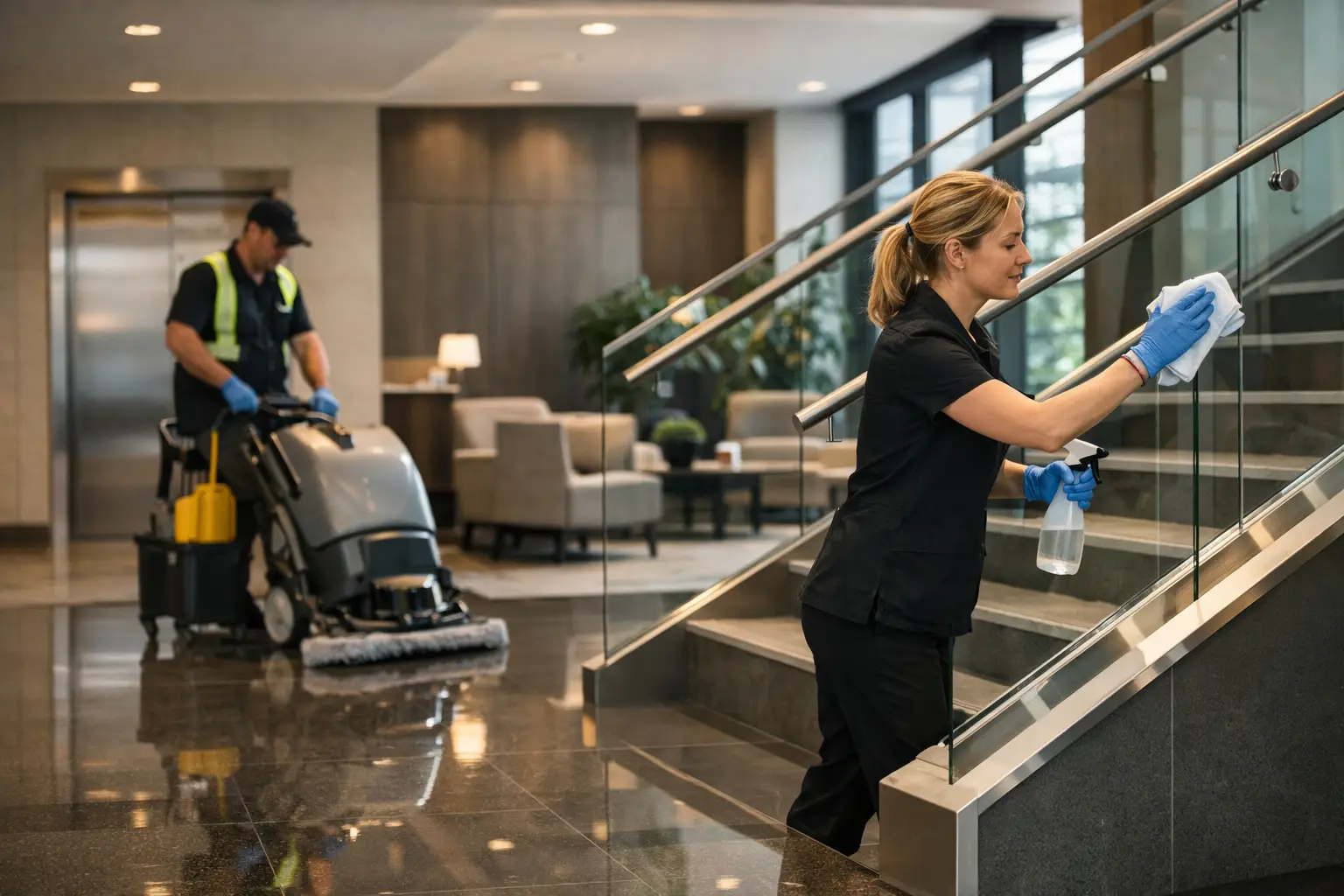
A lobby marked by foot traffic, dull entrance windows, a dusty stairwell, or construction residue in the common areas send an immediate message. For a property manager, owner, or maintenance supervisor, choosing a commercial building cleaning service isn’t just about comfort—it’s a decision about operations, image, and building protection.
In a commercial or multi-unit building, cleanliness isn’t judged solely by first impressions. It’s also measured by execution consistency, the ability to handle high-traffic zones, post-construction management, and the overall condition of spaces used daily by occupants. This is where a specialized provider makes a real difference.
What you really expect from a commercial building cleaning service
On the ground, needs are rarely uniform. A small office building doesn’t face the same challenges as a shopping complex, a condo with common areas, or a building at the end of construction. Yet expectations converge on one simple point: consistent results, without juggling multiple contractors or wasting time on unnecessary follow-ups.
A good provider doesn’t just sweep floors and empty bins. They know how to organize maintenance according to the building’s real rhythm. Entrances, hallways, vestibules, elevators, stairwells, and circulation zones require precise methods because they’re the most exposed to dirt and most visible to occupants, visitors, and tenants.
Materials also matter. Floors, glass surfaces, wall coverings, baseboards, exterior edges, and interlocking pavers don’t all accept the same products or cleaning frequency. A well-planned service protects both appearance and the durability of surfaces.
Routine maintenance, restoration, and post-construction cleaning: different needs
Many decision-makers make the same mistake at the start: looking for a single price for a generic term like “cleaning.” In reality, a commercial building often requires multiple levels of service.
Regular maintenance of common areas
This is the foundation. It includes frequent cleaning, removal of visible dirt, keeping high-contact points clean, floor maintenance, and overall presentation control. This work must be stable and predictable. If results vary from week to week, complaints will eventually arise—even in a well-managed building.
The challenge isn’t just executing tasks. It’s about consistency. A reliable provider knows how to maintain a schedule, manage unexpected issues, and intervene without disrupting normal site activity.
Intensive or periodic cleaning
Even with good routine maintenance, some areas need a refresh. Entrances darken, corners get clogged, low surfaces accumulate marks, and outdoor areas quickly lose their clean look. This type of intervention prevents a building from appearing neglected despite daily maintenance.
This is often where the building’s true perception is decided. A place can be maintained but still look neglected if visual details aren’t regularly refreshed.
Post-construction or end-of-construction cleaning
This is a different job entirely. Fine dust, material residue, window smears, deposits on baseboards, ledges, and technical surfaces require a rigorous approach. End-of-construction cleaning isn’t something a standard maintenance team can improvise.
If this step is poorly managed, the consequences are twofold. First, the handover of the space loses perceived quality. Second, some surfaces may be damaged by unsuitable methods. For a general contractor or manager taking over a space after construction, this point is as important as meeting deadlines.
How to evaluate a provider without wasting time
Choosing a commercial building cleaning service works best with a few simple, concrete criteria. The first is real specialization. A company experienced with commercial environments, multi-unit buildings, and post-construction contexts understands site constraints faster. They ask the right questions and propose a coherent intervention framework.
The second criterion is clarity of service. If the provider remains vague about what’s included, frequency of visits, treated zones, or service limits, gaps will appear quickly. A well-defined service makes follow-ups easier and reduces unnecessary discussions.
The third point, often underestimated, is the ability to cover multiple needs. When interior cleaning, common area maintenance, post-construction cleanup, and some exterior work can be coordinated with the same partner, management becomes simpler. For a building supervisor, this consistency saves time and eliminates grey areas.
Finally, look at the execution logic. A good provider talks about organization, access, schedules, intervention sequence, and expected results. They don’t just sell hours—they sell a method.
Why a commercial building’s cleanliness goes beyond image
Image matters, of course. In a commercial building, it influences how tenants, visitors, clients, and partners perceive the space. But reducing cleaning to a matter of appearance is too simplistic.
Consistent cleanliness helps keep spaces in better condition, limits deep-seated grime, and prevents buildup from becoming a more costly problem to fix. This is especially true in entrance halls, transition zones between indoors and outdoors, and high-traffic shared spaces.
There’s also a direct effect on occupant relations. A clean building conveys serious management. Conversely, a few neglected spots can create an impression of poor oversight—even if the rest is well maintained. For a condo or multi-unit building, this perception has a concrete impact on incoming requests and overall satisfaction levels.
In Montreal, Laval, and on the North Shore, real constraints exist
In this region, buildings face conditions that accelerate visual wear. Entrances quickly absorb moisture, abrasives, outdoor dirt, and marks from heavy traffic. Common areas degrade visually faster than expected, especially when multiple uses coexist in the same building.
This is why a generic service quickly shows its limits. Managers need a partner capable of adapting to the building’s reality—not just a standard cleaning pass. For more technical mandates, a specialized company like Nickel & Krome brings this on-site intervention logic, focused on results and the actual condition of the space.
What a good mandate should include from the start
To avoid misunderstandings, the mission must be precisely framed. This includes covered zones, frequency, expected finish level, and possible exceptional interventions. A building isn’t static. There may be a one-time incident, a construction project, seasonal exterior maintenance, or a refresh needed before an important visit.
It’s also important to accept that there’s no universal frequency. Some entrance halls require multiple visits per week. Others can handle a lighter schedule, provided deeper periodic interventions are added. Everything depends on traffic, layout, occupancy type, and expected standards.
This is where dialogue with the provider adds value. A serious provider won’t try to oversize the service, but they also won’t underestimate needs to fit an artificially low budget. A low price may seem attractive at first, but it can end up costing more in rework, complaints, and restorations.
The right choice often reduces invisible management
When a service works well, it’s rarely talked about. Spaces stay clean, interventions are consistent, occupants don’t report issues, and sensitive periods—like post-construction or refreshes—are handled smoothly. This is often what decision-makers truly seek: less follow-up, fewer surprises, and more consistency.
A well-chosen commercial building cleaning service doesn’t just keep a building clean. It helps maintain a presentable, functional, and credible building every day. And when a provider understands the site’s real challenges, cleanliness stops being a constant concern and becomes what it should always be: a reliable standard, maintained without debate.
Apply this guide to your property
Review the scope, access requirements and service details for Commercial cleaning services for offices and managed buildings.