Biodegradable products in professional cleaning
Biodegradable products can enhance professional cleaning, but only if chosen correctly. Here’s how to make the right selection for your needs.
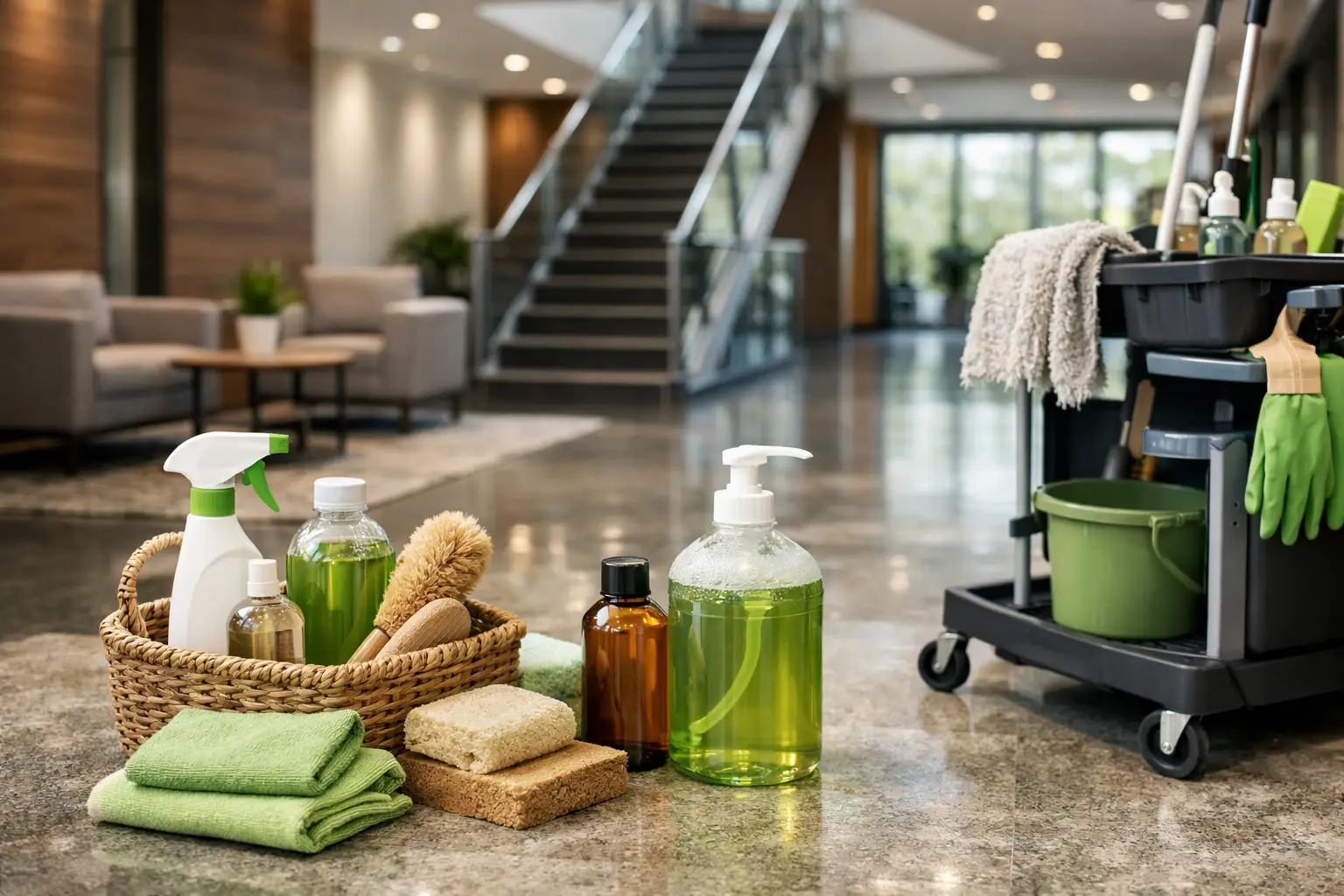
A spotless lobby, stairwells free of marks, a construction site left clean and residue-free — in the field, the question of biodegradable products isn’t just about a “green” preference. For a property manager or maintenance supervisor, the real issue is more concrete: do these products clean effectively, in which contexts, and with what impact on surfaces, occupants, and workflow?
In commercial cleaning and property management, a product’s effectiveness is judged first by performance. An effective product must remove dirt, minimize buildup, respect materials, and remain compatible with a high-frequency maintenance schedule. Biodegradable products can meet these requirements, but not uniformly. As is often the case in specialty cleaning, it all depends on the type of intervention.
Biodegradable products: what do we really mean?
The term is often used broadly. In practice, biodegradable products are formulations capable of breaking down naturally under certain conditions through the action of microorganisms. This doesn’t mean a product is automatically risk-free or suitable for all uses.
This nuance is crucial for real estate professionals. A detergent may be biodegradable yet poorly suited to porous flooring, delicate surfaces, or post-construction cleanup. Conversely, a well-chosen product can reduce chemical residues, improve usability, and ease constraints in occupied spaces.
In short, biodegradability is a useful criterion, but it’s not the only one. In commercial environments, you must also consider degreasing power, contact time, equipment compatibility, odour, rinsing needs, and result stability.
Why property managers are interested in biodegradable products
In office buildings, multi-unit residences, or condominiums, cleaning operations rarely take place in empty spaces. There are occupants, employees, visitors, and sometimes ongoing construction. In this context, biodegradable products attract attention for one simple reason: they can help reduce certain operational nuisances, particularly strong odours and persistent residues.
They’re also relevant when a building’s image matters. More organizations now want cleaning practices aligned with their environmental commitments. This applies to office towers, retail spaces, and professionally managed residential buildings. The product used then becomes part of the management strategy, not just a technical consideration.
However, one clear benchmark must be kept in mind: a good maintenance plan isn’t built around a marketing claim. It’s built around an expected cleanliness standard, a defined frequency of service, and clearly identified surfaces. Biodegradable products have their place in this logic if they genuinely support cleaning performance.
Where they work best
For routine maintenance of common areas, corridors, lobbies, certain washrooms, and lightly soiled surfaces, biodegradable products can be highly effective. These tasks typically aim to maintain a consistent level of cleanliness rather than correct heavy buildup.
They also deliver strong results for preventive maintenance. When frequencies are respected, dirt has less time to set in. This makes it easier to use gentler formulations without sacrificing visual cleanliness. This is a key point in condominiums and commercial buildings, where consistency often does more for a space’s appearance than a heavy but one-time intervention.
For certain outdoor or semi-outdoor surfaces, however, caution is required. Interlocking pavers, joints, organic deposits, grease stains, or construction residue don’t all respond the same way. A biodegradable product may be suitable, but it must be paired with the right method, pressure, contact time, and realistic assessment of the level of soiling.
The sensitive point: post-construction and restoration cleaning
This is often where misconceptions arise. Many assume a biodegradable product can replace any specialized chemistry. At the end of a construction project, reality is more demanding. Fine dust, grout residue, adhesives, protective films, glass residue, efflorescence, or material deposits sometimes require targeted technical products.
In this context, the right approach isn’t ideological — it’s operational. Biodegradable products can be integrated where they perform well, while specialized solutions are retained when the surface or residue demands it. This balance is often what distinguishes standard maintenance from true, controlled restoration.
For a general contractor or manager tasked with delivering a clean space on schedule, the bottom line remains the final result. If a biodegradable formula achieves this result without compromising pace or quality, it has its place. If it lengthens intervention time or leaves traces, it becomes counterproductive.
Choosing based on surface, not just promise
The first useful reflex is to start with the materials. A protected finish floor, natural stone, vinyl flooring, textured ceramic, or exterior façade won’t tolerate the same products. Biodegradability never replaces compatibility testing.
The second criterion is the type of soil. Traffic dust, food grease, urban pollution, limescale, or cement residue don’t require the same response. This is where many decisions go wrong: a product is chosen for its label rather than what it needs to remove.
The third criterion is the operational context. In an occupied building, a low-odour product with easy rinsing can save time and reduce complaints. On a site nearing completion, the priority may shift to corrective efficiency. There’s no single right answer, but a serious selection method.
Questions decision-makers should ask their provider
A competent provider should be able to explain where biodegradable products are relevant and where they’re not. If they promise they work for everything, they’re oversimplifying. If they dismiss them entirely, they’re missing out on useful solutions.
The right questions are straightforward. Which products are used for routine maintenance? Which serve for intensive interventions? What surfaces require special precautions? Does the method change based on occupancy? Does the protocol minimize residues, odours, and unnecessary rework?
In a commercial or para-real estate setting, this clarity matters as much as the product itself. A reliable supplier doesn’t sell a trend. They define a protocol consistent with the site’s reality.
A credible approach to professional cleaning
Using biodegradable products makes sense when it fits into a structured cleaning plan. This means using them where they’re effective, avoiding generalizations, and maintaining technical flexibility for heavy-duty cases. This is especially true for buildings that combine routine maintenance, occasional upgrades, and intermittent construction.
For a specialized company like Nickel & Krome, this kind of trade-off is part of the real work. On-site, it’s not about opposing performance and caution — it’s about choosing the right method to keep spaces clean, presentable, and aligned with client expectations.
Biodegradable products are neither a miracle solution nor a mere image argument. When well integrated, they can enhance routine cleaning, support cleaner practices, and reduce certain operational constraints. When poorly chosen, they mainly create rework, time loss, and mediocre results.
The right decision remains the same: start with your surfaces, your usage patterns, and the building’s cleanliness standards. That’s the only way a product becomes a true cleaning tool — not just another promise on a label.
Apply this guide to your property
Review the scope, access requirements and service details for Entretien commercial écologique (French).